(1790)
ENTHUSIASTIC CITIZENS

Lorem ipsum dolor sit amet, consectetur adipiscing elit. Phasellus vel lectus eleifend, posuere purus et, pellentesque sapien. Sed interdum, velit nec imperdiet lacinia, diam quam aliquet risus, in dignissim sapien velit sed justo. In bibendum in augue a suscipit. Sed ut justo dignissim velit pellentesque eleifend eget eu nisi. Nulla facilisi. Cras varius nibh nec placerat ultricies. Suspendisse potenti. Nam volutpat ligula pretium nulla auctor, sit amet vehicula turpis convallis. Pellentesque ut purus massa. Curabitur sodales ultricies ullamcorper.
Enthusiastic Citizens
On a clear, cool day this past January, I hopped into a car in Savannah, Georgia, with descendants of the Minises and the Sheftalls, two of the first Jewish families to settle there. The first stop was the 1773 family burial plot of Levi Sheftall, which lies locked inside an intimidating stone wall, awkwardly positioned in front of a school.
Around the corner is Mordecai Sheftall’s cemetery, established the same year, which he opened to the broader Jewish community. His is one of the gravestones that remain intact and legible. A highway lies on the other side of one of the walls, and there are apparently plans to erect a hotel between the two mostly forgotten Jewish cemeteries. The afternoon also included a drive by the site of Savannah’s original Jewish cemetery, now marked by a stone monument in the median at the intersection of Oglethorpe Avenue and Bull Street.

Levi Sheftall Cemetery
Savannah, Georgia
photo by Shari Rabin
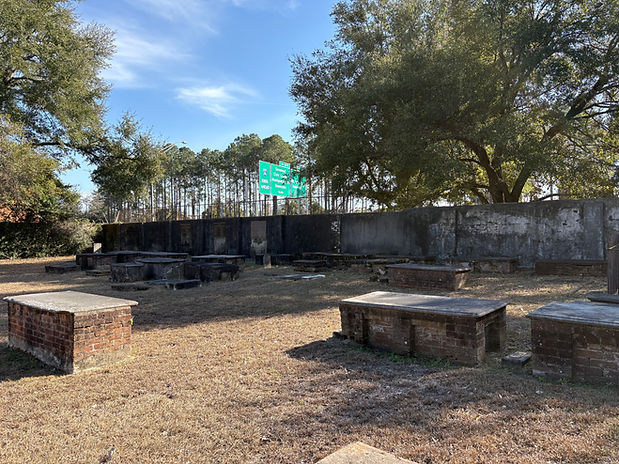
Mordecai Sheftall Cemetery
Savannah, Georgia
photo by Shari Rabin
Inside a condo with stunning views of downtown Savannah, I was shown eighteenth-century silver, including a portable set of eating utensils, displayed inside a glass coffee table. The walls of that room were decorated with four miniature portraits. In the den, a Jewish marriage contract and a royal land grant hung on the wall. All these heirlooms date to the eighteenth century. The family also has a tri-corner hat worn during the Revolutionary War and for years afterward by one of the more eccentric Sheftalls, a man named, in fact, Sheftall Sheftall. While others might have tossed out these objects or donated them to an archive, this family has stewarded them for over two centuries.
In June of 1790, Levi Sheftall, then president of the Jewish congregation in Savannah, wrote a letter to President George Washington. It was the first time that a representative of a Jewish community addressed a US president; Washington had been inaugurated fourteen months earlier. This letter might surprise those who understand the United States to have been founded as an exclusively “Christian nation.” American Jews, it turns out, were among the nation’s most enthusiastic new citizens, and they were given warm assurances by President Washington himself. This was not a sudden burst of universal religious freedom, however. It was the result of decades of negotiation in a context of Native displacement and African enslavement.
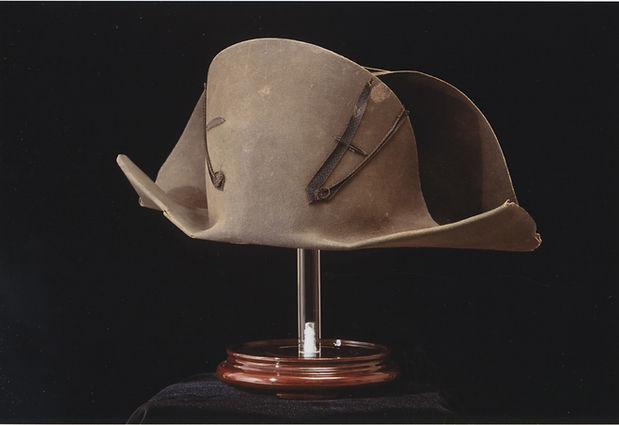
Sheftall Hat
American Jewish Archives of Hebrew Union College
Cincinatti, OH
In his letter, Sheftall lavished praise upon Washington for his “unexampled liberality and extensive philanthropy.” These had, he wrote,
dispelled that cloud of bigotry and superstition which has long, as a veil, shaded religion—unrivetted the fetters of enthusiasm—enfranchised us with all the privileges and immunities of free citizens, and initiated us into the grand mass of legislative mechanism.
In describing Washington’s achievements, he placed the blame for Jews’ past political exclusion on religion’s excesses, “superstition,” and “enthusiasm.” And he celebrated the new political system that just three months earlier had promised citizenship to “free white persons,” including European Jews. That this was assumed was somewhat remarkable. Jews had been expelled from England five hundred years earlier and were only allowed to return in the 1650s. This was after another expulsion–from Spain–had sent Jews moving throughout Europe, the Mediterranean, and eventually the Americas. Jews were officially forbidden from settling in Spanish and French America, but they were increasingly tolerated by the Dutch, fellow Protestants, and eventually by the English as well.
As Jews re-settled in English territory, colonial officials and residents worked to make sense of their presence. The 1669 Fundamental Constitutions of Carolina, which lay out a plan for the colony that Georgia would eventually be excised from, explicitly mentioned freedom of worship for “Jews, heathens, and other dissenters from the purity of the Christian religion,” positioning Jews somewhere between Indigenous Americans and dissenting Protestant groups like Baptists and Quakers. Over time, as English settlers worked to exploit American land and African labor, they came to understand Jews as dissenters whose difference was primarily a matter of opinion, and as a part of the emerging category of whiteness.

"American Jews, it turns out, were among the nation’s most enthusiastic new citizens, and they were given warm assurances by President Washington himself."
The Jewish community of Savannah began with a group of 41 arrivals – plus a Torah scroll and a circumcision kit – and they arrived, in 1733, in the earliest months of Georgia’s existence as an English colony. The last of the thirteen colonies to be established, Georgia was intended not only as a buffer against Spain, but also a utopian refuge for the poor and persecuted, in which slavery would be banned and land ownership restricted. The Jewish community of London saw in it an opportunity for Jewish settlement. When Georgia’s trustees found out that Jews were on their way, they complained that they “may be of ill consequences to the Colony.” Their concerns were likely a mix of economic, religious, and social issues. Jews were often represented in English discourse as deceptive in business and as stubborn refusers of Christ, and so they could hardly be assumed to make good neighbors. The Jews arrived to the colony in the midst of an epidemic, however, and a physician in the group treated the sick without pay, which helped to cement their acceptance.
Among these arrivals were Benjamin and Perla Sheftall; their son Mordecai was born there two years later. Perla died within a year, and Benjamin remarried Hannah Solomons, who gave birth to Levi in December of 1739. Levi was fifty-one years old when he wrote to Washington, a man seven years his senior. The younger man boasted the confidence of an early settler and a white citizen, even as he must have keenly felt his religious difference and the weight of his own uneven record in the recent war for independence.
The earliest Savannah Jews quickly set about the work of establishing religious community and building up the new colony. Levi’s father kept a record of Jewish activities in Savannah, documenting arrivals, departures, marriages, births, illnesses, and deaths. He noted in 1735 that the Jewish congregation had adopted the name “Mikva Israel,” or “hope of Israel,” a name for God from the prophetic book of Jeremiah. At the same time, Jews built houses, grew vineyards, ran a tavern, and supplied the colonial fort. It was something of a surprise when, in 1738, Jews were excluded from a petition to bring slavery to Georgia. Its organizers did not say why, but the implication was that Jews were not considered equal to other settlers. And yet, when Georgia began to allow slavery and more extensive landholding in the 1750s, the Sheftall men readily embraced these forms of wealth. Already, by 1766, Levi and Mordecai both possessed nine enslaved people, lots in town, and upwards of 650 acres of land.

Torah scroll
brought to Savannah in 1733
Mickve Israel Museum

Circumcision kit
brought to Savannah in 1733
Mickve Israel Museum
Even as they achieved important measures of success and white inclusion, the Sheftall brothers held tight to the Jewish traditions they learned from their father. Although they had been born into a large, robust Jewish community dominated by Sephardim, they were raised within a tiny, Ashkenazic one. When Levi was one year old and Mordecai was five, most of the original Jewish settlers, all of them Spanish and Portuguese Jews fearful of the Inquisition, had fled Savannah after the onset of war with Spain. The only other Jewish family to remain was the Minises, who were also of central European extraction. Together, these families kept Jewish life alive in the city in the decades to follow. In the 1760s, both Sheftall brothers married Jewish women in religious ceremonies. In 1773, they established their respective burial grounds after a conflict with local officials about the original one downtown. They reestablished the congregation in 1774, and they did it again in 1786, after American independence.
Georgia was the last colony to join in the patriot cause, but Mordecai was one of its most enthusiastic supporters. He donated significant funds and was imprisoned by the British, along with his son Sheftall, before waiting out the war in Philadelphia. Once it was over, the younger Sheftall invoked Psalm 119: “We are delivered from a cursed, proud nation.” Levi, however, had been more reticent at the beginning, and during the war took an oath of loyalty to the crown. He faced the threat of banishment from Georgia but was ultimately cleared of the loyalist label in 1787, as a result of his brother’s efforts.
Nevertheless, he was the accepted leader of his community, which was small but active. Levi had taken over the record-keeping after his father died in 1765 and continued it until shortly before his own death in 1809. In the late 1780s, Savannah Jews experienced the joys and pains of life in the early republic, which they faced with the additional tools and obligations of Jewish law. For instance, when a baby boy died in “Vainsborough” (probably contemporary Waynesboro, Georgia), he was brought to Savannah for circumcision before burial. And yet there were also signs of assimilation; among those arriving in town was a Jewish man with a French Catholic wife. Movement was far from unusual; Savannah Jews traveled and moved to and from Jamaica, Rhode Island, Charleston, New York, Philadelphia, and Georgetown, South Carolina.
In 1790 Washington was to receive two more letters from Jewish communities in some of these places (he also received letters from other religious minorities, like Baptists and Swedenborgians). The next one was from Newport in Rhode Island, a bastion of freethinking Protestantism established by the outspoken Baptist Roger Williams. Although its charter only promised protection for Christians, its Jewish community had grown gradually, merchant by merchant, over the course of the late seventeenth century. After a fallow period in the first half of the eighteenth century, by 1761 it boasted an estimated ten families with 56 individuals. A number of these Jews were actively involved in the slave trade and a few had grown quite wealthy, although when two of them petitioned to gain rights as freemen that year, they were denied. Two years later, the Jews of Newport erected an elegant synagogue, modelled on biblical descriptions of the ancient Temple in Jerusalem.
The author of Newport’s letter was Moses Seixas, who had arrived in the city from New York in 1770 and, unlike most other Jews, remained during the British occupation of 1776 to 1779. Like Levi Sheftall, he had a history as a loyalist as well as ardent patriots in his family. His letter was more florid and explicitly Jewish than the one that Sheftall sent. This may have been because he had more religious training than had Sheftall, or because in Newport, he was surrounded by pious, bible-quoting post-Puritans rather than by more lax Anglicans and an array of dissenting groups.
The letter referenced Daniel and Joshua, mentioned the “God of Israel,” and described Jews as the “stock of Abraham.” It briefly mentioned that they had once been “Deprived…the invaluable rights of free Citizens,” but focused on sharing a forward-looking vision of the country. It praised the new “Government, which to bigotry gives no sanction, to persecution no assistance—but generously affording to All liberty of conscience, and immunities of Citizenship: deeming every one, of whatever Nation, tongue, or language, equal parts of the great governmental Machine.”
It was probably easier in Newport – which in 1784 had passed “An Act for the gradual abolition of slavery” – to imagine that “all…of whatever Nation, tongue or language” might be treated fairly than it was in Savannah, where there was an enslaved Black majority and no end to slavery in sight.

The final letter was delivered to President Washington on December 13, 1790 – after considerable confusion and dissatisfaction over who would write what – by the Jewish communities of Philadelphia, New York, Charleston, and Richmond. New York was the oldest Jewish community in the new nation; it dated to 1654, when a group of Jews had arrived from Brazil. At the time, Dutch governor Peter Stuyvesant had denigrated Jews as “Enemies and blasphemers” who should be turned away, but they were allowed to remain. Jews had arrived gradually in Charleston, Philadelphia, and Richmond; they established congregations in 1749, 1773, and 1789, respectively.
The final draft of this collective letter was completed and delivered by Manuel Josephson of Philadelphia, a merchant who had aided the Revolutionary War effort. In 1789 he had tried to coordinate one address to Washington from all the Jewish congregations, to no avail. Now he delivered a letter echoing the praise found in the others. It too framed the President and the new nation in religious terms, drawing a comparison to “the wonders which the Lord of Hosts hath worked in the days of our Forefathers,” and describing Washington as God’s “chosen and beloved servant.” It ended with a prayer that quoted from Deuteronomy 33 and Isaiah 58, before concluding that when Washington died, “thy name and thy Virtues will remain an indelible memorial on our minds.”

“Government, which to bigotry gives no sanction, to persecution no assistance—but generously affording to All liberty of conscience, and immunities of Citizenship: deeming every one, of whatever Nation, tongue, or language, equal parts of the great governmental Machine.”
To each letter, Washington responded positively. To Sheftall, he deflected the flattery away from himself by pointing to the virtues of “the people of the United States of America” more broadly. Washington, a life-long, if idiosyncratic, Anglican, ended by offering a prayer:
May the same wonder-working Deity, who long since delivering the Hebrews from their Egyptian Oppressors planted them in the promised land—whose providential agency has lately been conspicuous in establishing these United States as an independent nation—still continue to water them with the dews of Heaven and to make the inhabitants of every denomination participate in the temporal and spiritual blessings of that people whose God is Jehovah.
The President invoked the biblical exodus from Egypt and the more recent role of Jews in the founding. He also assimilated Jews into the Protestant category of religious “denomination,” implying that, as many had come to believe, Jews were white citizens whose difference was only a matter of belief.
To Seixas in Newport, he responded with the general reflection that, “It is now no more that toleration is spoken of, as if it was by the indulgence of one class of people, that another enjoyed the exercise of their inherent natural rights.” He continued, repeating the congregation’s language, “For happily the Government of the United States, which gives to bigotry no sanction, to persecution no assistance requires only that they who live under its protection should demean themselves as good citizens.” This letter also ended with a prayer, one echoing the biblical prophets: “every one shall sit in safety under his own vine and fig tree.”
Responding to the final letter, Washington again deflected attention from himself by praising the general “liberality of sentiment…in this country.” He thanked the congregations for their compliments and agreed that “the Power and Goodness of the Almighty were strongly Manifested” in the American Revolution and had remained important in the new country. He ended with his most modest prayer: “May the same temporal and eternal blessings which you implore for me, rest upon your Congregations.”
These communities were blessed in the generations to come. New York, Charleston, Philadelphia and Richmond, have all maintained continuous Jewish communities until the present day, although Richmond’s original congregation was eventually folded into another.
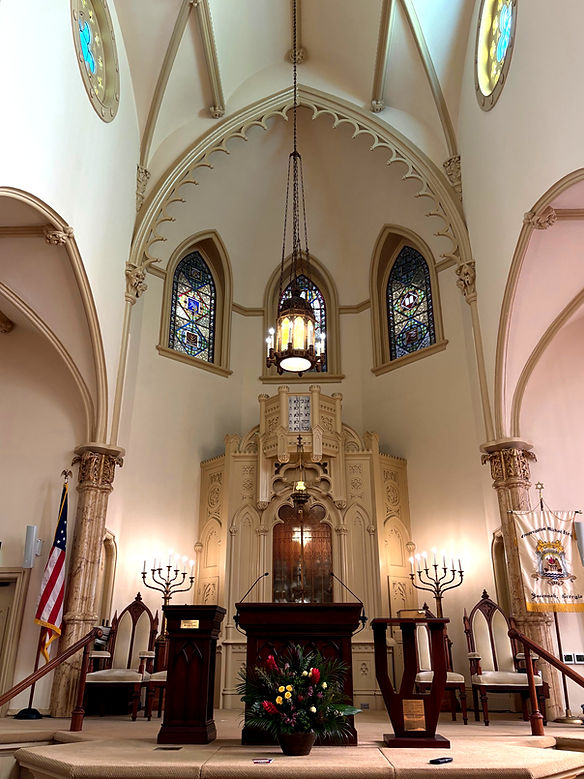
Synagogue Interior
Mickve Israel
photo by Shari Rabin
Newport’s congregation, however, did not last long after their letter to Washington. The city struggled to recover from the Revolutionary War, and as its fortunes waned, its Jews moved away. In the nineteenth century literary luminaries Henry Wadsworth Longfellow and Emma Lazarus wrote poignant reflections on Newport’s Jewish cemetery and synagogue, respectively. Both juxtaposed the seaport town with its empty, “dead,” Jewish spaces. The synagogue and the cemetery managed to survive the ravages of history, however, in large part due to the generous 1854 bequest of Judah Touro, a Newport native who made his life in distant New Orleans.
And yet, Washington’s correspondence with the Newport congregation, which has been heralded as a signal text in the history of American religious freedom, is much better known than the earlier correspondence with Savannah. The synagogue is now a major tourist site, managed by the Touro Synagogue Foundation. It sits next door to the Touro Synagogue National Historic Site, which features an impressive historical exhibit on religious freedom that celebrates Washington’s assurance that the United States would give “to bigotry no sanction, to persecution no assistance.”
On October 11, 1794, Abigail Minis, an “ancient lady,” died at 93 years old. Levi Sheftall dutifully noted in his records that she had arrived in Savannah in July 1733 and died there on the twenty-ninth anniversary of his own father’s death. In her will, she left all her assets to her surviving daughters. A granddaughter born a year and a half later was named Abigail Minis Sheftall, uniting the two family names. Descendants – most of them Christian – remain in Savannah to this day.
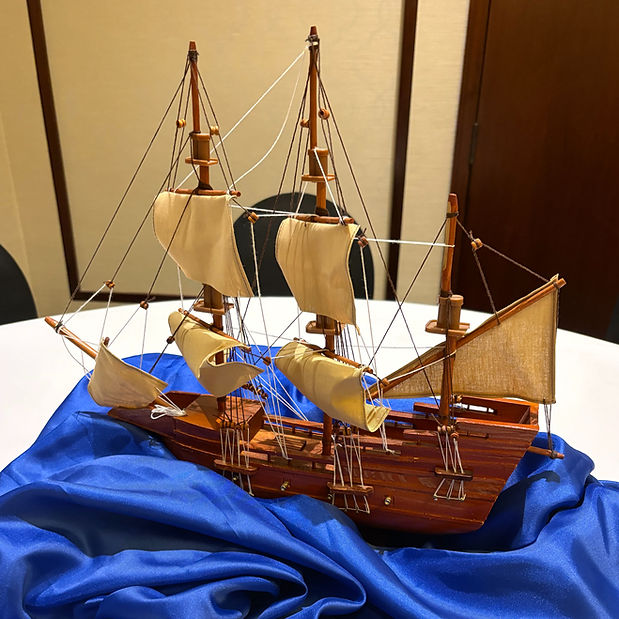
Replica of the William & Sarah
The ship that had brought the original Jewish settlers to Georgia
photo by Shari Rabin
Congregation Mickve Israel, which had so many starts and stops in the eighteenth century, also maintained an enduring presence. Its congregants continued to participate in slavery and eventually in the Civil War fought to defend it. Its synagogue is a stunning neo-gothic building from the 1870s–Princeton University Press selected an early twentieth century postcard of it as the “cover synagogue” for my recent book, The Jewish South: An American History. Tours nonetheless focus not on the building–though an audio recording describes its architectural features toward the end of the tour–but on the earliest Jewish history of Savannah, dramatically retold by trained volunteer docents. A small museum on the second floor of a later addition includes the Torah scroll and circumcision kit brought from England to the new colony of Georgia in 1733. At the Friday night dinner during my recent visit, as congregants were at work on their own exhibit commemorating 1776, the centerpiece on each table was a replica of the William and Sarah, the ship that had brought the original Jewish settlers to Georgia.
As they sat aboard that ship, Benjamin Sheftall, Abigail Minis, and the rest of their companions may have hoped or prayed, but certainly could not have expected that one day their descendants would address the leader of a new nation and receive a response that conveyed respect and promised equality. In the wide scope of Jewish history, this was a mighty accomplishment, to be sure. And yet, it is an accomplishment that cannot be fully disentangled from injustices done to others, nor could it guarantee that Jews would always, and by everyone, be treated fairly.
SOURCES & FURTHER READINGS
My host in Savannah, B.H. Levy Jr., has recently published a short memoir: “Rebraiding Southern Jewish Identity: The Savannah Memoir of B.H. Levy Jr.,” edited by Lance J. Sussman, Lynda Barness, and Karen Franklin. His father, B.H. Levy, authored, “Savannah’s Old Jewish Community Cemeteries,” The Georgia Historical Quarterly Vol. 66, No.1 (Spring, 1982), 1–20. ___ Congregation Mickve Israel has sponsored two community histories: • Saul J. Rubin, Third to None: The Saga of Savannah Jewry, 1733–1983 (Savannah: Congregation Mickve Israel, 1 983). • Ann Woolner, The Jews of Savannah: An Escape, A Voyage, A Home (Savannah: Congregation Mickve Israel, 2025). ___ Malcolm H. Stern produced important work on Jewish Savannah in the 1960s (especially his transcription of the “Sheftall Diaries”), as did Mark I. Greenberg in late 1990s, Holly Snyder in the early 2000s, and, more recently, Mark Bauman. Also significant is Aviv Ben-Ur, “Jewish Savannah in Atlantic Perspective: A Reconsideration of North America’s First Intention Jewish Community,” in The Sephardic Atlantic, edited by S. Rauschenbach and J. Schorsch (Berkeley, 2017). I discuss Savannah Jewish history in some depth in The Jewish South: An American History (Princeton, 2025). ___ On early Georgia, see Noelen McIlvenna, The Short Life of Free Georgia: Class and Slavery in the Colonial South (Chapel Hill, 2015). ___ On Jews in colonial America and the Atlantic world, see: • Adam Jortner, A Promised Land: Jewish Patriots, the American Revolution, and the Birth of Religious Freedom (New York, 2024). • William Pencak, Jews and Gentiles in Early America, 1654–1800 (Ann Arbor, 2005). • Laura A. Leibman, Messianism, Mysticism, and Secrecy: A New Interpretation of Early American Jewish Life (Portland, OR, 2012).
Shari Rabin
is Professor of Jewish studies, religion, and history and chair of Jewish studies at Oberlin College. She is the author of Jews on the Frontier: Religion and Mobility in Nineteenth-century America (NYU Press, 2017), which won the National Jewish Book Award in American Jewish Studies, and The Jewish South: An American History (Princeton University Press, 2025), which was a finalist for the same award. She currently serves as Vice President of the Southern Jewish Historical Society.


