(1782)
A COUNTRY BETWEEN

In 1782, American revolutionaries massacred ninety-six indigenous Moravian Christians. Following the story of one survivor, Peter Manseau introduces a country caught between gods, traditions, empires, and rival claims about "what it means for land to be divinely given."
The boys beneath the floorboards were roughly as old as the war.
During their childhoods, they had likely heard of skirmishes erupting in far-off Boston, then of Independence declared in Philadelphia, and then of the victory at Yorktown that promised to bring the conflict to a close. But now, in an Ohio River Valley village late in the winter of 1782, they could hear the Revolution’s violence immediately above them.
At first, the sounds were no different from the music they had grown up with: Unami, Munsee, and Mohican verses set to German chorale cadences, muffled by the wooden planks that separated them from the singers’ shuffling feet.
The two boys—one slight, one later remembered as “bulkier”—had been urged into their hiding place by “a very loving old widow,” as an account of these events describes her, named Judith. The night before, she had been forced with dozens of other women and children into the room above. The men of the community were locked in a cabin nearby. To spare the boys from the fate that was becoming clear, Judith had pried up a board and directed them into the cellar below.
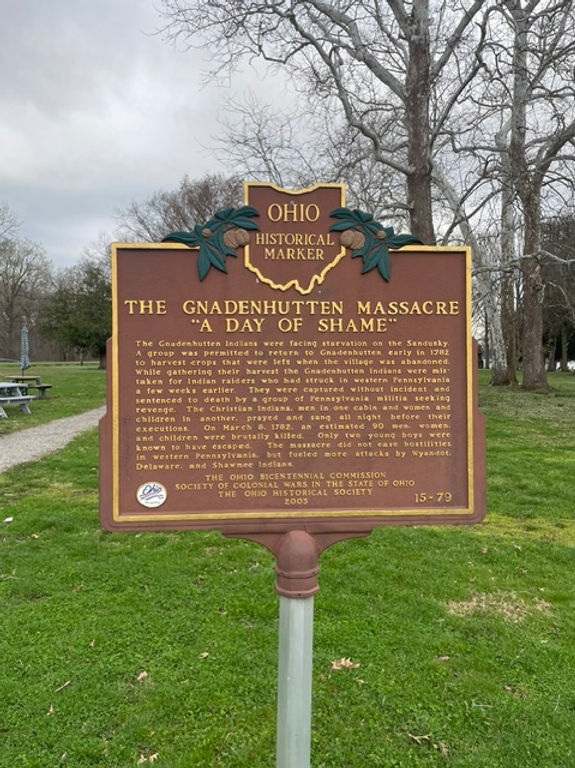
"A Day of Shame" Marker
The Gnadenhutten Massacre
photo by the author
Both Judith and the boys were Lenape—called the Delaware by the English, named for the river that was part of their ancestral mid-Atlantic homeland before they had been driven west. Others among them knew themselves as Muhhekunnew, a people displaced from further north. But the distinctions between tribes had lately given way to a new identity.
Collectively they had come to be known as Moravian Indians. The assembled families had embraced the religious practices of the Unity of the Brethren, brought a generation before by missionaries who preached a pacifist Christianity that proved particularly appealing to those caught up in a succession of wars.
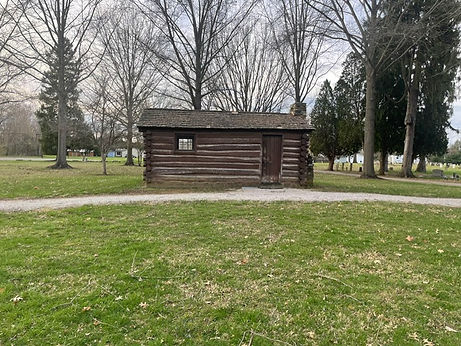

Log Cabins
Cooper's Shop and Meeting House
photos by the author
From 1772 to 1780, the converts and their teachers built three outposts along the Muskingum River, including the village of Gnadenhutten, which means “tents of grace.”
Beyond their new faith, the Moravian Indians had in common the experience of being caught in the middle. This was the country in which young George Washington, some thirty years before, had heard an Indian leader express his consternation at living at the crossroads of French and British forces clashing in the brutal conflict now known as the French and Indian War.
“We live in a Country between,” he said, “therefore the Land does not belong either to one or the other; but the Great Being above allow’d it to be a Place of residence for us.”
Since that time, the opposing armies had shifted. It was now British and American soldiers vying for control over this unlikely intersection of empires, each with their own view on which side the Great Being favored. As one of the missionaries recorded Gnadenhutten’s response to the latest fighting: “They declared publicly against wars & bloodshead, & when the revolutionary War commenced, they passed a resolution: that no one joining, or taking up the hatchet against either Nation, whether English or Americans, could & should be permitted to live with them.”
Above the boys’ cellar, American voices could be heard competing with the Moravian hymns. A detachment of Pennsylvania militiamen had happened upon the Gnadenhutten Indians as they harvested their corn. They shouted accusations: that despite the Moravians’ claimed neutrality they were supporting the enemy, that they harbored among them members of raiding parties that had targeted white settlers, that their farming tools had been pillaged from the homes of those they had killed.
The militiamen argued amongst themselves and then put it to a vote to determine the sentence for these alleged crimes. Many among them had lost family members in the frequent British-supported Indian attacks that kept the frontier always on edge. Only eighteen of the one hundred and sixty Americans urged restraint. The rest judged that every man, woman, and child in Gnadenhutten should be put to death.
The Moravians responded to this sentence by asking for time to pray and sing as they awaited the end.
Nearby in the village barrel-making shop, one of the Pennsylvanians found a large wooden cooper’s mallet. He returned to the cabins where the prisoners were held and showed off his find with a flourish.
“This will answer for the business,” he said.
If his meaning was not clear, it soon became so. He began methodically bashing the skulls of the male captives, one by one. After fourteen lay dying, he announced, “My arm fails me!” and passed the mallet to another who took up the task. Others among them removed scalps from the men who had refused, as a tenet of their faith, to offer any resistance.
When all in the men’s cabin lay still, the militia moved on to the room above the two boys. The cooper’s mallet was again put to use. Judith was the first to fall.
The singing of hymns was soon accompanied by an endless percussion of hammer blows. The spaces between the floorboards were narrow enough to keep the boys concealed, but wide enough, one account notes, that “blood began to run a stream down upon them.”
The smaller of the two boys moved toward a ventilation gap in the back of the cellar wall. He clambered through and hid in nearby hazelnut bushes, assuming the other boy would follow. But the hole proved too tight. When the militiamen kindled a fire and set the cabin alight with the dead and dying inside, the larger boy remained trapped below, where he became one of 96 Moravian Indians who lost their lives that day.
Crouched in the bushes as his world burned, the boy who survived the attack later known as the Gnadenhutten Massacre could not have fully grasped the global politics that created the scene. But he likely understood a fact often missing from histories of the founding era: the Revolution was guided not just by the desire for independence, but by contested notions of what it means for land to be divinely given.


Markers
Markers at the burial mound of the Gnadenhutten Massacre Site
photos by the author
Gnadenhutten today is a sleepy town of just over one thousand, a tidy grid of two dozen streets that some residents travel by golf cart, occasionally braking for a horse and buggy from one of the Amish farms nearby. Children wander freely across well-maintained lawns and on sidewalks that are barely needed.
Despite its quaint appearance, the village is haunted in subtle ways by the atrocity that occurred there. A few signs off the highway point toward the massacre site, but far more celebrate the high school sports team: the Indian Valley Braves, whose mascot wears a mohawk adorned with feathers in red, white, and blue. Not far from Tomahawk Drive, you’ll find a senior living community called Tents of Grace, “where care and compassion thrive.” A Moravian church endures as the largest congregation in town.
All that remains of the original settlement is a historic park surrounded on two sides by a cemetery that holds some of the oldest headstones in Ohio. The park is home to a small museum and two log cabins built in frontier style, one a replica of the mission chapel, the other of the cobbler’s shop where the executioners found their cudgel. An obelisk erected on the occasion of the town’s centennial in 1872 bears the inscription: “Here Triumphed in Death Ninety Christian Indians.”
The site’s oldest feature is just a few feet from the museum’s gravel parking lot: a burial mound four feet tall and fifteen feet wide. It was created sixteen years after the massacre, when one of the region’s original Unity of the Brethren missionaries, John Gottlieb Heckewelder, returned to rebuild the town he had helped found. The shape of the mass grave he made was likely a practical necessity. Because the 96 victims had burned together, there was no differentiating the dead. Yet in fashioning this communal grave into a mound, like those that had been built by the area’s Indigenous people since time immemorial, Heckewelder also joined the doomed converts of Gnadenhutten to customs they had left behind.
The burial mounds of the Ohio River Valley are monuments to American religion’s antiquity. With thousands known, some built millennia ago, they are evidence of the presence and influence of spiritual traditions as old as any brought across the Atlantic.
Gnadenhutten’s mound, with its Christian remains gathered in a pre-Christian ritual form, is also part of a long history of interaction and influence. 2026 marks not just two hundred and fifty years since 1776, but five hundred years since the first attempted European colony in the land that would become the continental United States: the short-lived San Miguel de Gualdape on the Georgia coast. For a period as long as those now called Americans have celebrated their independence, those who were originally called Americans contended with a collision of religious cultures and its enduring aftershocks.

Monument
at the Gnadenhutten Massacre Site
dedicated on 5 June 1872
photo by the author
The missionary Heckewelder knew this better than most. Born in England to German Moravian parents, he arrived in the Ohio Territory in 1762 and soon became one of the foremost European students of Indigenous cultures. As the author of An Account of the History, Manners, and Customs of the Indian Nations who once inhabited Pennsylvania and the neighboring States, he chronicled the Lenape’s practices and beliefs with flashes of surprising sensitivity.
“The Indians consider the earth as their universal mother,” he wrote of one cosmogony he encountered. “They believe that they were created within its bosom, where for a long time they had their abode, before they came to live on its surface. They say that the great, good, and all powerful Spirit, when he created them, undoubtedly meant at a proper time to put them in the enjoyment of all the good things which he had prepared for them upon the earth, but he wisely ordained that their first stage of existence should be within it, as the infant is formed and takes its first growth in the womb of its natural mother.”
Such a creation myth, Heckewelder argued, would have been “admired and extolled” for its novel metaphoric treatment of communal and cosmic origins if it had come from Egyptian or Hindu sources, but because it arose among those his readers regarded as “savage,” he lamented, it would never receive the praise that was its due.


Gnadenhutten historical marker
Zeisberger preaching
David Zeisberger, a Moravian missionary, speaking to Indians gathered around a fire. After an 1862 oil painting by Christian Schussele called “The power of the Gospel: Zeisberger preaching to the Indians.’’ (c1864)
Heckewelder was less sympathetic to other aspects of Lenape religion. During the decades in which the Ohio Territory had been caught in the middle of warring powers, the region had given rise to a lineage of prophets who framed questions of survival and resistance in theological terms.
As early as the 1730s, recorded accounts of Indian “seers” predicted the divine retribution awaiting those who fell prey to the imported sins of alcohol, violence, and “dreadful debauchery.” By the time of the Moravians’ arrival in Ohio, these general warnings had become detailed jeremiads, intended to guide not just personal behavior but communal response to an existential threat.
The Lenape leader Neolin, known as the Delaware Prophet, built a movement striving for unity and resistance among the region’s native nations, based on a vision he had of a North America returned to the pure state that preceded the arrival of Europeans. During a journey to the spirit world, he said, he encountered the Master of Life, who told him:
“The land on which you are, I have made for you, not for others. Wherefore do you suffer the whites to dwell upon your lands? Can you not do without them?”
Neolin drew on deerskin an intricate depiction of the spirit realms, which he used to illustrate his preaching. This “great book” showed life as it once had been in paradise, the reasons why they were there no longer, and “the only way that was now left them to regain what they had lost.”
Another prophet called Wangomend couched prescient cultural critique within fantastical tales of spirit voyages and the afterlife.
“He would make his followers believe,” Heckewelder wrote, “he had been borne by unseen hands to where he had been permitted to take a peep into the heavens, of which there were three, one for the Indians, one for the negroes, and another for the white people. That of the Indians he observed to be the happiest of the three, and that of the whites the unhappiest; for they were under chastisement for their ill treatment of the Indians, and for possessing themselves of the land which God had given to them. They were also punished for making beasts of the negroes, by selling them as the Indians do their horses and dogs, and beating them unmercifully, although God had created them as well as the rest of mankind.”
Prophets like Neolin and Wangomend called for withdrawal from European influence but did so through appropriation of Christian tropes: a great book with all the answers, land granted to God-chosen people, just reward and punishment in the world to come. Given that Christianity had by then been part of the American cultural landscape for centuries, such blending was inevitable. But it nonetheless caused the missionaries distress.
Because these prophets advocating complete separation offered something similar to yet more inviolable than the Moravian call for neutrality, Heckewelder and his peers regarded them as competition.
“Among the obstacles which the Missionaries encountered,” he wrote, “the strong opposition which was made to them by the prophets of the Indian nations was by no means the least.”
While Heckewelder viewed these prophets as charlatans, he nonetheless recognized the power of their message. He even seemed to regret that it had not been marshalled earlier and more effectively in the cause of Lenape survival.
“There was a time when the preachers and prophets of the Indians, by properly exerting the unbounded influence which the popular superstitions gave them,” he wrote, “might have excited among those nations such a spirit of general resistance against the encroachments of the Europeans, as would have enabled them, at least, to make a noble stand against their invaders, and perhaps to recover the undisturbed possession of their country.”
Both the Moravian missionaries and the Indigenous prophets of the Ohio Valley promised salvation, not just spiritual but practical, presenting the Lenape with an essential question: Which religious framework was most likely to see them through war? That some of the Moravian Indians moved fluidly from one framework to the other suggests spiritual ambivalence was the most reasonable response to their perilous situation.
In the end, there was likely no religious framework that could have saved them. Seven months before the massacre, the leader of a neighboring Wyandot tribe visited Gnadenhutten and delivered a prophecy of his own.
“You live in a dangerous place,” he said. “Two powerful and mighty spirits or gods are standing and opening wide their jaws toward each other to swallow, and between the two angry spirits, who thus open their jaws, are you placed. You are in danger, from one or from the other, or even from both, of being bruised and mangled by their teeth; therefore it is not advisable for you to remain here longer, but bethink ye to keep alive your wives, and children and young people, for here must you all die.”
Of all the prophecies directed at the Moravian Indians, only this one proved tragically true.
Heckewelder had devoted his life to steering the Lenape away from the influence of their prophets, but he was aware that it was ultimately not the teachings of Indigenous religious leaders that had doomed them. As he wrote of an a Moravian convert who had been away from the community at the time of the massacre but who lost two daughters and countless friends, “Though he was never heard to utter a revengeful sentiment against the murderers, he however could not conceal his astonishment that a people who called themselves Christians and read the scriptures, which he supposed all white people did, could commit such acts of barbarity.”
On his way back to Gnadenhutten in 1797, Heckewelder visited Marietta, the site of the extensive earthworks and burial mounds that the missionary likely encountered. In his writing on native customs and beliefs, he took particular interest in funerary practices, which connected living communities to the “large flat mounds” he had seen throughout the region, some holding hundreds of the dead.
“I have often observed with emotion this remarkable delicacy,” he wrote of expressions of grief he witnessed, “which certainly does honour to their hearts, and shews that they are naturally accessible to the tenderest feelings of humanity.”
By then, all who remained from the Muskingum villages had journeyed north to British territory. As reconstituted by Heckewelder, Gnadenhutten would soon become home to a thriving white Moravian trading outpost. But when it came to providing an appropriate—if belated—burial, it fell to him.
Perhaps recalling the creation story he recorded, when Heckewelder visited the massacre site, now overgrown with sumac, honey locust, wild plums, and hazel bushes, he did not inter the murdered Moravian Indians singly under Christian headstones, as had previously been the case with members of the community. Instead, after he had searched for the bones of the boy trapped in the cellar, the very loving old widow Judith, and ninety-four others, he gathered them into a single mound, and returned them to the womb of the earth.
Four years after Heckewelder’s return to Gnadenhutten, a different kind of Moravian homecoming occurred some one hundred and fifty miles north.
Through the previous decade, the village of Fairfield, on the far side of Lake Erie, had become home to much of Ohio’s Christian Lenape diaspora. Its residents often welcomed newcomers, but a young man arriving in August 1801 caused an immediate stir.
“An Indian came to visit today who had been captured by whites as a child and raised by them,” a mission diary entry noted. “He has wandered around for some time now looking for his people and thus came to our town.”
The young man was recognized by his brothers and sisters by two scars, one over his eye and another on his leg.
“It turned out he is Benjamin, the son of Daniel and Johanne, who we thought had been killed on the Muskingum,” the diary continued. “He has all but forgotten what had happened to him immediately after his capture.”
Any joy the residents of Fairfield might have felt upon encountering this lost brother was tempered by the Moravians’ concern for the state of Benjamin’s soul.
“When we examined the condition of his heart, we found that it was quite dead,” the mission chronicler laments. “He knew nothing of the fall of man nor that all men must come to the Saviour as Sinners. At first, he had shown an interest in living here but now it seems too restricted for him.”
Despite his misgivings, Benjamin sought permission to remain and made his life again among the Christian Indians—but only for a time. In the years that followed, he came and went from the community, never fully accepting Moravian teachings or the spiritual surety they offered.
After a dozen years, during which he married, moved often between Christian and non-Christian Indian settlements, and on at least one occasion announced he “wished to live according to God’s word,” he fell sick and died unexpectedly. The missionary diarist took the opportunity of his passing to record what was known of the path that had brought him to Fairfield.
“Benjamin's funeral took place today. He was born and baptized in 1773 in Gnadenhutten on the Muskingum,” the diary notes. After the massacre, he was taken in by a white family who, apparently doubting the validity of his baptism, christened him again and gave him a new name. His original name “had been added to those who were murdered,” along with the names of his parents.
“He worked at living a guilt-free life and, when he was at home, regularly attended the meetings. However, his attitude was one of self-righteousness and self-love. He did not recognize his natural depravity and did not know what a blessed sinner was. He died in this frame of mind after a short illness. He was forty years old.”
It cannot be known with certainty if this survivor of Gnadenhutten was the same child who hid beneath the floorboards thirty-one years before. If he was, it is possible the boy who was with him was his brother Gottlieb, who was never seen again.
In any case, it does seem likely that Benjamin had inherited some of the same spiritual ambivalence that had informed many who had lived and died in the “country between,” defined by boundaries of competing beliefs and impossible decisions.
Then and now, the contest between beliefs rarely has a clear conclusion. Seven months after Benjamin’s death, the village of Fairfield was also destroyed—burned just as Gnadenhutten had been. As American and British forces fought on both sides of the border during the second year of the War of 1812, angry spirits again surrounded, insisting with open jaws that neutrality was not an option.
SOURCES & FURTHER READINGS
I first learned of Gnadenhutten through Moravian Soundscapes, linked above, an innovative digital project recreating the sung worship of eighteenth century indigenous Christians. Two related publications, Moravian Soundscapes: A Sonic History of the Moravian Missions in Early Pennsylvania (Indiana University Press, 2020) by Sarah Justina Eyerly, and Strong Wounds, Eight Mohican Moravian Hymns (Moravian Music Foundation, 2022), edited by Sarah Eyerly and Rachel Wheeler, provide a fuller picture of music's role in the religious practices of the community. This telling of the massacre and its aftermath draws on the writings of John Heckewelder and his fellow Moravian missionary David Zeisberger, including: Diary of David Zeisberger: A Moravian Missionary Among the Indians of Ohio (R. Clarke & Co., 1885); Thirty Thousand Miles with John Heckewelder (University of Pittsburgh Press, 1958); and A Narrative of the Mission of the United Brethren Among the Delaware and Mohegan Indians (McCarty & Davis, 1820). Heckewelder's encounter with Lenape religion is found in History, Manners and Customs of the Indian Nations Who Once Inhabited Pennsylvania and the Neighboring States (Historical Society of Pennsylvania, 1881); for a more recent consideration, see Alfred A. Cave’s “The Delaware Prophet Neolin: A Reappraisal,” Ethnohistory 46, no. 2 (Spring, 1999): 265–90. I'm also grateful to several overviews of events recounted here: Eric Sterner's Anatomy of a Massacre: The Destruction of Gnadenhutten, 1782; Earl P. Olmstead's David Zeisberger: A Life Among the Indians; and Alan D. Gutchess's "The Forgotten Survivors of Gnadenhutten", which pointed me toward the chronicle of Benjamin's return found in The Diary of the Moravian Indian Mission of Fairfield, Upper Canada, 1792-1813, translated and edited by Gerlinde Sabathy-Judd.
Peter Manseau
is a historian, novelist, and the Lilly Endowment Curator of American Religious History at the Smithsonian's National Museum of American History, where he also directs the Center for the Understanding of Religion in American History.
