(1809)
PRAYING AND SHOUTING

For generations of enslaved Africans and their descendants, the “shout” marked some of life’s most important transitions. Combining song, prayer, drumming, and circular movement, it was performed at funerals, harvest celebrations, and other sacred gatherings. Alexis Wells-Oghoghomeh shows how West and West Central African cosmologies were carried across the Atlantic during the slave trade and adapted in the American South, where it helped enslaved communities mourn the dead, celebrate renewal, and maintain connections to ancestral worlds.
A single drum beats a long sound in the distance and stops. People bending low over crops, stirring pots in cramped kitchens, hauling heavy loads to wagons, and laboring over other tasks within hearing radius of the Lowcountry plantation inhale and wait. When the second long drum beat comes, they exhale in recognition and resignation. Someone among them has transitioned to the ancestral realm. For now, their hands resume their labors, but their minds splinter. “Who was it?” “When did they go?” “How did they go?” “Was it a ‘natural’ death?” Grief, rage, relief, resentment, and the emotions of the moment intermingle with the undercurrent of fury and sorrow that shapes the psychological and emotional ecosystem of enslaved people’s communities.
They have learned from witnessing children killed in a single blow from an enslaving mistress, postpartum mothers hemorrhaging in fields, and siblings tortured to death in public squares that there is no “natural” death in an unnaturally lived life. So they dam the flow of their emotions, work, think, and wait. Later—after the women prepare the body on the cooling board, the carpenters construct the wooden coffin, and the community gathers—they will release the flow of emotion and shout the dead into the disembodied realm.
The “shout” named both a rite performed by enslaved Africans and their descendants, and the collection of practices that characterized it. As a practice, it described the various combinations of song, supplication, and movement that frequently consecrated significant events in enslaved people’s lives. As a rite, it was a marriage of the three: the union of song, supplication, and movement in the ring shout that enslaved people performed to mark sacred moments of transition. Enslaved people “shouted” at weddings, brush arbor meetings, and Christian services—reconfiguring the performance and imbuing it with layered meaning. At the same time, they held “shouts,” distinct religious ceremonies, to mark important transitional thresholds like death or the harvest. Both manifestations evidenced West and West Central African understandings of communal movement as a form of sacred interaction with the unseen realm.
And both represented the ways captive Africans and their American-born descendants circumscribed their cultural differences to create religious practices that connected them to worlds beyond slavery. Against the violent backdrop of slavery, bondpeople performed shouts and shouted at critical moments to assert their humanity and reclaim time, space, and movements as their own.

The First African Baptist Church
Savannah, Georgia
"Front View, from Franklin Square.” History of the First African Baptist Church, from its Organization, January 20th, 1788, to July 1st, 1888. Including the Centennial Celebration, Addresses, Sermons, etc. Rev. E. K. Love, D. D. Savannah, GA: The Morning News Print, 1888.
University of North Carolina at Chapel Hill
Rare Book Collection
Enslaved in Georgia until adulthood, Shad Hall recalled that the harvest occasioned a shout for the people in his community. After working towards the harvest for an entire year, bondpeople would pray and sing “all night long ’till the first cock crow,” whereupon they’d begin to “dance round in a circle and sing and shout,” bowing to the sun until it rose in the sky. When performed as a rite of transition, a shout generally involved a circle. Most people would have moved in a counterclockwise circular motion as they bowed and sang. In another enslaved community, the people took the first fruit to the church to distribute a piece to every member of the enslaved community, after which they’d “pray over it and shout” in a “ring.” This circular movement and its timing were not coincidental, but rather evinced how bondpeople’s practices often housed cosmologies their enslavers believed long suppressed or forgotten.
Though the significance of the harvest varied among regions in the African Atlantic, a number of cultures performed rites with similar symbolism to celebrate moments of communal renewal. People like Hall from the region along the Georgia and South Carolina coast known as the Lowcountry were an amalgam of cultures from the Caribbean, other parts of the US, and most notably West and West Central Africa. Of these culture regions, the BaKongo speakers of West Central Africa (modern day Democratic Republic of the Congo and Angola) left perhaps the most conspicuous imprint upon the Lowcountry areas, from which many enslaved people were trafficked as slavery expanded in the South.
As large swaths of BaKongo-speaking people and their descendants dispersed throughout North America, they brought with them their cosmologies: their understandings of the relationship between humans, non-human life, and the cosmos. The BaKongo Kosmogram, the visual representation of BaKongo cosmology, appeared on the floors of First African Baptist Church of Savannah, in the stories of formerly enslaved people, and in the nuances of the shout’s performance.
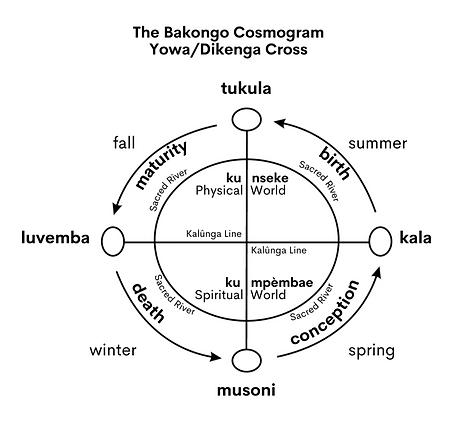

Kongo Cosmograms
Diagram by Middle of Africa
licensed under CC BY-SA 4.0
Photo: Kongo Cosmogram in the First African Baptist Church
JIBLAND2000
licensed under CC BY-SA 4.0
In the Kosmogram, day, night, the moon, and the sun correlate to sacred points within the BaKongo cosmological system, just as the four moments of the sun (dawn, noon, sunset, and midnight) correspond to critical junctures in human life (birth, adulthood, death, spiritual existence). As bondpeople moved in a circular motion at dawn, they paralleled the counterclockwise movement of the sun in the Southern Hemisphere, which was replicated in the Kosmogram, and celebrated the new beginnings ushered in by the harvest and daybreak. They also embraced temporalities that defied their enslavers’ capitalistic, inhumane concepts of time. Whereas time is often understood as an objective metric, temporality names how people experience and structure time. Enslaved people marked the significance of the first harvest annually with a shout that supplanted the enslavers’ profit-driven schedules in favor of their foreparents’ concepts of cosmic time.
All but the youngest among the enslaved likely recognized the fleeting nature of their celebration. After the harvest, enslaved farmers returned to 9- to 16-hour days, preparing and clearing fields, sowing new crops, tending livestock, repairing tools, and performing other tasks in all weather. Their shout during the harvest festival sacralized the fruits of their hands and commemorated their efforts, despite the certainty that their captors would reap the profits of the sale and taste the balance of the bounty. It was a reminder of cultures and rites performed generations prior, an ocean away, where their humanity was unquestioned and freedom was their natural state.

Funeral on a Rice Plantation
U.S. South (1859)
Harper’s Monthly Magazine
Of all the moments when the shout was performed, the transition between embodied and disembodied existence elicited the most solemn and faithful performance of the rite. When interviewed by the Works Progress Administration in the early twentieth century, formerly enslaved Georgia Sea Islander Ben Sullivan definitively declared: “We ain dance then the way they dances now.” Rather, bondpeople would “dance round in a circle” and then they’d dance “for praying.” Sullivan went on to explain that they had “drums for music” and “drums for dances.” On the Couper plantation where he was born, “ole man Dembo he used to beat the drum to the funeral, but Mr. Couper he stop[ped] that.” Couper didn’t approve of drumming around the dead. Even so, community members persisted with the practice to memorialize their dead properly. Drummers beat the drum during the long procession to the burial ground. And after “submit[ting] the body to the ground,” the mourners danced “around in a right” as they “motion[ed] with their hands.” Paralleling the ring shout performed during the harvest, the enslaved sang “the body to the grave” and then “circle[d] around in the dance” after burial to honor the deceased’s transition to the spirit realm.
As a person who lived his life in a world that refuted his intelligence and demeaned his culture, Sullivan easily discerned outsiders’ tendency to narrate enslaved people’s practices as examples of primitivity and ridiculousness. Perhaps for this reason, he clarified the difference between dances performed for leisure and sacred dances by distinguishing between the drums and drumming that accompanied each. The “music” of leisure drumming and sacred sounds of ceremonial drumming were not the same. For West and West Central Africans and their descendants in the Americas, the drums and other percussive sounds were key features of sacred performances like shouts. Drumming was a form of communication that connected the embodied and disembodied worlds: it was a spirit, energy, and language unto itself. As such, it served as an intermediary at critical junctures like funerals, where the embodied ushered the newly disembodied to the ancestral realm with the ring shout.
The ring shout featured prominently in the death rites of people in the Lowcountry, though generalized shouting featured in funerals around the South. It was among the last of a string of sacred performances that often began with the death announcement.
In areas where drumming was permitted, drummers not only announced the death, but also called people to the “sitting up” with the body and funeral using different beats. Drum beats formed the auditory backdrop for the “sitting up,” where community members whispered goodbyes and messages to take to the ancestral realm into the ears of the departed, while partaking in bread and wine with those who remained. Drummers drew upon knowledge passed between family and community members to stretch animal hide over hollowed-out logs and communicate via the “bass” and “kettle” drums they crafted. Positioned on a “cooling board” or in a wooden coffin, the body lay unmoving, with pennies on the eyes and salt on the stomach, throughout the evening or night. The drum called people together again when the time came to escort the body to its final resting place. A long slow beat, called the “death march” by some, accompanied mourners to the grave, where, like the enslaved community on the Couper plantation, they would “shout round the grave in a circle, singing and praying” while each throwing a handful of dirt into the grave.
In some enslaved communities, the sitting up, burial, and ring shout were the last rites for the departed, while in others they preceded a second funeral presided over by a minister months later. Regardless of the timing, bondpeople recognized the shout as a sacralizing ritual. In his interview, Sullivan defiantly named the union of sacred sound and circular movement witnessed at the funeral a “rite,” though the interviewer muddied his meaning by transcribing the homophone “right” instead of the correct spelling. Sullivan came from an enslaved community where Islamic rites were conspicuous—the plantation’s manager, Salih Bilali, and other enslaved Muslims wore prayer beads, veiled, and prostrated themselves during prayers. Consequently, Sullivan comprehended the full meaning of a “rite” when he applied it to the ring shout. By performing the shout, the community acknowledged the sanctity of the transition from matter to spirit, mourned the loss of the body, and ushered the departed to the threshold of the next realm.
In the Lowcountry, broken dishes on graves and graveside dinners shared between the living and their departed loved ones signaled the persistence of West African notions of the thin veil between the embodied and disembodied worlds. The body began to decay, but the spirit lingered for a short period, hearing the goodbyes and supplications of the embodied, prior to transitioning to the ancestral realm. For a people brutalized and subjugated in life, the funeral shout acknowledged how death recalibrated the scales, reunited them with long-lost loved ones and homelands, and inaugurated an alternative reality.


Praise Houses
licensed under CC BY-SA 3.0
Coffin Point Plantation, South Carolina
Courtesy of Neill-Cochran House Museum
Whereas the harvest and funeral shout connected the enslaved to their ancestral cultures, the brush arbor and praise house shouts mingled ancestral and new practices. Bondpeople and their descendants would entrench the shout, and later shouting, as integral sacred performances within their religious gatherings. During brush arbor, praise house, and Christian church meetings, bondpeople ritually communed with the unseen world, transforming themselves spiritually and initiating one another into new religious communities. Shouts at times competed with performances that were more legible to Christian onlookers.
In an 1862 journal entry, Laura M. Towne—a White teacher on St. Helena Island—distinguished between the praise house, where the “better persons go,” and a shout, which she deemed “the remains of some old idol worship.” Towne’s unabashedly prejudiced account shows that for outsiders the shout was singular in its performance and foreign to those only familiar with Christian rites. Three people stood apart leading a chorus and clapping, while the remainder of participants shuffled in a circle, “turning round occasionally and bending the knees, and stamping so that the whole floor swings.” Towne opined that the performance looked like a “regular frolic,” but the participants, like Sullivan in his account, declared it a “religious ceremony.”
Similar to the shouts of the harvest festivals, the counterclockwise circular performance of song and movement continued until late into the night when allowed, though few commentators moved past their prejudiced assessments to record the rite’s purpose. To Towne, the shout was a “savage heathenish dance,” unconnected to the hallowed practices of prayer witnessed in Christian gatherings. To the enslaved, it was a rite reserved for those who had completed the period of spiritual questing they called “seeking” and emerged reborn to be initiated into the religious community. “Seekers” generally signaled their entry into the requisite period of seclusion by tying their heads with a handkerchief and tarrying between “heaven and hell,” before emerging from the “lonesome valley” to offer an account of their spiritual quest. Tellingly, once the community accepted the seeker’s account, they became a “shoutin’ member” of the religious community.
Steeped in an Abrahamic religious context, but rooted in West and West African cosmologies, many enslaved people regarded conversion and acceptance into an ostensibly Christian community as an important milestone. Yet, as the number of bondpeople born on the African continent dwindled in the latter half of the nineteenth century, and westward expansion into Indigenous territory forced families and communities to disperse, enslaved people subordinated the ceremonial ring shout to shouting. Shouting was an individually performed combination of sacred movement and ecstatic irruption that became a feature of Christian baptisms, gatherings, and spirit encounters at brush arbor and other religious meetings.
Lacking the resources to build churches, mosques, praise houses, or other religious edifices, some enslaved people constructed religious structures called “brush arbors” using the “forked branches” of felled trees to form the “framework” and “thickly placed” brush to form a wall along the top and sides. Brush-arbor denizens sat on wooden slabs and used umbrellas or papers to protect themselves from the elements as they engaged in religious exercises. And though they weren’t solely Christian spaces, formerly enslaved person Cordelia Thomas reported that “[t]here was lots of praying and shouting at them old brush arbor revival meetings.”
Bondpeople throughout the South reported shouting following river baptisms and after “getting religion.” But by the turn of the twentieth century, the majority referred to the individual ecstatic performance as opposed to the communal rite. The term’s fluid meaning and adaptive purpose during the slavery era made it ripe for modified attributes in the post-slavery period. In her now-iconic study of southern Black religious cultures The Sanctified Church, Zora Neale Hurston described shouting as a “survival of the African ‘possession’ by the gods” elicited through various types of “sung,” “spoken,” “humming,” and “foot-patting or hand-clapping” rhythms. By the time she observed the performance in the postemancipation South, the descendants of enslaved people had integrated features of the performance into their Christian services and adopted the term to describe the union of sound and movement that ensued when the spirit(s) descended upon a parishioner.
As freedpeople converted to Christianity en masse after Emancipation, they dispersed into historically Black denominations like the African Methodist Episcopal Church and various Baptist denominations, pollinating these spaces with practices and cosmologies that diverged in various degrees from those of their free counterparts. Some, like William Seymour and Bishop Charles Mason, founded entire movements and denominations around their enslaved foreparents’ cosmological understandings of ritualized spirit encounters, esoteric performance, charged materiality, and a world animated by spirit energies. Seymour’s years-long Azusa Street Revival dispersed elements of bondpeople’s cultures into the global religious atmosphere via Pentecostalism, while Mason’s Church of God in Christ unapologetically adopted shouting as a cornerstone of its religious practice. Through such adaptations, the shout, or rather shouting, endured as a feature of contemporary Christian denominations.
Whether performed as a communal rite or as an individual practice, the shout was bondpeople’s assertion of their humanity amid the inhumanity of slaveholders and other beneficiaries of the Black/White American racial binary. Slavery did not dehumanize enslaved people. Rather, it evinced the inhumanity of those who held them captive, whether by law or tacit consent. The system showcased the radical extremes of human behavior: the depths of depravity that ensue when one group has the power of life and death over another, as well as the heights of human resilience achieved in the face of inhumanity. Through the shout and shouting, bondpeople emoted, mourned, celebrated, and healed. They asserted alternative temporalities, acknowledged their labor, honored transitions, and layered practices with meanings that defied their captors’ attempts at erasure and containment. Most importantly, they avowed their humanity over and against those who aimed to strip them of it. In the face of violence, the shout and shouting remained as proof of the histories that bodies can hold.
SOURCES & FURTHER READINGS
Brown, Ras Michael. African-Atlantic Cultures and the South Carolina Lowcountry. Cambridge University Press, 2012. Espinosa, Gastón. William J. Seymour and the Origins of Global Pentecostalism: A Biography and Documentary History. Duke University Press, 2014. Fu-Kiau, Bunseki. African Philosophy of the Bantu-Kongo: Principles of Life and Living. . Athelia Henrietta Press, 1980. Herskovits, Melville J. The Myth of the Negro Past.. Harper & Brothers, 1941. Roberts, John W. The Negro and His Folklore in Nineteenth-Century Periodicals. University of Ohio Press, 1989. Georgia Writers’ Project. Drums and Shadows: Survival Studies Among the Georgia Coastal Negroes. University of Georgia Press, 1940. Stuckey, Sterling. Slave Culture: Nationalist Theory and the Foundations of Black America . Oxford University Press, 2013. Washington, Margaret. A Peculiar People: Slave Religion and Community-Culture among the Gullahs. New York University Press, 1988.
Alexis Wells-Oghoghomeh
is Associate Professor of Religious Studies and affiliate of the department of African and African American Studies and Program in Feminist, Gender, and Sexuality Studies at Stanford University. She is author of the multiple award-winning The Souls of Womenfolk: The Religious Cultures of Enslaved Women in the Lower South (The University of North Carolina Press, 2021). Dr. Wells-Oghoghomeh is currently at work on her second monograph tentatively titled American Fetish: Witchcraft and the Invention of Black Women in the Era of Slavery and two edited collections. Her work has been supported by the American Council of Learned Societies, Ford Foundation, Forum for Theological Education, and Mellon Foundation, among others.
