(2002)
COYOTE RELICS

After a debate over a Spanish-language Mass, a Catholic parish in Tulsa, Oklahoma decides to embrace its immigrant community and builds the nation's first shrine to Saint Toribio Romo, the patron saint of undocumented immigrants. William Calvo-Quiros shows how migration, political violence, and popular devotion have transformed the spiritual landscape of Latino American religious life at the turn of the twenty-first century.
Father Tim Davison arrived at Sts. Peter and Paul Catholic Parish in Tulsa, Oklahoma, at the beginning of 2002. As a relatively young priest, he was excited to fulfill his pastoral duties and care for those entrusted to him by the local bishop, Edward J. Slattery. The then 55-year-old parish, like many other inner-city Catholic churches across the US, had experienced a significant demographic transformation in recent decades because of a massive relocation of Anglo parishioners to suburbia and an influx of Spanish-speaking new members, most of whom had migrated from Mexico and Central America. Conscious of these changes, Davison engaged in “intensified efforts to reach out to the growing Hispanic community within the parish,” as the National Catholic Reporter explained. However, some Anglo parishioners perceived the Latino ministry as a “disruption” that made them “feel unappreciated and unloved.” Tensions within the parish erupted during a spring 2006 confirmation Mass led by Bishop Slattery.
Since the majority of the young teens receiving confirmation were Latino, Bishop Slattery celebrated the Mass mostly in Spanish. Upset by the bilingual service, some Anglo families walked out in protest during Mass, and “the family of at least one confirmand left the parish over the incident.” Very much aware of the disturbance this caused, Bishop Slattery decided to meet with about 60 Anglo parishioners over a potluck dinner a few weeks later. However, the event turned into a tense, difficult, and identity-defining moment for Sts. Peter and Paul Catholic Parish, particularly for its Latino members and for the bishop’s tenure in Tulsa.

Sts. Peter & Paul Catholic Parish
Tulsa, Oklahoma
photograph by the author
During most of the 90-minute meeting, the parishioners expressed their frustrations over what they called “illegal immigration.” Slattery was stunned when people rejected the idea of holding Spanish Catholic Masses at the parish. He explained to them that “as a bishop, we are about the salvation of souls, not Spanish or English.” He recognized that the US immigration system was broken, but he asked them what should be done about the millions already in the United States: “Should they all—mothers and fathers and children—be sent back?” to which one parishioner responded, “Yes, and I’ll drive a bus.”
Scandalized, the bishop responded, “You have something to learn here, and it’s the Gospel.” He left the meeting and, in the following days, instructed Sts. Peter and Paul Catholic Parish to focus its mission on the Latino immigrant community. Eventually, it would become a cultural and religious center in the region, soon commissioning a six-foot-tall statue of Saint Toribio Romo from Mexico and acquiring a first-degree relic in the form of his bone—the first of Romo’s relics in the US. The parish eventually spearheaded the construction of the nation’s first Saint Toribio Romo shrine. Today, they host an annual weekend-long celebration (or Cabalgata) that attracts thousands of Catholic followers to Saint Toribio Romo, known as El Santo Pollero, the Holy Coyote, or the Smuggler Saint, the patron of undocumented immigrants.


Saint Toribio Romo Shrine
Calbalgata Toribio
Annual weekend-long celebration (or Cabalgata) of Saint Toribio Romo
photography by the author

Saint Toribio Romo flyer
photograph by the author
This dramatic event illustrates that changing economic and migration conditions led to both an uptick in death-related saint veneration and friction within Catholic communities. It shows the deep tensions that intertwine religion, culture, and migration policies in the US, as well as the challenges faced by the Catholic Church in the US. It demonstrates how a religious institution navigates both the contradictions and struggles of its global "without borders" status and its moral and religious obligations in the context of a deeply divided nation.
Religious life and the deeds of the secular world are deeply interconnected, not two distinct realities. Social and political changes, both national and international, informed Latinos’ religious experiences on both sides of the US-Mexico border and in Latin America. The late twentieth century was characterized by cataclysmic shifts reflecting a world in transition and crisis. Cold War frameworks were no longer adequate to define (and contain) the geopolitics of religion. The question of where the US and Latin America begin or end became increasingly ambiguous, particularly among the complexities of religious communications, fluid borders, and the early emergence of the World Wide Web.
Neoliberalism reshaped Latin America as it took on a global form, influenced by institutions like the International Monetary Fund and the World Bank. It also hurt vulnerable social groups preyed on by “carnivorous” transnational free-market blocs, including NAFTA, which was implemented in 1994. Devastating effects on the environment, women, and Indigenous communities in Mexico soon became clear, leading to a new wave of migration: displaced male farmers and low-skilled workers who had lost their land in southern Mexico began to move to the US, while women became trapped by a wall of maquiladoras, or sweatshops, along the border—an environment that led to the killings of thousands of women in Juárez, Mexico.
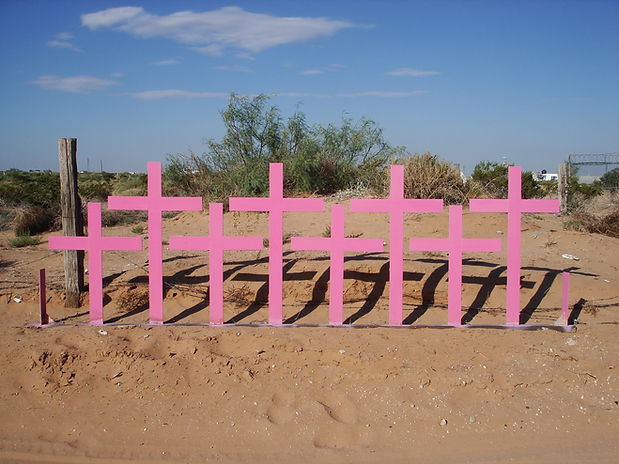
Crosses
Placed in Lomas del Poleo Planta Alta (Ciudad Juárez, Chihuahua) at the site where the bodies of eight female victims of femicide were found in 1996
It is not coincidental that this period was characterized by new forms of both extreme violence and popular religious devotions. Organized crime drew inspiration from neoliberal business models and fed on the opportunities created by free-market blocs. NAFTA facilitated the cross-border movement of goods between Mexico and the US, which consequently reduced the cost and risk of smuggling illegal drugs, leading to a surge in profits and competition among cartels striving to control smuggling corridors. Mexican cartels evolved beyond their role as intermediaries between Colombia and the US. They became their own transnational all-inclusive ventures, partly as a response to the destabilization events experienced by Colombian cartels, culminating in the death of Pablo Escobar in 1993, and the US anti-drug intervention in the region.
These shifts in power led to an increase in violence and created a vacuum for spiritual intervention to navigate a world that felt under siege and on the brink of collapse. Intense religious practices emerged around figures such as Saint Toribio Romo and Jesus Malverde, La Santa Muerte, who is viewed as a quasi-benevolent spirit of death. How do these devotions connect to premature death? How do they manifest in people's everyday lives?

These social-political changes led José, like many other anonymous men from Michoacán, to the US-Mexico border without authorization to cross or work in the US. He was exhausted and desperate. Without water or transportation, his chances of surviving the scorching temperatures of the Sonoran Desert were slim. The increase in militarization, monitoring, and the introduction of physical walls, fences, and advanced surveillance technology along historical crossing sites have forced José and many immigrants like him to alter their migration paths, moving away from major cities and settlements into the deadly desert. Many have lost their lives.
A TV comedian joked that a vampire was killing migrants as they tried to cross, but José knew it was more likely the extreme heat, lack of water, coyotes (smugglers), and drug cartels that were responsible. He also understood that if he survived the desert, he would still need to secure a job and a place to stay despite the language barrier. Invisibility would be crucial for a successful crossing, and it could be challenging to avoid detection by immigration authorities once he crossed. He had been praying to God for help, but he felt that this might be the end of his journey. He wished he could see his family one more time.
Out of nowhere, a tall güero (light-skinned man) with light-colored eyes, clearly from El Bajío in Jalisco, appeared. The man provided water and transportation to a city. José had no money to repay him, but the man told him not to worry; later, when he had the means (and hopefully his papers), he could come to Santa Ana de Guadalupe in Jalisco and pay him a visit. It would be years before José could fulfill his promise.
When he finally arrived in Santa Ana, he learned that the man he had seen in the desert had been dead for decades before he encountered him. What he saw was his spirit—a saint who had helped thousands like him to cross. God did answer his prayers. José believed in Saint Toribio Romo. Once his story became known and was published in a newspaper, Romo's popularity exploded. Now, thousands of pilgrims visit Santa Ana every year, turning the little town into a religious tourist site.


Pope John Paul II
with President Reagan and Nancy Reagan
National Archive
Officers from the regimento "Castañon."
The early 2000s was marked by the explosion of religious marketplaces that reshaped the Latino experience, moving beyond a simple multiculturalism of faiths. For Catholics, this era is defined by the tenure of Pope John Paul II, a charismatic global religious leader and a shrewd political figure. In 1992, after 125 years, Mexico officially restored diplomatic relations with the Vatican when President Carlos Salinas de Gortari modified the constitution, particularly Article 130. These modifications restored legal status to religious orders and groups, allowed Catholic priests to vote, and, crucially, reaffirmed property rights and tenure for churches.
This was one of the crucial elements that had ignited the Cristero War, also known as La Cristiada (1926–1929), which pitted militant Catholic groups against the Mexican government, particularly in response to the implementation of secularist and anticlerical articles in the 1917 Mexican Constitution. The conflict gained particular relevance in the central and western states of Jalisco, Michoacán, Guanajuato, and Zacatecas. These areas, which intersect with the region of El Bajío, not only hold deep Catholic traditions but also have predominantly agricultural populations that influenced migration patterns to the US during the first half of the twentieth century. Moreover, the Cristero War prompted many religious migrants to flee to the US, as many Catholics sought refuge from religious persecution. The religious practices and beliefs of many Southwest communities in the US mirror the developments and social relationships of El Bajío.
Saint Toribio was a martyr from the Cristero War. He was a Catholic Mexican priest who was killed by government-aligned forces in 1928. Decades later, migrants like José spread their devotion in the US, following the religious patterns set by the Cristeros and shaped by transnational migration. Since the 1990s, US and Mexican newspapers have reported on undocumented immigrants who claim to have seen, just like Jose, the spirit of a priest assisting those in distress by providing water, food, money, or transportation.
But this did not occur in a vacuum. Between 1996 and 2005, US immigration policies underwent significant changes, including the Illegal Immigration Reform and Immigrant Responsibility Act of 1996, which expanded grounds for deportation and mandated detention for many immigrants, as well as the Personal Responsibility and Work Opportunity Reconciliation Act, which restricted access to public benefits for legal immigrants. After 9/11, the USA PATRIOT Act (2001) and the Homeland Security Act (2002) increased the government's authority to detain and deport non-citizens while consolidating immigration functions under the new Department of Homeland Security.
In other words, it is not coincidental that as immigration policies became more stringent and undocumented migrants were forced deeper into the dangerous Sonoran Desert in the US, devotion to Saint Toribio Romo began to rise. Romo was beatified by Pope John Paul II in 1992 and canonized in 2000, during a period of heightened migration. Toribio Romo’s relics, in the form of bone fragments, have circulated throughout the US as part of a campaign for comprehensive immigration reform. Today, many Catholic immigration centers have incorporated “Toribio Romo” into their names, and his relics are housed in several states, including Oklahoma, Illinois, and Michigan, reflecting the new Latinx enclaves of settlement outside the Southwest. It can be argued that the evolution of El Santo Pollero (Romo’s nickname, “the holy coyote”) is deeply tied to the neoliberal practices of the state and the Catholic Church as they intersect with the migration of faith.

Population Map
Steven Manson, Jonathan Schroeder, David Van Riper, Tracy Kugler, and Steven Ruggles. IPUMS National Historical Geographic Information System
Version 17.0 1790-2020 IPUMS-NHGIS (OFFICIAL TABULATION). Minneapolis, MN: IPUMS. 2022 | licensed under CC BY-SA 4.0
La Posada
photo by Scott Wagner
licensed under CC BY-SA 2.0

Parade
San Francisco, California
photo by Selvin Esteban
Certainly, the ‘miracle’ of the popularization of Toribio Romo was partly facilitated by the increased demand from a growing population of Latino Catholics in the US. From 1996 to 2005, the US Hispanic population surged from 28.4 million to an estimated 42.5 million. This explosion was driven by both migration and internal growth. The massive mobilization of people facilitated the translocation of religious practices and beliefs, both from Latin America to the United States and from El Norte back to Latin America, as part of a two-way process.
In this sense, there is no question that Hispanic Catholics have increasingly become the demographic engine of the American Catholic Church. However, this increase in parishioners did not automatically translate into a shift in leadership. To address the needs of this rapidly expanding demographic, the US Bishops Conference called for the creation of Encuentro 2000 in November 1997, under the slogan “Unity in Diversity.” This massive project aimed to promote the integration of Spanish-speaking Catholics into national church leadership positions and training. The event took place from July 6 to 9, 2000, at the Los Angeles Convention Center in Los Angeles, California. Nevertheless, the kind of racial tensions that erupted at Sts. Peter and Paul in Tulsa in the early 2000s are still prevalent. Many parishes (and some dioceses) with diverse populations essentially operate as “two churches under one God” with separate English and Spanish masses and distinct ministries.
Nevertheless, by 2005, 177 out of 193 Roman Catholic archdioceses operated an official Hispanic Ministry Office or Secretariat for Hispanic/Latino Affairs. This marked the institutional culmination of decades of advocacy driven by the National Pastoral Plan for Hispanic Ministry. These offices oversaw a wide range of localized pastoral care, including Spanish-language catechesis, leadership training (such as the Instituto Fe y Vida), and connections with lay ecclesial movements, including cursillos and the Neocatechumenal Way, which have historical ties to grassroots Latino communities.
These demographic changes have also ignited transformations in style and religious expressions. In the 1990s and early 2000s, many Latinos began to transition into evangelical US Protestantism or identify as religiously unaffiliated. Overall, many foreign-born Latino American Catholics maintain their religious faith after migrating to the US, whereas US-born Latinos are more likely to change their affiliation. This highlights a generational gap, as older and immigrant Latinos tend to remain Catholic, while younger generations vary in their styles, engagement, and religious identification.
As part of a symbiotic transformation of the Catholic Church through contact with spiritual renewal characteristics of Protestant worship, we also observe significant changes in practices and modes of religious participation. Rituals that invoke the emotions brought by the Holy Spirit have become increasingly popular. In 1993, Pope John Paul II granted a statute to the Catholic Fraternity of Charismatic Covenant Communities and Fellowships, thereby recognizing this Protestant-inspired religious modality and formalizing its role within the larger Catholic institution. Charismatic movements became a dominant small-group experience, characterized by divine healing, direct revelations, and strong lay leadership. This personal relationship and intimate connection with the Holy Spirit, viewed as an everyday living reality of Pentecost, inspired and mobilized many local and regional Latino groups unified by the charisms (spiritual gifts) of the Holy Spirit.
Yet as the example of the Tulsa parish demonstrates, fear, misconceptions, and stereotypes about Latina/os accompanied the rise of charisma and revivals. This raises the important question: how were they connected?

For María Medina-Copete, life has not been easy. Her precarious situation in Mexico as a single, poor woman without an education forced her to reenter the US after being previously deported in 2007. She is familiar with the dangers of everyday life as an undocumented person in El Norte. Despite everything, life feels potentially better in the US. María has become a devotee of La Santa Muerte, a controversial female personification of the Grim Reaper who emerged publicly in 2001 in Mexico, in part because death seems to be the only constant in her life.
She became very nervous and began shaking when Sergeant Arsenio Chávez, a State Trooper, activated the siren and pulled their car over along Interstate 40 in Albuquerque, New Mexico, on June 28, 2011. She knew that any encounter with the police was fraught because of her legal status. However, she felt relieved knowing she was not the one driving; it was her friend Rafael Goxcon-Chagal, a US citizen. She learned they were stopped because Rafael was driving too close to the car in front of them.
When Sergeant Chávez approached the car, she did the only thing she thought would be useful: she begged for divine intervention and started praying:
Holy Santa Muerte, I invoke your Holy Name to ask for your help…
Make my way over the mountains, valleys, and paths an easy one; never cease bestowing upon me your good fortune…
Glorious Santa Muerte, be my protector and light my path. Be my advocate before the Redeemer. Be my truth in times of darkness.
The prayer was printed on the votive candle she was carrying. Unfortunately, Chávez interpreted her words as evidence that Goxcon-Chagal and Medina-Copete were engaging in illicit drug trafficking. He called for backup. During their search of the car, they found a gun and drugs. Both passengers were arrested. Goxcon-Chagal denied knowledge of the contraband, arguing that the car had been borrowed from a friend. Eventually, María and her companion were prosecuted, found guilty, and sentenced to 15 years each.
The case became an important legal battle that illustrates the often nebulous interconnections between secular and religious powers in the US. During the deposition, the government argued that a person’s religious practices could indicate criminal activity. Moreover, Robert Almonte, an expert brought in by the district attorney, contended that María’s religious paraphernalia and devotion to La Santa Muerte were part of the “tools of the trade” often used by “criminal drug traffickers and other criminals… for protection from law enforcement.” In other words, displaying one's religious preferences could be used against a person in court. In the end, despite the fact that her conviction was ultimately overruled, she was deported to Mexico.

La Santa Muerte
South of Nuevo Laredo, México
The devotion to La Santa Muerte, as well as the circumstances surrounding many women like María Medina-Copete from Mexico, must be understood in the extreme social and economic precariousness in the wake of NAFTA. This includes the 1994 economic depression in Mexico, known as the Tequila Crisis, as well as the resurgence of nationalist and xenophobic movements against migrants in the US. In many ways, for poor Latinx individuals, this period has been defined by the normalization of social death. Consequently, the emerging spiritual entities reflect their vulnerable status and the anxieties of the times.
The popularization and mass consumption of La Santa Muerte’s iconography have also been instrumentalized by private and governmental agencies, such as the DEA, FBI, and the US Department of Homeland Security, as well as various organized policing entities within the Catholic Church, for-profit private vigilante organizations, and local police forces, to criminalize Latinos.

Our Lady of Guadalupe Shrine
Saint Mary Magdalen Church
Brighton, Michigan
photo by Nheyob
licensed under CC BY-SA 4.0
As illustrated by the events in Tulsa and the Santo Coyote, saints are influenced by the historical, economic, and social contexts that shape their emergence and the popularization of their devotions. In many ways, we can say that Catholic saints serve as markers of social history. Here, we are not referring to holiness but rather to saints as cultural figures.
The spiritual qualities of a saint, such as the ability to heal, grant miracles, and assist people, are ultimately social products: they respond to real human needs. Saints help people find housing or love partners, secure jobs, save their homes from foreclosure, and address various illnesses, among other things. They are pragmatically relevant because they can meet human needs, particularly when society has failed to provide the necessary resources or has created and perpetuated social vulnerabilities.
Holiness as inspiration and lifestyle does not always correlate with the cultural figure of the saint, despite the Church’s official canonization process. Saints, in social consciousness, have their own lives as part of their devotions. Saints can function as buffer zones to help navigate and negotiate the precarities of life created by state-sanctioned exploitation.
Migration, transnational markers reshaping, state tensions, nativist and xenophobic fears will transform religion for and within Latinos, both in formal institutional and vernacular ways. This period shows us how the creativity and complexity of religion can accommodate people’s needs and meet the challenges of the times. The Latino community in the US, much like the US-Mexico border, is marked by a social body that is bleeding and in pain, bearing a constant stigmata, redefining healing, and waiting for its resurrection and promised land.
SOURCES & FURTHER READINGS
“Migrantes Reportan Supuestas Apariciones de San Toribio en Sonora.” Excelsior, May 12, 2012. Butler, Matthew. Popular Piety and Political Identity in Mexico's Cristero Rebellion. Oxford University Press, 2004. Calvo-Quirós, William. Undocumented Saints: The Politics of Migrating Devotions. Oxford University Press, 2022. Cano, Arturo. “De la Virgen Histórica al Santo Pollero: Viejas y Nuevas Devociones de los Migrantes.” La Jornada Sin Fronteras, August 4, 2002. Espinosa, Gastón, and Mario T. García. Mexican American Religions: Spirituality, Activism, and Culture. Duke University Press, 2008. Facio, Elisa. Fleshing the Spirit: Spirituality and Activism in Chicana, Latina, and Indigenous Women’s Lives. University of Arizona Press, 2014. Gaspar de Alba, Alicia, and Georgina Guzmán. Making a Killing: Femicide, Free Trade, and La Frontera. University of Texas Press, 2010. Martín, Desirée A. Borderlands Saints: Secular Sanctity in Chicano/a and Mexican Culture. Rutgers University Press, 2014. Metz, Allan. “Mexican Church-State Relations Under President Carlos Salinas de Gortari.” Journal of Church and State 34, no. 1 (1992): 111–30. Meyer, Jean. La Cristiada: A Mexican People’s War on Religious Liberty. Square One Publishers, 2013. Murphy, James. The Martyrdom of Saint Toribio Romo. Liguori Publications, 2007. Pantaleo, Katherine. “Gendered Violence: An Analysis of the Maquiladora Murders.” International Criminal Justice Review 20, no. 4 (2010): 349–65. Pew Research Center. “The Shifting Religious Identity of Latinos in the United States.” May 7, 2014. Romo, David. “My Tío, the Saint.” Texas Monthly, November 2010. Thompson, Ginger. “Santa Ana de Guadalupe Journal: A Saint Who Guides Migrants to a Promised Land.” New York Times, August 14, 2002.
William A. Calvo-Quirós
is Director of Latino Studies and Associate Professor of American Culture and Latinx Studies at the University of Michigan. He holds a Ph.D. in Chicana/o Studies from the University of California Santa Barbara (2015) and a Ph.D. from the Department of Architecture and Environmental Design at Arizona State University (2011). His research investigates the relationship between state violence, imagination, religiosity, and spirituality along the US-Mexico border region during the twentieth century. His work studies the evolution and the politics of surveillance and control around Latino religiosity. His award-winning book Undocumented Saints: The Politics of Migrating Devotions (Oxford University Press, 2022) follows the migration of popular saints from Mexico into the US and the evolution of their meaning. It explores how Latinx battles for survival are performed in the worlds of faith, religiosity, and the imaginary and how the socio-political realities of exploitation and racial segregation frame their popular religious expressions. It also tracks the emergence of inter-religious states and transnational ethnic and cultural enclaves unified by faith. His book received the 2023 Best First Book in the History of Religions by the American Academy of Religion (AAR) and the 2023 Frank S. and Elizabeth D. Brewer Prize by the American Society of Church and Religion History. His other areas of interest include Chicana/o Mexican American aesthetics, design and urban planning, Chicana feminist and decolonial methodologies, and the power of empathy and forgiveness to formulate new racial, gender, sensual discourses, as well as the power of empathy. His new research project, titled God 5.0, looks at the intersection of faith, religiosity, theology and power online. You can find more about his research and teaching at www.barriology.com.
