(1988)
TONGANS IN ZION
![An illustrated portrait of a person wearing a dark blue beanie and a white shirt, centered within a blue bandana-style diamond frame on a black background. At the bottom, on either side of the frame, blue street-sign graphics read “HUSTLER BLOC 6.27.81” and “MENTALITY WAY 4.16.1[].” At the bottom center is a blue graffiti tag with wing-like accents.](https://static.wixstatic.com/media/262761_630fbfbf31134f92b61e5080fb4a0602~mv2.jpg/v1/fill/w_405,h_405,al_c,q_80,usm_0.66_1.00_0.01,enc_avif,quality_auto/hustler%20mentality_edited.jpg)
The large Tongan-American Mormon community in Utah develops its own form of Pacific Islander Christian nationalism, blending Tongan traditions with Mormon visions of Zion. Esiteli Hafoka explains what happened after Tongan youth found themselves in the crosshairs of FBI suspicion.
On a quiet morning in 1988, police officers handcuffed a ten-year-old Tongan boy outside his elementary school in Salt Lake City. He had scrawled two words on the wall, “Tongan Crip,” in letters so crude they barely qualified as writing. A second grader, he could not have fully understood what the words meant, let alone the firestorm they would ignite. But the adults were sure they knew what the words meant. For local law enforcement and the white Mormon establishment, this single act of vandalism confirmed their deepest suspicion: the Tongan immigrants settling in the city’s westside suburbs were not faithful converts seeking Zion. They were the vanguard of a criminal insurrection.
The arrest of a child as a “gang member” was no isolated mistake. It marked a collision between two visions of American Christian nationalism. On one side stood the Tongan enclave of Glendale—a community whose Christian faith, according to Eric B. Shumway’s Tongan Saints: Legacy of Faith, was inseparable from monarchy, family duty, and the intertwined pieties of Wesleyan Methodism and Latter-day Saint theology. On the other side, as W. Paul Reeve describes in Religion of a Different Color: Race and the Mormon Struggle for Whiteness, stood white, Mormon-dominated Utah, which saw itself as the truest embodiment of Christian America: a Zion, or ideal society built by Mormon pioneers who fled persecution only to become the arbiters of who truly belonged.
Between 1986 and 1995, this collision forged a new kind of Tongan American identity that emerged in churches and family gatherings, as well as interrogation rooms, courtrooms, and prison cells.
Based on my reading of Sione Latukefu’s seminal work, I detail the meeting of two Christian nationalisms in the Salt Lake Valley during the latter twentieth century. The first began in Tonga more than a century earlier. In 1875, King Taufaʻahau, now called George Tupou I, unified the archipelago under a constitutional monarchy crafted alongside Wesleyan Methodist missionaries. King Tupou I dedicated the island kingdom to God at Pouono, Vavaʻu, a move that intentionally entangled royal authority and theology. From that point on, to be Tongan was to be Christian, and to be Christian was to honor the king, the church, and the family in an unbroken chain of obligation.
Then came the Mormon missionaries. In the 1890s, the Church of Jesus Christ of Latter-day Saints (LDS) found fertile ground among Tongans, who already believed in divinely chosen kings and sacred lineage. By the mid-twentieth century, the LDS church established an educational pipeline from Tonga to Utah, calling Pacific Islanders to “gather to Zion.” Thousands came as pilgrims fulfilling prophecy. By 1986, roughly half of Utah’s Tongans were Mormon. The other half remained Wesleyan Methodist, worshipping at the First Tongan United Methodist Church on Glendale’s main road. Both groups shared the same conviction: their migration was part of a divine plan. However, the Zion they found was not what they expected.
Max Perry Mueller argues in Race and the Making of Mormon People that the Mormon settlers who colonized the Great Basin beginning in 1847 carried their own prophetic history. They believed the US Constitution was divinely inspired, that the nation’s founding prepared the way for the restored gospel, and that they, the Latter-day Saints, were the true heirs of the American covenant. By the 1980s, nearly 90 percent of Utah’s state legislators were Mormon. Church leaders met regularly with legislative leadership to coordinate on “moral issues.” Non-Mormons called it a theocracy in all but name. This was American Christian nationalism as governing apparatus, not merely as belief. In the 1980s, this apparatus turned its attention to the Tongans in its midst.

The gang panic began in 1988. Months before the ten-year-old’s arrest, local police began documenting a new criminal organization: the Tongan Crip Gang, or TCG. In his chapter, “Raise Your Pen,” Kepa ‘Okusitino Maumau details the gang’s formation and transformation, noting that it was founded in Inglewood, California, by Tongan youth who felt caught between African American Crips and Latino gangs and formed their own alliance. When Los Angeles police cracked down, parents of these TCG members sent their children to Salt Lake City, a place with an established Tongan community, LDS church connections, and a reputation for safety.
A handful of gang-affiliated youth arrived that year. But the response that followed far exceeded any real threat. Between 1988 and 1995, police, media, and political leaders constructed a narrative of Tongan criminality that the evidence could not support. Officers admitted that Pacific Islanders were not committing more crimes, but claimed their crimes were becoming more violent. Unlike in the Los Angeles environment, the perception of Tongan violence in Utah had less to do with statistics than with the spectacle of Polynesian bodies violating white Mormon norms.
On October 15, 1990, that anxiety crystalized. Four Tongan high school students walking home were confronted by a vehicle full of young men who pulled alongside and opened fire with a shotgun. Two of those Tongan boys, Fatafehi Samani, 15, and Alama Tausinga, 18, were struck by shotgun pellets. The shooters were white youth who later told police they were tired of Tongans taking over their community, which included the football team, a neighborhood dance hall, and most provocatively, white girls.
Yet when the case reached Judge Michael Murphy, the shooters’ narrative inverted. The defense attorney for one shooter described her client as “an outstanding young man” who was “continuously assaulted by members of the Tongan Crips Gang.” The defense argued that the Tongan victims were known gang members, which transformed a racially motivated shooting into an act of self-defense against criminal intruders.
This sleight of hand was possible because of Utah’s deeper racial and religious order. The Tongan youth were not simply suspects; they were figures in a moral drama about who belonged in Zion. A sheriff’s gang detective warned that “when you come up against a 250-pound Polynesian, you’d better have some backup or you’re going to get your melon thumped,” invoking a racial caricature as old as American popular culture—the savage male Pacific Islander. Moreover, his warning also illustrated a specifically Mormon anxiety: the convert called to Zion threatens to defile it with the violence of Los Angeles.
The Salt Lake City Police Department and Tongan youth in Salt Lake City were entangled in a self-fulfilling prophecy. Police responded to the perceived threat of Tongan violence in the city with community surveillance; they attended Tongan cultural events, photographed attendees, and compiled intelligence files on community leaders. Inversely, young Tongan men who were subject to constant surveillance and routine stops responded with the only resources they possessed: physical strength, group solidarity, and a defiant assertion of belonging. The very traits that made them excellent rugby players and football stars—their size, aggression, and loyalty—became evidence of criminal predisposition.
But to tell only the story of violence and policing is to miss something stranger and more complex. The Tongan youth who joined gangs were not simply “Americanizing” in the classic immigrant pattern. They were producing a new identity that drew on Tongan, American, and specifically Utah Mormon elements in surprising combinations.
Consider Sonasi Poʻuha, a twenty-year-old gang member known on the street as “Lazee,” who remained an active member of the LDS church even as he participated in gang activities. “I’m getting out,” he said, but “I still have a little more gangbanger in me.” He described sending younger kids on “missions” to “test their nuts,” a phrase that deliberately parodied LDS missionary service. The gang was not a rejection of Mormonism but a distorted reflection: a hierarchical, fraternal organization demanding absolute loyalty, testing its young members through trials, offering a form of belonging that the white church had denied them.
These youth navigated three competing models of Christian manhood: the Tongan Methodist emphasis on family hierarchy and village obligation, the LDS emphasis on patriarchal priesthood and missionary sacrifice, and the American street emphasis on toughness and honor. The gang offered a way to reconcile them all—to be simultaneously Tongan, Mormon, and American.
Yet this synthesis came at a terrible cost. The same church that had encouraged their families to migrate to Utah responded counterproductively. Elder Alexander Morrison acknowledged the problem with bewilderment: “We’ve got some kids who are believing, who say, ‘The church is important in my life, but I’m still in a gang.’ I just weep for them.” Weeping was not an intervention. The church initially responded by organizing separate Tongan-speaking wards, but that isolated rather than integrated Polynesian converts, a move that likely exacerbated the very alienation that made gang membership appealing.
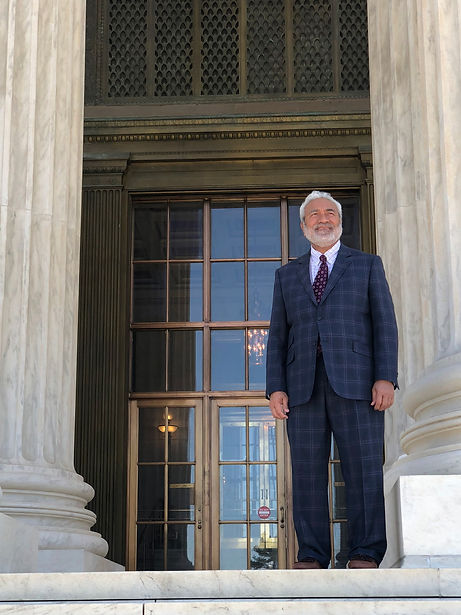

Filia Uipi
Left: at the Supreme Court
Right: with daughter, Beverly
courtesy of Beverly Uipi
If the gang members represented one pole of Tongan American identity, Filia Uipi represented the other. In a 2015 interview, Uipi recounts his life journey. Born in Tonga to a Methodist minister, Uipi converted to Mormonism as a young man, migrated on a Brigham Young University scholarship, graduated from law school in Utah, became a citizen, and in 1988 was elected as a Republican to the Utah House of Representatives. He became the first Tongan American to hold state legislative office anywhere in the United States.
Uipi embodied the promise of Mormon-inflected Christian nationalism. He embraced the gospel, assimilated, and rose to influence. He founded the Tongan Educational Society to promote academic achievement and served as a role model for a community struggling with poverty and high dropout rates.
But his career also revealed the limits of that promise. In November 1992, he traveled to Tonga to attend a pro-democracy convention. When he arrived at the airport, police met him on the tarmac and ordered him back onto the plane. Witnesses said Uipi wept as he was denied entry to the country of his birth. The Tongan government barred all foreign passport holders, including naturalized citizens like Uipi, from participating in the convention.
The irony was excruciating. Uipi accomplished everything the American system asked: converted, assimilated, achieved, and served. He even embraced the Republican Party, which in Utah was virtually indistinguishable from the LDS hierarchy. Yet when he sought to participate in democratic reform in his homeland, he was told he was no longer Tongan. And when he returned to Utah, he discovered that his Americanness was also conditional. The same attitudes which shaped the law enforcement apparatus that criminalized Tongan youth were also responsible for excluding Tongan communities from the larger Anglo-dominated community. According to Uipi, ethnic communities were ignored rather than actively discriminated against, something that he was not exempt from as a Tongan legislator. In the eyes of both Tongan and American nations, his identity remained provisional.
The Tongan American identity that emerged from this decade was co-created by two forces that imagined themselves as antagonists. The white Mormon state, through its law enforcement and political institutions, constructed the Tongan as a figure of threat by drawing on old racial stereotypes but also on specifically Mormon anxieties about the corruption of Zion. The Tongan convert who arrived expecting a community of saints instead found a white-dominated hierarchy offering spiritual inclusion without social equality.
In turn, the Tongan youth constructed an identity that was both a rejection of and a mirror image of the white Mormon order. The gang borrowed its structure from the LDS priesthood: hierarchical, fraternal, and demanding sacrifice while also inverting its moral content. It claimed territory that the white church had denied them, using violence to enforce boundaries that should have been secured by welcome.
But this was not a symmetrical process. The state wielded vastly more power. When Judge Murphy sentenced the white youth, who had shot four Tongan students, to prison time, he acknowledged that the shooter acted out of racial animus. The Tongan victims, by contrast, were treated as provocateurs whose very presence in Kearns justified the violence against them. The law did not simply reflect existing racial hierarchies. It actively produced them.

Finally, the story of Tongan Americans in Salt Lake City between 1986 and 1995 is ultimately a story about the contested meaning of the “nation under God.” For white Mormon Utahns, that phrase meant a nation whose laws reflected LDS moral teaching. For Tongan converts, it meant something different: a nation where Christian identity guaranteed belonging, where the faithful were welcomed as brothers and sisters regardless of race or origin.
These two visions collided in the body of a ten-year-old boy handcuffed for writing on a school wall. That child—whose name we do not know, whose fate we cannot trace—embodied the tragedy of American Christian nationalism. He was likely taught that he belonged, and that his faith entitled him to the same rights as any white Mormon; but the police officers who arrested him, the judges who convicted him, and the media that labeled him operated with a very different understanding. In their eyes, his Tonganness marked him as an outsider, and his adolescent rebellion confirmed what they had always suspected: that some bodies were unredeemable.
The Tongan community that emerged from this crucible was not the one that entered it. The mid-century pilgrims who understood themselves as building Zion gave way to a generation that understood itself as survivors of a hostile state. The churches remained central; the First Tongan United Methodist Church still stands in Glendale, and the Tongan LDS stake now includes a dozen wards, but they no longer served as unambiguous sites of belonging. For every Filia Uipi who rose to office, dozens of young men cycled through the Utah State prison system, marked by the state as permanently unassimilable.
And yet the story does not end in despair. The identity forged in this period was not only a wound but also a weapon. The youth who formed TCG learned to organize, to demand recognition, and to refuse exclusion. The community leaders who watched their children arrested learned to navigate the legal system, to advocate for policy changes, and to hold the state accountable. Belatedly, the LDS churches work to confront their own complicity in the racial order responsible for criminalizing their members.
Today, Utah’s Tongan community is more visible, more organized, and more powerful than ever. But the underlying structures that produced the crisis of this decade remain largely intact. American Christian nationalism still operates as a narrative of belonging that excludes those who do not fit its racial and religious ideal. And the question that a ten-year-old boy’s arrest report inadvertently posed: who belongs to the nation under God? This remains unanswered.
SOURCES & FURTHER READINGS
These three books offer deeper background on the key themes of this essay: how religious communities shape racial and national identity, how Mormonism navigated questions of whiteness and belonging, and how Tongan Christianity was forged through the entanglement of monarchy, mission, and law. Judith Weisenfeld, New World A-Coming: Black Religion and Racial Identity During the Great Migration (New York University Press, 2015) W. Paul Reeve, Religion of a Different Color: Race and the Mormon Struggle for Whiteness (Oxford University Press, 2015) Sione Latukefu, Church and State in Tonga: The Wesleyan Methodist Missionaries and Political Development, 1822–1875 (University of Hawaiʻi Press, 1974) Header image courtesy of Esiteli Hafoka
Esiteli Hafoka
is a full-time Adjunct faculty member in the Ethnic Studies department at Sacramento City College, where she teaches general Ethnic Studies, the department’s first Pacific Islander Studies-focused course, and Introduction to World Religions. She received her Ph.D. and M.A. in Religious Studies from Stanford University and her B.A. in Religious Studies and Ancient History from the University of California, Riverside, graduating Magna Cum Laude. Her academic journey follows a non-traditional path; after dropping out of community college, she worked for seven years as a residential electrician before returning to school on academic probation and eventually transferring to UC Riverside, where she discovered her passion for academia. Her research introduces Angafakafonua, a Tongan epistemological framework, to explore Tongan collective identity in the United States, examining how religious threads from 19th-century Methodism, Mormonism, and Tongan Crip gangs inform Tongan religio-racial identity. Her publications include: “Tongan Crip Gang: A Tongan American Identity,” Art/Research International 8, no. 2 (2024): 457–70; “Oceania: Revisualizing the Pacific in American Religious History,” in “Retelling U.S. Religious History: A Roundtable Retrospective,” American Religion journal website; and, with Finausina Teisa Paea Tovo, “Mana as Sacred Space: A Talanoa of Tongan American College Students in a Pacific Studies Learning Community Classroom,” in Disciplinary Futures: Sociology in Conversation with American, Ethnic, and Indigenous Studies, eds Nadia Y. Kim and Pawan Dhingra (New York University Press, 2023).