(1923)
HOW THE SHAKERS BECAME FURNITURE

Shaker furniture is famous for its simplicity, craftsmanship, and elegance. But as Kathryn Reklis shows, the objects that fill galleries and design magazines are part of a larger story of a celibate, ecstatic communal movement committed to gender and racial equality, spiritual perfection, and divine love. Yet as artists and collectors transformed Shaker craftsmanship into a symbol of American modernism, the religious communities that produced it were rapidly disappearing. Reklis sheds light on the radical spiritual world hidden behind the iconic American aesthetic.
In the early 1920s, American modernist artists began to collect Shaker objects. The painter Dorothy Varian remembered driving through rural New Hampshire and Maine in 1923 with a group of artists who were all staying at the Ogunquit artist colony hunting for “rural American objects” and having to hire a van to bring back all the Shaker goods they collected. Charles Sheeler, another modernist painter, began collecting Shaker objects in the early 1920s. He included an oval Shaker box in his famous 1931 painting Americana. Juliana Force, the founding director of the Whitney Museum of American Art, was also a Shaker collector and became so enamored of Shaker objects that she named her home in South Salem, New York, Shaker Hallow.
Artists and curators were attracted to Shaker material culture, especially Shaker furniture and home fixtures, because they saw in it a blend of simplicity and utility that echoed the aesthetic aims of modernist artists and designers. Shaker design suggested to them a kind of homegrown American modernism. American artists could look to the Shakers and other pre-industrial traditions instead of turning to European artists or European history to find inspiration. Perhaps even more importantly: at a moment when Americans were seeking a confident national identity, Shakers pointed to an American tradition of art and design that was inherently democratic. These were beautiful, simple objects that had been designed to be useful and accessible to ordinary people. They had not been created just to be collected and admired by the wealthy and elite—though that is, of course, what started to happen in the 1920s. In modeling their own artistic practices on Shaker design principles, American artists could tap into an inherently American art form.
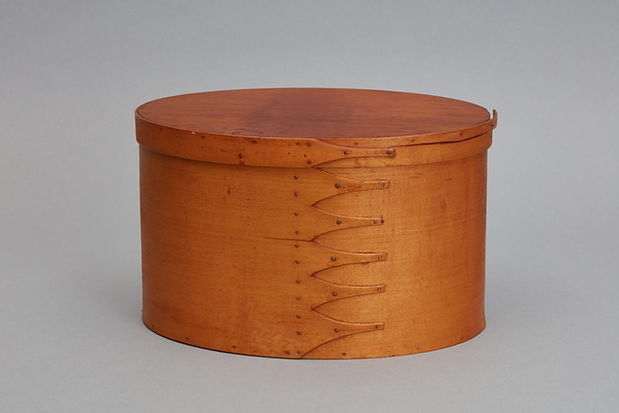
In the same decade when Shaker objects were being discovered as art, however, Shaker communities were rapidly declining. 1916–1925 marked an acceleration of the decline that had begun at the turn of the century: half of the eighteen long-term Shaker communities closed in that decade, joining several others that had closed a few years prior. By 1925, only five were still operating—and one of those would close in 1926, another in 1931. These two realities were connected: because Shakers were no longer seen as an active, contemporary religious force, they could be interpreted as American folk art, largely imagined as existing in the past. Indeed, as images of a lost past were being fractured by industrialism, rapid urban growth, drastic income inequality, and debates about immigration and race relations, the Shakers were held up as a model of a simpler, American tradition, one that ordinary Americans could tap into through new modernist design principles.
The fascination with Shaker objects only grew in the following decades, so much so that most people, if they know anything about Shakers, probably think of furniture. In 1980, Shaker Sister Mildred Barker famously quipped, “I almost expect to be remembered as a chair, or a table.” This was not, of course, what Sister Mildred or any Shaker had hoped for when they committed themselves to a life of celibacy, radical community, and the pursuit of spiritual perfection. Then again, if the early twentieth century saw a new fascination with Shaker design, it was not the first time worldly outsiders had been attracted to the utopian religious group.
The Shakers have been part of America’s story since the country’s founding. The experimental, creative freedom of the early Republic allowed the Shakers to flourish. The group began in a small home church of “shaking Quakers” run by Jane and James Wardsley in Manchester, England, so called because of the ecstatic song and dance that marked their worship. The small community was eagerly expecting a second coming of revelation, this time in the body of a woman, to complete the work of God in Christ, who had appeared in the body of a man.
When Ann Lee, a young illiterate daughter of a blacksmith, joined their community, she experienced a series of visions from God, revealing a new spiritual truth: the root of all sin lies in sex, and the only path to true union with God is the public confession of sin, complete celibacy, and communal life. Her community became convinced that she was the revelation they had been waiting for. Persecuted by the Church of England for inciting disorder and heresy, they heard reports of religious revivals in the North American colonies and believed that God would allow their group to flourish in this new land.
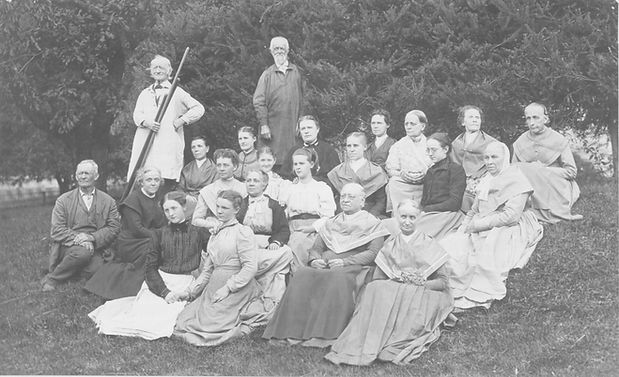
Anna White & the North Family
Anna White and 22 men and women of the North Family sometime in the 1920s. Included are Levi Shaw, Catherine Allen, and Leila Sarah Taylor. Trustee Levi Shaw at left with rake and hoe. Catherine Allen is fourth from left in the last row seated next to Anna Case (in glasses). Leila Sarah Taylor is second from last in the second row.
Winterthur Museum, Garden & Library
Mother Ann Lee and her eight religious companions arrived in New York City in 1774. They settled their first community in upstate New York in 1776, just as the Revolutionary War broke out. As new immigrants from England who refused to take sides in the Revolutionary War because of their commitment to pacifism, they were initially greeted with suspicion by their new countrymen. Shakers were celibate, foreswearing marriage and sex of any kind. They lived in communities of unmarried men and women. Continuing their practices from England, their religious worship was centered around ecstatic dancing and song, sometimes lasting for hours or even days. All of this was strange and alarming to many of their neighbors.
The Shakers were unusual. In an agricultural society that depended on reproductive families for labor, giving up sex and marriage was not only strange but seemed like economic and social suicide. In a heavily Protestant society, celibacy was especially suspicious. The Protestant Reformation had overthrown Catholic European assumptions that celibacy was a holier path than marriage. Unlike Catholic priests, Protestant clergy were encouraged to marry, and Protestants were taught that the family was the primary setting to serve God and to develop Christian virtues.
Since the 1730s, the North American colonies had been embroiled in debates about ecstatic religious experience, with many prominent clergy preaching against such worship, arguing that it elevated the individual’s experience over the disciplining word of God. It is no wonder that many people didn’t know what to make of a communal, celibate group that insisted they were overflowing with love for God in ecstatic song and dance.

Still, Mother Ann was right: America offered fertile ground to grow her communities. By the 1780s, Shakers were attracting new converts and founding many new communities throughout New England. After Lee’s death, the group took the name the United Society of Believers in Christ’s Second Appearing to reflect the core of their convictions: God had completed the revelation of Christ in the work of Ann Lee. They continued to be called the Shakers, however, in reference to their form of worship.
By the height of their community in the mid-nineteenth century, they had spread as far south as Florida, as far west as Kentucky, and they had an estimated six thousand official members. Six thousand members was a tiny percentage of the US population, even in pre-Civil War America. But given the rigor of Shaker commitment, it is perhaps more remarkable than it sounds.
All the strangeness of the Shaker way of life, it turns out, had many tangible, material benefits. Before the Civil War, most Americans lived in farming communities, often centered around a nuclear family, sometimes with extended families living together to share labor and expenses. Life was lived within tight margins. If Pa or Ma got sick, they had to soldier through or suffer a loss of necessary food or labor. If a worse accident or illness befell a family, it might spell financial ruin. Shaker communities, on the other hand, combined the intelligence, practical training, and labor power of hundreds of adults into one functioning community. As a result, they were able to innovate new methods in farming and woodwork, irrigation and laundry systems.
In addition to their famous furniture design, they invented many items that are still used today, like seed packets, the flat broom, and the circular saw. Even before the industrial revolution, they could manufacture goods at a scale that exceeded most of their neighbors. The Mount Lebanon community had a whole building devoted to the making of chairs. The community itself—six hundred people strong at its height—needed hundreds of chairs a year. They also made hundreds more to sell. When members were sick or injured, they could convalesce in peace with dozens of community members who could step in to fill their duties.

Shaker communities exuded a spirit of peace and abundance in a time when most experienced scarcity and uncertainty. They provided reliable food and shelter to many people who could not feed or care for themselves. The Shakers preached gender and racial equality in a colonial system that was doubling down on patriarchy, slavery, and white supremacy. Women fleeing domestic abuse and those fleeing slavery helped swell the ranks of the early Shaker houses.
Beyond the thousands who “signed the book of life,” as Shakers refer to conversion, many thousands more lived with the Shakers for short periods of times, including thousands of children whose parents had died or could no longer care for them. In the absence of public orphanages or welfare support, the Shakers provided security and care for children who would otherwise have been abandoned. While some of these children chose to sign the book of life when they reached adulthood, most did not, choosing to pursue “worldly” lives outside the community.
The material benefits of Shaker communities, however, cannot alone account for all those who did commit to the radical Shaker lifestyle. Shaker theology and spirituality was attractive to the thousands of people who took on Shaker commitment. Much of this had to do with the very ecstasy that made them seem so strange to their first observers. Communal song and dance enacted the core Shaker belief in complete surrender to the love of God and served to bind the community together.
In the 1830s, as the last of the first generation of Shakers died and new converts had less personal connection to the founding charisma of the group, a new era of spiritual experience began, which historians now call the Era of Manifestations. Thousands of members received spirit communications, from Mother Ann and also from other dead Shakers, other prominent spiritual leaders, and even from Native American spirits. Members created elaborate, beautiful “gift drawings”—paintings and sketches that represented celestial gifts bequeathed to other members. Some entered trance states, spoke in unknown tongues, and danced, whirled, or flung their bodies in wild movements. Many nineteenth-century Americans sought access to the spiritual realm through seances and visions. Like the new telegraph that was connecting the expanding United States, the Shakers believed they had received “proof of a telegraphic communication established between the two worlds” that opened the spirit world to thousands of people.
Long before people discovered Shaker furniture, outsiders flocked to Shaker communities to observe these ecstasies in action. In 1857, a reporter for Harper’s Magazine wrote a long profile of the New Lebanon Shaker community where he described a Shaker worship service. Having received a “physical manifestation of the power of God,” a young man whirled in the middle of the room, arms outstretched, for over an hour, so caught up in the gift of the spirit he was “apparently unconscious of all that was passing around him.” Eventually Shaker communities grew tired of observation of their sacred experiences and closed their worship to outsiders. They also grew increasingly wary of extreme expressions of ecstatic experience, adopting a set of Millennial Laws that dictated the dress, behavior, and worship patterns of members. By the end of the nineteenth century, they gave up dance in worship all together.
It was at this same time that the Shaker communities began to decline. Older members were dying, and few new members were joining. As the industrial revolution transformed most aspects of American society, people were leaving the country and agricultural life for factory jobs in expanding cities. Farmers were adopting new tools and machinery that allowed smaller farms to grow with less labor power. New ideas about social welfare and state intervention led to new social services for orphans and widows, so fewer people sought out the Shakers for social support. New forces of secularization were transforming American public life—from intellectual ideas like evolution and psychoanalysis to the self-conscious effort to uncouple religious commitments from public institutions like schools, media, and government. More than ever, Americans were encouraged to seek prosperity in this-worldly comforts and the new commodities made possible by industrial manufacturing. Shaker millennial fervor seemed more out of place in a nation brimming with new material confidence.

The Shakers were themselves affected by these currents of change. In giving up ecstatic dance, they were moving with the times to more somber, orderly religious expression and away from prophetic and spiritualist experiences. Always savvy businesspeople, trading and selling goods to support their communities, they were attuned to new consumer desires. We know the Shakers now for their plain and simple design, but as fashions changed, so did Shaker production. In the second half of the nineteenth century, they made many ornate carved objects, lace doilies, and other “fancy goods” like poplar sewing boxes lined with satin and colored ribbons.
The Shakers were still making these ornate, fancy objects well into the twentieth century when modernist artists and curators began to discover their material goods as proto-modernist art. If people would buy it, Shakers would make it, especially as they relied on outside sales to bolster their shrinking communities. Fancy Victorian objects, however, did not fit the narrative modernists wanted to tell about Shaker simplicity, leading these fancy objects to be largely ignored or excised from popular narratives about the Shakers. So, too, for many years, the ecstatic worship, spiritual visions, and radical social politics of the Shakers were ignored or downplayed in favor of a narrative about rural simplicity and the simple labor of useful hands.
In the decade of precipitous decline, Shakers participated in crafting this new narrative about their past. As more Shaker communities closed between 1916 and 1925, Shaker Sister Catherine Allen, who served as lead Ministry eldress during this era, expended great energy attempting to collect, organize, and preserve Shaker documents, ensuring that many were sent to libraries near former Shaker communities. She also established a partnership with the Western Reserve Historical Society, leading to the preservation of some 10,000 items. In the decades that followed, private collectors and art museums would actively participate in preserving and curating Shaker material culture, often buying Shaker objects directly from Shaker communities that were closing, or from local families who had purchased Shaker items. Many of the prominent Shaker communities became museums, offering tourists a chance to step back in time to the height of Shaker prominence.
The “Shaker fever” that started in the 1920s reached a peak in the next two decades. By the 1930s, Shaker objects could be found at major art museums around the country—including the Metropolitan Museum of Art in New York City—and by the 1940s, popular magazines ran articles about Shaker art and design to inspire homemakers with the simplicity of this homegrown modern tradition. The passion for Shaker design has never really abated. One can still find design websites and magazine articles praising Shaker style and suggesting how these simple principles can be incorporated into American homes.
The fascination with a particular mid-nineteenth century moment of Shaker design speaks to nostalgia for an imagined simpler past in American history. But it might also tell us something about our vexed and confused relationship with material stuff. On the one hand, modern Americans have inherited many traditions from Christianity and Enlightenment philosophy that encourage us not to invest meaning in objects. Unlike so-called superstitious people in the past, modern Americans are supposed to know that stuff is just stuff. On the other hand, consumer culture promises to fulfill our deepest desires and transform our lives if we buy the right stuff.
We are surrounded by objects that mean both too little and too much. To enter a Shaker space—in photographs, through a Shaker museum, or through a design magazine showing us how to remodel our kitchens in the Shaker style—is to enter a different relationship with stuff. The Shaker style promises simplicity and order on the outside—but we hope that it will create peace on the inside too. “A place for everything, and everything in its place,” after all, is a phrase often associated with the Shakers.

Gift Drawing
vision from Mother Ann to Amy Reed
attributed to Sarah Bates
(7 January 1848)
It has taken longer for popular consciousness to catch up with the other dimensions of Shaker life—the ecstatic worship, the radical community, the commitment to gender and racial equality. Far more than chairs or tables, this is the legacy Mother Ann and her followers hoped they were bequeathing to America, and through America, to the world.
There are signs that Shaker theology is becoming better known. Actress Francis McDormand and her friend the artist Suzanne Bocanegra created a small exhibit and performance to showcase adult-sized Shaker cradles, focusing attention on the practices of care that Shakers provided for elderly or ailing members of their community. A major motion picture about Ann Lee and the early Shaker community, The Testament of Ann Lee, directed by Mona Fastvold, was released in theaters in 2026, emphasizing the spiritual visions and ecstatic experience that marked early Shaker worship. The Institute of Contemporary Art at the University of Pennsylvania is hosting a major show of Shaker artifacts in the summer of 2026, focused on utopian communalism.
There is one Shaker community remaining in Sabbathday Lake, Maine, with two living Shakers and a provisional third who is undergoing a trial period. They run an excellent website and still welcome outsiders to worship with them. They will tell you that Shakers have more to offer the world than beautiful chairs or hat boxes, though they do still make a small number of those. Far from anachronism or nostalgia, the last living Shakers continue to teach the world the central truth revealed to Ann Lee: “God is Love… and that our most solemn duty is to show forth that God who is love in the World,” as they say on their website.
Shakers have always been a numerically small part of the US’s religious story, but their influence has exceeded their size. Then again, Shaker theology teaches that the work that God has begun in Jesus Christ and continued in Ann Lee is ongoing and will not end, even if all the Shakers were to disappear from the world. They cannot ever really disappear, Shakers believe, because the work they were called to do was always God’s work, and it will persist, through renewal, even out of decline.
SOURCES & FURTHER READINGS
Stephen Stein’s book, The Shaker Experience in AmericaL A History of the United Society of Believers (Yale University Press, 1994), is still the best single volume history of the Shakers Spiritual Spectacles: Vision and Image in Mid-Nineteenth-Century Shakerism by Sally Promey (Indiana University Press, 1993) is a wonderful study of Shaker art, especially spiritualist art produced during the Era of Manifestations. A new edited volume on the Era of Manifestations, Shakers at the Center: Manifesting Spirits & Spectacles in Nineteenth-Century America, edited by Douglas L. Winiarski (University of Massachusetts Press, 2026), brings together many scholars of American religion to consider this extraordinary period of Shaker history. An excellent place to understand the fascination with Shaker art and objects that began in the 1920s is William Moore’s book Shaker Fever: America's Twentieth-Century Fascination with a Communitarian Sect (University of Massachusetts Press, 2020).
Kathryn Reklis
is Associate Professor of Modern Protestant Theology at Fordham University, with affiliate appointments in Comparative Literature and American Studies. Most of her research projects explore how religious subjects appeal to and understand beauty, art, and embodied experience as a salve against the ills of modernity—whether those are understood as scientific rationalism, the iron cage of bureaucratic life, or the devastations of colonialism, racism, and patriarchy. She is currently writing a spiritual and cultural biography of the literary work of American author Shirley Jackson for the Iconologies series with the University of Chicago Press. Since 2024 she has been a Scholar in Residence with the Social and Moral Cognition Lab at Columbia University, where she is working on a project that explores the links between Christian theology, moral decision making, and climate action. She is the author of Theology and the Kinesthetic Imagination: Jonathan Edwards and the Making of Modernity (Oxford University Press, 2014) and Editor, together with Sarah Covington, of Protestant Art and Aesthetics (Routledge, 2020). She writes a monthly Screentime column on film, television, and other screened art for The Christian Century.
