(1927)
EVA JESSYE’S SPIRITUALS

1927: Celebrated Harlem Renaissance choral conductor Eva Jessye publishes a collection of spirituals from her childhood as an "Exoduster" with Afro-Cherokee roots in rural Kansas, offering them as a unique cultural heritage and universal spiritual resource. 2026: Judith Weisenfeld uses My Spirituals to reconstruct the religious musical life of Black Coffeyville.
In the spring of 1926, reported the Baltimore Afro-American, Eva A. Jessye took a courageous stand for African American religious music. Jessye had moved to Baltimore from the small city of Coffeyville, Kansas, in 1919 to serve as the music director at the historically Black Morgan College and as an occasional reporter and columnist for the Afro-American. She was also the director of the Dixie Jubilee Singers, a group that specialized in Negro spirituals, a type of religious folk song created by communities of enslaved Africans in the United States expressing their sorrow and hope in God, even in captivity.
When M. Witmark and Sons, a white-owned New York-based music publishing company, had sent Jessye sheet music for her to consider performing, they described the music they were selling as “negro spirituals” and “darkey songs.” Jessye sent a letter of protest, expressing her “indignation at the use of the small ‘n.’” In insisting on capitalizing Negro, Jessye represented many people of African descent in the US at the time who argued that such labels for collective peoplehood required the respect of capitalization. She also objected to their use of “the disgusting term ‘darkey,’” a demeaning term for African Americans. Jessye sought to counter the predominance in American entertainments of racist representations of Black culture, including minstrel shows, where white performers in blackface makeup sang songs caricaturing African Americans.
Despite common claims by some white Americans that minstrel shows were simply fun or inconsequential, Jessye knew well that racist representations of Black communities and religious cultures contributed to social marginalization and hindered the cause of civil rights for African Americans. As she commented in another context on the demeaning label, “I do not approve of the word, chiefly because of the opinion it gives the black children of themselves and the white children of their darker brothers. As a subtle, but potent influence that can mold the sentiment of the younger generation of both races, it is not to be regarded as foolishness to raise the question.”
Her letter of protest worked, according to the Afro: the publisher apologized to Jessye for the disrespect of the music that their words had conveyed, and pledged to do better. Far from the “darkey songs” that denigrated Black culture for the entertainment of white people, Jessye understood Negro Spirituals to be a source of pride for African Americans and a valuable part of “the folklore of America.”
Less than a year later, in 1927, Jessye would show the world what she meant. She published My Spirituals, a collection of sixteen songs, for which she had written piano and voice arrangements and narrative introductions. This book became the launching pad for a life-long vocation of preserving and presenting this genre of religious music.

My Spirituals, Title Page
Schomburg Center for Research in Black Culture
Jean Blackwell Hutson Research and Reference Division, The New York Public Library
Black Baltimoreans were familiar with Jessye at the time of her challenge to the music publisher and the publication of My Spirituals, but she was relatively unknown elsewhere. Jessye would soon go on to national and international fame as a leading interpreter and advocate of Negro spirituals. The Dixie Jubilee Singers, the group she led, performed in the stage show that preceded movie showings at New York’s Capitol Theatre, recorded on Brunswick and Columbia Records, and appeared on the radio. Jessye served as the musical director for Metro-Goldwyn-Mayer’s 1929 film, Hallelujah, Hollywood’s first major all-black-cast film; and as choral director for the Broadway production of George Gerswhin’s Porgy and Bess, which premiered in 1935 and featured members of her Eva Jessye Choir. Her choir also appeared in the 1934 production of Virgil Thomson and Gertrude Stein’s opera, Four Saints in Three Acts. She and her choir toured the country, often performing oratorios Jessye composed in the 1930s combining biblical and other texts and Negro spirituals, including The Story of Baltasar, The Black Magus, The Life of Christ in Negro Spirituals, and Paradise Lost and Regained.
The Eva Jessye Choir was such a prominent cultural institution that National Association for the Advancement of Colored People Executive Secretary Roy Wilkins invited the group to be the official choir of the 1963 March on Washington for Jobs and Freedom, an event most remembered for Dr. Martin Luther King, Jr.’s “I Have a Dream” speech. The choir was listed on the program, along with superstar gospel singer Mahalia Jackson, and sang Jessye’s own composition, “Freedom is a Thing Worth Talking About.”
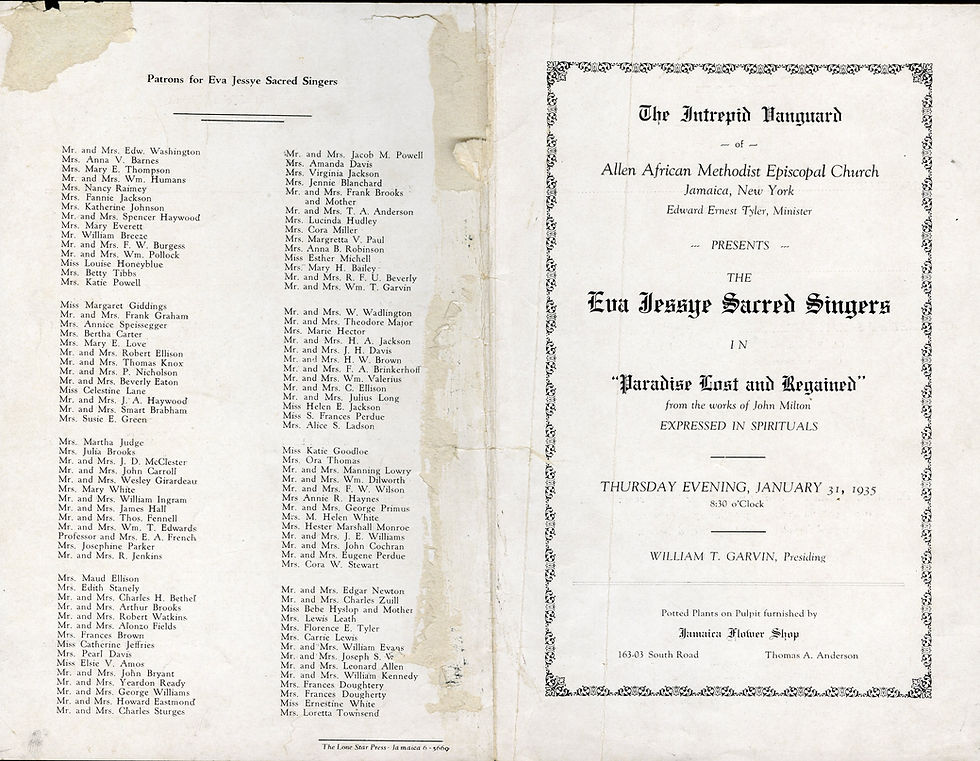

The Eva Jessye Sacred Singers
31 January 1935
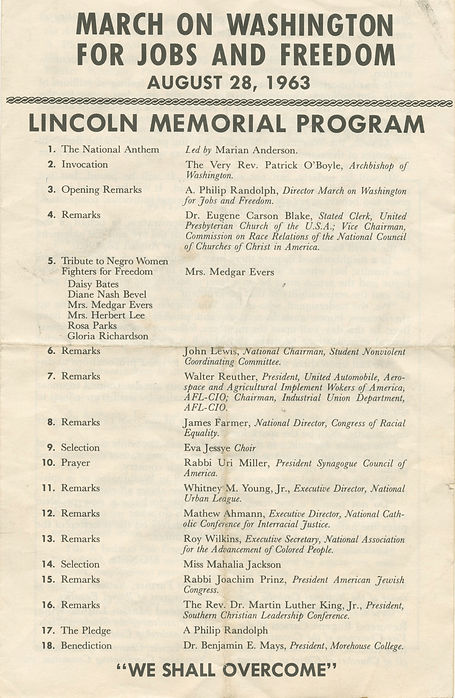
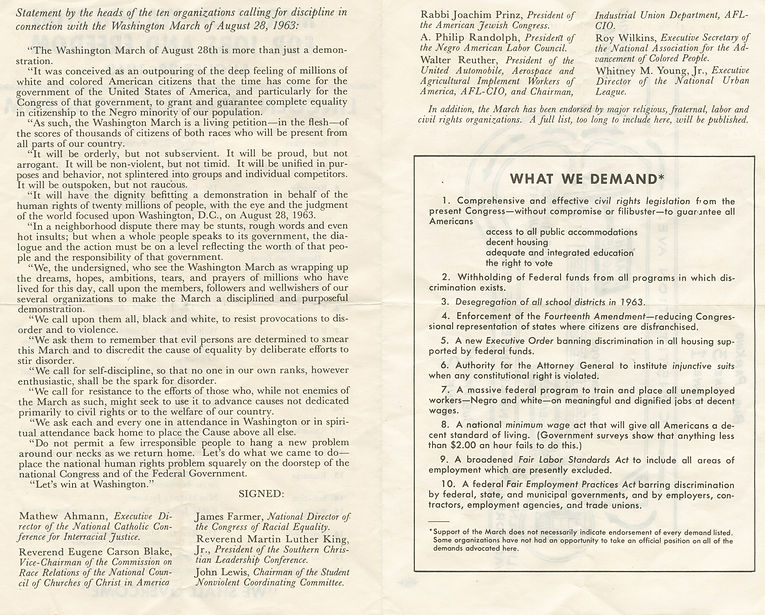

Program from the March on Washington
for Jobs and Freedom
The Lincoln Memorial
Smithsonian National Museum of African American History and Culture
Gift of Samuel Y. Edgerton
The remarkable My Spirituals garnered wide attention and helped to propel Jessye’s rise into the public eye. At twelve inches tall and nine inches wide and featuring musical notations and woodcut illustrations by a visual artist throughout, the slim hardback book could be perched on a piano’s music rack for the songs to be played and sung, so that people could experience the music’s power and beauty for themselves. Jessye also wanted to encourage African Americans to embrace this legacy of their enslaved ancestors’ faith with pride.
Jessye’s was not the only collection of spirituals by Black authors available by 1927. The book joined other collections of spirituals by African American composers and authors, including the brothers James Weldon Johnson and J. Rosamond Johnson, who in 1900 had composed “Lift Every Voice and Sing,” soon known as the Negro National Anthem, and published The Book of American Negro Spirituals in 1925. Offering arrangements of sixty spirituals, plus a fifty-page preface with historical, musicological, and literary analysis of the genre, the Johnsons’ book also aimed to highlight the dignity and spiritual depth of the religious music of enslaved Africans in America.
But the genius and power of My Spirituals stem from Jessye’s decision to locate the book in the world of the Black community of her hometown of Coffeyville, Kansas. In the two-page preface to her much smaller volume, Jessye declared that she did not plan to spend time discussing “the why, wherefore, and significance of this priceless heritage of song” because other works had done so. Instead, she crafted stories to accompany her spirituals, to demonstrate the enduring cultural value of this “priceless” music. “They are the songs of my childhood and of my own people,” she wrote. “I have sung them all my life.”

Coffeyville, Kansas (1896)
Digitization project funded by the
National Historical Publications and Records Commission
Coffeyville, Kansas, had a population of five thousand around the time of Jessye’s birth, about eight hundred of whom were African American. By telling a story for each song, Jessye showed that spirituals offered unique insight into the spirituality of the formerly enslaved and their descendants. Her commitment to this approach stemmed from her experience as the granddaughter of people who had been enslaved, and as a Black woman living most of her life in the era of racial segregation in the United States.
Jessye, nurtured in the cradle of the religious and artistic culture of Black Protestant churches, saw her work as bolstering African American collective identity in slavery’s long wake, working against the racism that marked much of American public discourse about Black people. In the generations after emancipation, African Americans withstood persistent claims that they were unfit for freedom, and that they lacked culture and religion. Both of these claims were mobilized to justify racial segregation, political and social marginalization, and racial violence and terrorism against Black people. Religious community and culture sustained many Black communities in the face of these challenges. Jessye’s work testified to this history.

My Spirituals presents a striking portrait of life in Coffeyville in the first decades of the twentieth century, elevating the lived religion of the African American community of southeast Kansas through story and song. Jessye acknowledged in the book’s preface that readers might question the authenticity of the spirituals she collected and arranged because they did not come from the deep South, the region of the country most associated with slavery and, by extension, with the religious music of the enslaved. However, she noted, the free state of Kansas had been “the nearest refuge of the runaway slave,” aided by the underground railroad that navigated enslaved people to freedom.
After the end of slavery, the state continued to appeal to African Americans as a place where they could make a new start. Jessye writes that “migrants from Tennessee, Kentucky, Texas, Georgia, Arkansas, and Alabama” settled in Coffeyville and created a tight-knit community, anchored by churches—two Baptist, one Methodist, and one African Methodist Episcopal. Jessye’s father’s family had been among these “Exodusters,” migrating to Kansas from Texas in 1879; her mother’s family had moved from Kentucky and Tennessee, settling both in Kansas and in Indian Territory, which would be incorporated into Oklahoma in 1907. Both Kansas and Oklahoma were home to several prosperous Black towns founded by formerly enslaved migrants, including Nicodemus in Kansas and Boley, Langston, Taft, and Tullahassee in Oklahoma. Jessye was a graduate of Langston University, and had taught at schools in Taft and Tullahassee before she moved to Baltimore.

The Elected Town Council
for the all-Black town of Boley, OK (1907)
Oklahoma Historical Society
The world of My Spirituals is populated by the formerly enslaved African Americans who created Coffeyville’s Black community, labored in dignity, supported their families, took joy in play, worshiped in churches, and praised God in song. Each of the sixteen Negro spirituals in the book was associated with a specific person from this community, illustrated in striking woodcuts by Millar of the Roland Company.

“The Singer”
Schomburg Center for Research in Black Culture
Jean Blackwell Hutson Research and
Reference Division, The New York Public Library
Jessye brings the people and place to life, highlighting the harshness and violence of slavery in ways that amplify the sorrow of many of the songs, attaching them to specific historical contexts and people, rather than to abstract religious sentiment.
For example, Sister Fannie Watts, whom Jessye describes as a sweet and noble woman, impressed her as a child “as the personification of Christian piety and humility.” Jesse informed her readers that Sister Fannie had suffered greatly during a childhood enslaved in Saint Augustine, Texas. “The indignities heaped upon her girlish shoulders during slavery left wounds that were never healed and to hear her doleful singing of ‘I Been ‘Buked' was to be haunted for days by the pity of it all.”
I been ‘buked an’ I been scorned
I been ‘buked an’ I been scorned
Chillun, I been ‘buked an’ I been scorned
I’s had a hard time, sho’s you born.
In Macedonia Baptist, Sister Fannie served as “the preacher’s right hand helper in the Amen corner,” and her faith buoyed the community as she called on them to “testify to the glory of her Almighty God.” With this portrait and arrangement of the spiritual, Jessye shows readers how faith supported Black people in slavery and points to the role of religious community in forging freedom. This is perhaps the most familiar of the Spirituals that Jessye arranged. Alvin Ailey choreographed an ensemble dance to it as part of his famed Revelations, which premiered in 1960, and Mahalia Jackson sang a version of “I’ve been Buked” at the 1963 March on Washington. (Although the lyrics are somewhat different from more common renderings, the song has appeared in many other significant contexts in African American cultural history.)
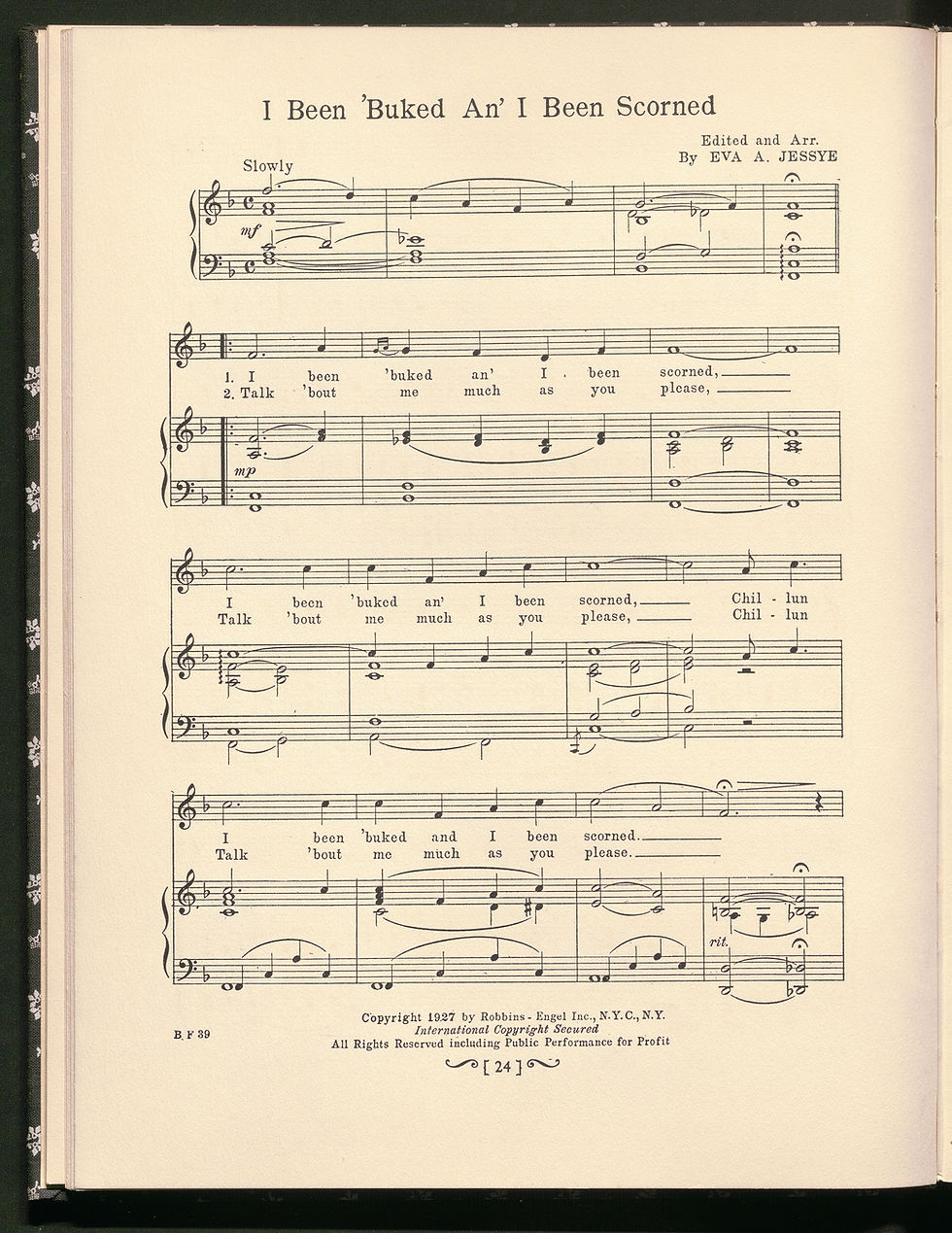
Sheet music titled "I Been ’Buked An’ I Been Scorned," edited and arranged by Eva A. Jessye. The page shows musical notation with lyrics beneath the melody. Copyright information at the bottom indicates 1927 by Robbins-Engel Inc., with page number 24.

Sheet music titled "I Been ’Buked An’ I Been Scorned," edited and arranged by Eva A. Jessye. The page shows musical notation with lyrics beneath the melody. Copyright information at the bottom indicates 1927 by Robbins-Engel Inc., with page number 24.
from My Spirituals by Eva Jessye, pp. 24-25
illustrated by Millar of the Roland Company
edited by Gordon Whyte and Hugo Frey
Other Coffeyville elders who experienced the oppression of slavery appear in the pages of My Spirituals and bring the songs to life. “Aunt” Betty James, enslaved for almost twenty years in Tennessee and living with a physical disability, engaged the world from her porch, from which she conversed with neighbors, sang along with the services at nearby Macedonia Baptist Church, rejoiced at weddings, and mourned at funerals. Despite the disability that kept James from physically joining the life of the community, Jessye reported that “her disposition remained sweet in spite of her painful condition.” My Spirituals features a funeral song that Jessye says James “delighted in singing, never seeming at all depressed by the tragic fatality of the sentiment.”
Down to the grave yard we must go
To see dem long graves, see dem short,
De dust begin to roll!
De coffin sound’
Friens’ an’ relations standin’ ‘round.
This funeral song also recalled the connections many enslaved Africans in America drew between slavery in the US and the experiences of the biblical Israelites in bondage in Egypt, with lyrics that declared:
I can’t stay away,
Oh I can’t stay away, Lord,
I can’t stay away,
I ain’t a gonna die in a Egypt lan!
The portrait Jessye offered in My Spirituals of her maternal uncle Holliday Buckner similarly noted the combination of hardship in thirty-six years of enslavement in Kentucky and the powerful resources of “a boundless faith in an all-wise Providence,” which helped him not to dwell on “troubles and vexations.”

“When Moses Smote de Water”
Schomburg Center for Research in Black Culture
Jean Blackwell Hutson Research and
Reference Division, The New York Public Library
As a young girl Jessye heard him whistling “When Moses Smote de Water” and decided to learn it. Like so many Negro spirituals, this one featured the figure of Moses facilitating the exodus of the Israelites from bondage by parting the Red Sea:
When Moses smote de water
De chillun all crossed over.
When Moses smote de water
The sea give away.
The singer of the spiritual also expresses faith in Jesus as the captain of a ship sailing a rough sea and, combined with the Exodus story, illustrates the depth of her uncle’s faith.
In Jessye’s rendering, Coffeyville’s Black churches, especially Macedonian Baptist, to which her family belonged, anchored community life. Her aunt Lizzie, uncle Holliday’s wife, who had also been enslaved in Kentucky, was one member of what Jessye called “the triumvirate of the Baptist Church in which all three were charter members.” Sister Fannie Watts and Aunt Charlotte Elias were the other two members, Elias having migrated to Kansas from Texas where she had likely been enslaved. Jessye described the three as “typical devotees of the old order [who] considered it a sacred obligation omitted if they failed to shout when the preacher delivered a stirring sermon.” Accompanying their supportive exclamations would be the “rhythmic shout” titled “Tall Angel at the Bar,” in which singers encouraged congregants in their faith. Jessye presents the lyrics she heard growing up, but alternate versions existed, including one recorded in 1960 by Texas-born Mance Liscomb that gives a sense of what Jessye describes as “the swing and monotonous recurrence of phrases.”
Tall angel! Tall angel at the bar,
Tall angel! Tall angel at the bar.
Doan you want to go to Heaven?
Tall angel at the bar.
Doan you want to go to Heaven?
Tall angel at the bar.

“Tall Angel at the Bar”
Schomburg Center for Research in Black Culture
Jean Blackwell Hutson Research and
Reference Division, The New York Public Library
Aunt Charlotte’s skill at shepherding members of Macedonia Baptist through “repentance at revival meetings” was memorable to Jessye, and she recalled a “protracted” meeting, where she and other children listened to preaching and exhortation “urging the unsaved to come forward to the mourner’s bench.” The preacher impressed upon the children the “uncertainty of life” and a future when their mothers would be gone, reducing them to tears. Charlotte then prayed with them at the mourner’s bench, her ministrations enhanced by the congregation singing, “I’m a po’ li’ orphan in dis worl’. Good Lord, I cannot stay hea by mahse’f.”
For those who underwent conversion, the church community gathered at “the baptizing ground” at the Verdigris River, where the church elders sang songs that “were marvels of intricate phrasing and accents.” Jessye reflected, “regardless of how far from some of the old customs the church might have grown, or how modern the ritual as customarily practiced, at baptismal and revival meetings the hymns sung were the old traditional plaints of the ‘Race.’” In My Spirituals, she offers “March Down To Jerdon,” a baptismal song particular to the region. In 1929, Jessye directed the Four Dusty Travelers, a male vocal quartet, recording the song on Columbia Records.
Oh whar yo’ gwine mourmah,
Oh whar yo’ gwine I say?
Gwine down to de ribber of Jerdon,
For to wash my sins away.
Yes, I’m gwine to march down!
March down yes,
I’m gwine to march down to Jerdon, Hallelujah!

Schomburg Center for Research in Black Culture
Jean Blackwell Hutson Research and
Reference Division, The New York Public Library
Jessye’s portrait of the life of formerly enslaved African Americans in southeast Kansas broadens at moments to engage the significance of Coffeyville’s proximity to Indian Territory. She writes of the custom of Coffeyville residents journeying by wagon each Fall to Indian Territory “in order to provide for the coming winter” by picking cotton. She recalled a lively competition between “the native Territorians and the visiting Kansans” being motivated by song, including Negro spirituals.
Jessye also had personal connections to Indian Territory through her maternal great grandmother Hill, an Afro-Cherokee who lived there and would visit her “Coffeyville crop” of daughter, grandchildren, and great grandchildren unannounced. She recalled her grandmother as she “settled back in her chair, removed the old clay pipe from her lips and in a slow dreamy voice began to weave colorful tales of the Indian country.” Her grandmother sang “rousing songs of the hunt” and demonstrated dances as best she could, given her age. Gran’ma Hill, a Baptist, also sang spirituals with what Jessye described as the “pathetic resignation” of someone of such advanced age. “I’s mighty tired of dis heavy load, I wants to be wid Jesus” she recalled her great-grandmother singing.
The compelling portraits in My Spirituals of the music and religion of Coffeyville’s formerly enslaved elders; and her performances with the Dixie Jubilee Singers and the Eva Jessye Choir she directed on stage, screen, radio, records, and in churches contributed to a growing interest in Negro Spirituals in 1920s American culture. Her collection was reviewed in major Black newspapers, including the New York Amsterdam News and the Pittsburgh Courier, and in periodicals such as the NAACP’s journal, The Crisis, and the National Urban League’s Opportunity magazine. The Courier’s reviewer described Jessye’s text accompanying each song as offering “a delightful story of the country, people, and customs surrounding it, which lends to the spirituals a new color and understanding. As a work of art ‘My Spirituals’ is quite the elegant thing.” White-owned newspapers and periodicals, including The Baltimore Sun, The New York Times, and The Nation also reviewed it, noting that the unusual setting of Coffeyville and the inclusion of less familiar spirituals made the work, in the word of The Nation’s reviewer, “superlatively good.”
Jessye’s musical arrangements received praise alongside reviewers’ admiration for her writing. Black poet Gwendolyn B. Bennett wrote in Opportunity that, “for me there was a keen joy in playing these spirituals over on the piano and humming out the words as I went along. Most of the songs I had never heard before and I was most delighted to find them charged with a wistful beauty that should make them as popular as many of the old favorites.” Prominent singers used her arrangements in their concerts, expanding the influence of Jessye’s work.
The famed singer, actor, and civil rights advocate Paul Robeson wrote to Jessye in 1927 to congratulate her on the publication of My Spirituals, praising the uniqueness of the selections and informing her that he planned to sing her arrangements of two spirituals in his recitals. Robeson saved his personal copy of the book, which is now in Emory University’s Woodruff Library. Well-known composer, singer, and arranger of Negro Spirituals Harry T. Burleigh sent a note to Jessye in 1928 to report that his performance of “March Down to Jerdon,” which had been in his repertoire since the publication of her collection, was a hit with his audience in Detroit.
Throughout her career, Jessye held fast to the religious and artistic culture she had inherited and that had shaped her. Along with other proponents of the art of the Negro spiritual, she promoted it as the unique product of Black experience in America, as an American gift to the world, and as an example of universal spiritual expression. In 1926 she told the Pittsburgh Post-Gazette that “the real Negro songs possess an amazing sense of rhythm, harmony, and melody. They are a type of music which delights the senses and at the same time appeals to the intelligence.” She described the lyrics as “elemental,” highlighting a simplicity she believed contributed to the spirituals’ greatness. Jessye attributed the growing popularity of Negro spirituals among a range of Americans in this period to the high caliber of African American performers, as well as to “the very human quality” of the songs “that is wonderfully appealing to the heart of every listener.”
The following year, in a review of several concert performances by Black singers, Jessye noted “the growing importance and popularity of Negro impression, whether in word or song,” which she saw as signaling that “the world is accepting the many gifts offered” by African Americans. For Jessye and other Black culture workers in this period, insisting on the merit of spirituals contributed to African Americans’ resources to withstand the violence and oppression of life in Jim Crow America. In this context, the responsiveness of Americans from a range of backgrounds to the Negro spirituals, and to Jessye’s My Spirituals in particular, buoyed her to continue to promote this music, especially the distinctive songs that she learned in her childhood in Coffeyville.
SOURCES & FURTHER READINGS
Header image: “Eva Jessye.” Author and arranger of My Spirituals (c1923). Pittsburg State University, Axe Library, Special Collections. Author photo credit: Denise Applewhite SOURCES AND FURTHER READING: Fisher, Donald Black. “The Life and Work of Eva Jessye and Her Contributions to American Music.” PhD diss., University of Michigan, 1986. Jessye, Eva A. My Spirituals, illustrated by Millar of the Roland Company, edited by Gordon Whyte and Hugo Frey. Robbins-Engel Corporation, 1927. Johnson, James Weldon, and J. Rosamond Johnson. The Book of American Negro Spirituals. Viking Press, 1925. Painter, Nell Irvin. Exodusters: Black Migration to Kansas After Reconstruction. Knopf, 1977. Weisenfeld, Judith “‘Truths that Liberate the Soul’: Eva Jessye and the Politics of Religious Performance.” In Women and Religion in the African Diaspora: Knowledge, Power, and Performance, edited by R. Marie Griffith and Barbara Dianne Savage, 222–44. Johns Hopkins University Press, 2006.
is Agate Brown and George L. Collord Professor of Religion at Princeton University. A scholar of African American religious history, her books include New World A-Coming: Black Religion and Racial Identity during the Great Migration (New York University Press, 2016), which won the 2017 Albert J. Raboteau Prize for the Best Book in Africana Religions, Hollywood Be Thy Name: African American Religion in American Film, 1929–1949 (University of California Press, 2007), and African American Women and Christian Activism: New York’s Black YWCA, 1905–1945 (Harvard University Press, 1997). Her latest book, Black Religion in the Madhouse: Race and Psychiatry in Slavery’s Wake, was published by New York University Press in April 2025. She currently directs The Crossroads Project: Black Religious Histories, Communities, and Cultures, which is supported by a grant from the Henry Luce Foundation.
