(2026)
BELIEF ON THE BAYOU

A square block of Synott Road in Houston, recently renamed "Union Corridor," is home to a Vietnamese Buddhist monastery, a masjid, a Hindu Temple, a Syriac Orthodox Church, a Baptist Church, and more. Ken Chitwood visits this dense religious landscape and reflects on what the future of American pluralism might look like.
Synott Road does not immediately feel like American religion’s next frontier.
As you drive down the lengthy, high-density connector, passing strip malls and subdivisions in Houston’s southwestern sprawl, you may just miss it. But if you slow down, a vision of our nation’s potential futures comes into focus. Here, on a roughly 0.7-mile stretch of road where the Houston suburb of Alief meets the neighboring city of Sugar Land, the vast, blue sky fractures into domes, minarets, steeples, and monumental statues.
The heat rises from the pavement in wavering sheets, and the sound of mufflers hums past in constant secession as the air carries a peculiar braid of petrol, incense, cut grass, and frying oil from a nearby pupusería. A white steeple gives way to a towering bronze effigy, a crescent flashes above a low stucco façade, reflecting the Texas sun, and what looks like a storage facility stands in for the riot of carved figures that might otherwise climb the face of a Hindu temple. Sneakers and flip flops pile at one doorway, pickup trucks in front of another, a woman in a sari passes a man in a Texans jersey on the way into a temple.

BAPS Shri Swaminarayan Mandir
Hindu temple
photograph by the author
This is the “Union Corridor” in Fort Bend County, where less than a mile of otherwise ordinary road has become a seemingly accidental atlas of contemporary US religion—mosque, mandir, church, monastery, temple—each within a turn signal of the next.
To move along it is to feel the country reorganizing itself in real time. Houston, once shorthand for the evangelical South, home of Joel Osteen’s stadium-sized megachurch and capital of the Protestant Sunbelt, now reads like a weird and wonderful ledger of arrivals, adaptations, and rearrangements in one of the country’s most diverse metro areas.
Here are faiths multiplying, languages layering, rituals keeping time on overlapping clocks. The effect is less melting pot than polyrhythmic dance, a choreography of difference, practiced daily—block by block, congregation by congregation—where American religion is not disappearing so much as stepping into its next, vividly plural evolution.

At the national level, American religion has undergone significant transformation over the past decade, most notably in the decline of Christian identification and the rise of the religiously unaffiliated.
According to the Pew Research Center, the share of Christians has fallen from 78% in 2007 to about 62% today, though the US remains the country with the highest number of Christians in the world. Concurrently, the number of “nones”—those who do not identify with any particular religious group—has grown to roughly 29%. Other surveys, including those from Public Religion Research Institute and Gallup, show similar patterns.
This national transformation is reflected, and in some ways amplified, in Houston. Data from the Kinder Institute for Urban Research shows the share of religiously unaffiliated Houstonians has climbed from about 10% in the late twentieth century to 27% in 2024, with organizations like Houston Oasis—a secular, non-religious community that meets weekly on Sunday mornings for live music, educational talks, and social interaction—providing alternatives to Sunday mornings at one of Houston’s many megachurches.
Meanwhile, Protestant affiliation has dropped from 63% in 1982 to 38% today, while Catholics remain relatively stable at 26%, though below earlier peaks. Religious participation has also declined overall, with fewer than half of residents reporting recent attendance at services. Even as institutional participation declines, belief in God or a higher power remains widespread, and most of the drop-off has been among Christians, signaling a rebalancing of belief in the Bayou City.
That shift has come with a concomitant increase in the number of Muslims, Hindus, and Buddhists, driven largely by immigration and generational change. Immigrants make up almost a quarter of the city’s nine-county metropolitan population—significantly higher than proportions in Texas (17%) and the US overall (13.6%). Almost all of the population increase in Harris County, of which Houston is the seat, has been fueled by international immigration.
In other words, immigrants have reshaped the region’s religious identity, producing a landscape defined less by uniform belonging than by pluralism and fluid affiliation, so that rapidly growing Muslim, Hindu, Sikh, and Buddhist communities now exist alongside long-standing Black Protestant, Latinx Catholic, and white evangelical traditions.

This makes “Houston one of the most racially and ethnically diverse metro areas in the US,” sociologist Michael Emerson of Rice University’s Baker Institute for Public Policy told me.
Immigration has transformed what Emerson once described as a “Bible Belt mega city” dominated by Baptists and Methodists into a far more complex religious ecosystem that includes large Hindu, Muslim, Buddhist, Jewish, and various Christian communities.
That diversity is also tied to Houston’s urban infrastructures and economic forces. As the largest US city without formal zoning, Emerson explained, it “opens up possibilities that other places don’t,” allowing religious institutions to emerge side by side in highly localized ways, sometimes forming what he describes as spontaneous “worship corridors” like that along Synott Road. In other parts of the city, the concentration may not be as acute, but the cumulative effect remains the same, with new religious communities moving into neighborhoods across the metroplex.
Unconstrained by zoning codes, the effective regulations in the “market city,” and its moderate levels of taxation focused on growth, provide the “freedom to start things,” Emerson said. Religious innovation has flourished in Houston in both immigrant congregations and megachurches like Lakewood. “The largeness of these places, the impressiveness of the buildings and programs, shows just how much moral entrepreneurship thrives here,” Emerson said, even as overall attendance patterns have softened.
Sana Patel, Assistant Director of Religious Diversity and Pluralism at Rice, underscored the role economic opportunity has played in drawing immigrant communities to the area, immigrants who then establish lasting religious institutions. “Texas provides many economic opportunities for professionals in various fields,” she said, “but specifically for those in the oil and gas and healthcare industries.”
To her point, the Texas Medical Center in Houston is one of the largest medical complexes in the world. Described as a “medical mini-city,” the center employs over 120,000 people and has a gross domestic product of $25 billion, making it a small-to-mid-sized economy unto itself. Houston is likewise regarded as the energy capital of the world. Home to more than 4,700 energy-related firms (including 550 renewable energy companies), it is the headquarters for BP America, Shell USA, Chevron, ConocoPhillips, and Occidental Petroleum. Together, Houston-area companies control 15.3% of total US oil-refining capacity and more than 50% of its natural gas pipeline capacity.
Patel said most of the city’s South Asian migrants came to Houston in the 1980s and 1990s in search of employment in such fields, and over time, their presence contributed to the development of multigenerational communities that have shaped Houston’s religious and cultural landscape.
For example, the Islamic Society of Greater Houston (ISGH), established in 1969, is one of North America’s largest Islamic organizations, serving approximately 200,000–250,000 Muslims across the metro area. It operates 22 locations, manages a dedicated Muslim cemetery, and provides a range of social services, including employment help, health centers, financial aid to over 800 families monthly, and five full-time, accredited Islamic schools serving over 1,000 students from pre-K through high school.

Before ISGH’s establishment, Patel said, Muslims got together to pray at various places across Houston, including at its well-known Rothko Chapel. Indeed, if Synott Road offers a glimpse of what religious pluralism looks like in the form of heterogeneous/ improvisational street festival, Rothko Chapel presents a concrete vision of what it might look like in contemplative unity.
Founded in 1971 by philanthropists John and Dominique de Menil, the project emerged from the moral and theological reckonings that followed World War II and the Holocaust. Also inspired by the reforms of the Second Vatican Council, the de Menils wanted to create a place where people could encounter the sacred without being told exactly how to understand it: a space for quiet, honest, and shared reflection across differences. Set in Houston’s lively Montrose neighborhood, surrounded by a park where local students can be found slack-lining or tripping and discussing everything from politics and spirituality to the shape of the clouds in the sky, the building itself is deliberately understated—an octagonal brick structure with no religious symbols outside, surrounded by oak trees and a quiet reflecting pool anchored by Barnett Newman’s “Broken Obelisk,” a monument dedicated to Martin Luther King Jr.
Inside, the space opens into a meditative interior where 14 large-scale paintings by Mark Rothko line the walls in deep shades of black, maroon, and violet. Simple wooden benches take the place of pews, and natural illumination filters in from a central skylight, shifting subtly throughout the day and changing how the paintings are perceived.
Conceived as an interfaith sanctuary, the chapel brought together a pair of Catholic patrons and a Jewish artist to create a space where art, contemplation, and social justice converge, embodying the de Menils’ vision of a sacred space without doctrinal boundaries.
And if Rothko is a cypher for Houston’s religious communities coming together, and Houston an exemplar of the possibilities and perils of the American experiment writ large, few figures articulate these matters more distinctly than Abdullah Antepli, the chapel’s newest president.

Antepli’s own journey mirrors the complexity of the city he now calls home. Born in southeast Türkiye and raised in a largely secular environment, he describes his early turn to Islam as a kind of teenage rebellion. That decision, along with adopting the name Abdullah, meaning “servant of God,” began what he calls a lifelong “love affair” with religion. Yet even as he immersed himself in Islamic studies, he resisted institutional constraints, uneasy with state control of religion in Türkiye. His path eventually led him through humanitarian work in Southeast Asia, graduate study in the US, and a hybrid vocation that blended scholarship with pastoral engagement at Duke University—earning him the nickname “the Blue Devil imam” in playful reference to the school’s mascot.
What drew Antepli to the US, he said, was not just opportunity but a distinctive model of religious freedom. Unlike with more rigid forms of secularism such as French laïcité and Kemalist laiklik (historical Turkish secularism), which seek to legislate, remove, control, or modernize religion from the top down, Antepli said, the American system “trusts society… to do religion on its own,” allowing faith to flourish without direct government control. That openness, he argues, creates space for experimentation, particularly for communities like American Muslims. “It is an experiment,” he said, one that asks which elements of tradition endure and which must adapt. “This is what I love about the US, we can do that here.”
Variety alone, he cautioned, is not enough. “Human history shows that diversity does not automatically produce positive pluralism.” People may live side by side, but without intentional effort, “that does not mean they will get along or build something together.”
In that sense, the Rothko Chapel stands as both symbol and intervention. It is a space, Antepli said, dedicated to “radical pluralism”—deeply rooted in particular faith traditions, yet “immensely curious” about others. It seeks to do what Emerson and Patel describe at the citywide level, to turn proximity into understanding, and multiplicity into cooperation. But Antepli is more pointed about the stakes. Houston, he argues, often celebrates its diversity in ways that are “well-meaning, but empty”—a surface-level achievement that masks deeper tensions.
The task, then, is unfinished. “We have to turn diversity into pluralism,” Antepli insisted, a process that requires institutions capable of cultivating empathy, resilience, and moral imagination. He envisions the Rothko Chapel not as an alternative to religion, but as a space where religious and nonreligious people alike can grapple with shared questions of meaning and responsibility. “We invite people to take religion seriously,” he said.
For Antepli, Houston’s story remains open-ended, much like the American experiment itself. The nation’s expanding heterogeneity, religious and otherwise, has enlarged the meaning of “We the People,” but history offers no guarantees about where that evolution leads. “It is in our hands,” he said, framing the present moment as one of both danger and possibility, not unlike earlier periods of global upheaval or US history. The choice, he suggested, is whether to retreat into fear or to build a more expansive pluralism.
In that sense, the quiet, contemplative space of the Rothko Chapel is not removed from Houston’s bustling diversity, but an attempt to shape what that diversity becomes.

Antepli said Houston’s religious dynamism also carries real dangers, particularly as its burgeoning diversity collides with state politics and the city’s ongoing, almost unchecked, growth. In such places, “diversity and bigotry live next door to each other,” he said.
As Stephen Klineberg observed in Prophetic City: Houston on the Cusp of a Changing America, religious conservatives increasingly shape Texas politics, pushing restrictions on abortion, immigration, voting rights, and religious freedom, even as the Houston area remains far more diverse and often more moderate, even decidedly liberal, in its politics.
In recent years, that agenda has extended to rhetoric and policymaking that disproportionately target Muslim communities, whether through efforts to limit refugee resettlement, heightened scrutiny of mosques and Islamic institutions, or legislative proposals framed around banning the influence of “foreign law,” widely understood as coded references to Sharia. Political campaigns and public statements have, at times, amplified fears of demographic and cultural change, casting suspicion on Muslim civic participation and reinforcing broader anxieties about immigration.
Representative Chip Roy (R-Texas), for example, who exerts significant influence over statewide Republican rhetoric, has repeatedly framed Islam as a civilizational and political threat, warning of the “Islamification of Texas.” According to reporting by Anna Liss-Roy for The Washington Post, Roy has posted about Muslims, Islam, or “Sharia” more than 244 times across his 2026 campaign for Texas Attorney General and official accounts since January, more than any other member of Congress. The combined result is a growing dissonance between the lived reality of Houston’s plurality and a state-level political climate that, for many residents, feels increasingly exclusionary.
That divide surfaces in local flashpoints, particularly on Houston’s outskirts. In suburban Katy, for example, opposition to a proposed mosque—MAS Katy Center (or Masjid Al-Rahman)—in 2006 and 2007 escalated into anti-Muslim protest theatrics when local resident Craig Baker began to host pig races immediately next to the construction site where Muslims would pull into park before Friday prayers.
In other corners of the metro area, more organized forms of Christian nationalism have taken root, said Emerson. Churches such as Grace Woodlands and affiliated initiatives like FORGE pastoral training, along with networks such as Citizens Defending Freedom, reflect a growing effort to shape civic life, education, and local governance around a particular vision of Christian identity and to “raise up candidates to run for office” and “shape the nation.” Back in Katy, its independent school district recently removed dozens of books from circulation, a move driven by trustees aligned with a network of Christian nationalist advocacy groups, making the bedroom community a focal point in broader culture war disputes.
Critics argue that these movements risk hardening divisions in Houston, especially in its less diverse suburbs, where fears about religious and cultural change can be more politically potent.
Even Houston’s hallmark lack of zoning has faced pushback. In nearby Stafford, in Fort Bend County, officials moved to limit new religious buildings in 2006 after a surge of construction strained tax revenues and limited the city’s abilities to plan more tax-producing residential and business properties. It was a rare move toward regulation in a region normally defined by flexibility. At the time, Stafford had 51 religious institutions—for Buddhists, Muslims, Hindus, Chinese Baptists, Filipino Baptists, Spanish-speaking Baptists, and almost “every other variety of Christian you can imagine”—packed into its 7 square miles and for a population of some 17,000.
These examples underscore a critical anxiety coursing through Houston’s religious topography, and perhaps a portent of what is to come for the nation as a whole. The same entrepreneurial openness that fuels the city also creates space for backlash, boundary-drawing, and competing visions of the community’s potential futures.

Along the Union Corridor, meanwhile, global histories of migration and displacement continue to take physical form on a single stretch of suburban land, despite opposition or obstacle.
Taking advantage of cheap parcels of property and a lack of zoning laws, Synott Road is where numerous religious communities have built their spiritual homes within close proximity to one another in recent decades. Just north of Keagan’s Bayou lies a Cao Dai Temple, and just a bit further south, the Vietnamese Buddhist Center (VNBC), which is next door to the Shree Swaminarayan Hindu Temple, which is next door to Sri Ashtalakshmi Temple. Across the street are two more Hindu temples, including an outpost of the Chinmaya mission, which shares a property line with Masjid At-Taqwa, where South Asian, Latinx, and Arab families mill around outside after Friday prayers. Further down is a West African apostolic Pentecostal congregation, and around the block in one direction is St. Mary's Malankara Orthodox Syrian Church and in the other Our Lady of Guadalupe store, which sells a range of Catholic devotional paraphernalia.
This is only a glimpse of the some 12 churches, 13 temples, 2 mosques, and other religious centers packed into the two square miles around Synott Road—not to mention the hundreds more places of worship stretched across the dense corridor between the Westpark Tollway to the north and Interstate 69 to the south, from the nation’s only Latinx-focused masjid, Centro Islámico, to Sugar Land’s Chinese Baptist Church.
“Given that many religious institutions in the Union Corridor are in the same neighborhood and on the same street, they are an example of how commitments to the common good are good for social welfare and community well-being,” said Patel. “[February 2026] was a special month for many Houstonians, as the beginnings of Ramadan, Lent, and the Lunar New Year fell on the same day,” she said. “Such days are special opportunities for people to celebrate their own religious traditions while also acknowledging and appreciating those of their neighbors and peers, with celebrations taking place all over the city in (non)religious institutions and neighborhoods.”
It was also an opportunity to share parking lots along Synott Road, with Pentecostals providing space for Muslims up the road, Buddhists offering spots for their Hindu neighbors, and the mosque making room when the Buddhists held their annual festivals.
The Venerable Tri Tanh, a 43-year-old monk at the VNBC, which unfolds across a carefully tended landscape of shrines, gardens, and winding paths, said that when the road gets busy with festivals and celebrations, different institutions will free up parking spots and even offer to shuttle members of other communities up and down the bustling thoroughfare.

But today, the garden is quiet, with just a few out-of-town visitors walking the carefully manicured grounds. A lotus pond anchors the property, blooming each spring as a symbol of renewal and continuity, while prayer halls and meditation spaces sit quietly among trees and open courtyards. Rising above the complex is a towering, 72-foot, milk-white statue of Quan Âm, the bodhisattva of compassion—among the tallest statues in Texas—facing outward in a gesture of protection and mercy. Just beyond the property line stands an even larger 90-foot panchaloha statue of the Hindu deity Hanuman, the tallest statue in Texas and the US’s fourth largest.


Hanuman
Statue of the Hindu deity Hanuman
photographs by the author
The so-called “Statue of Union” is yet another new neighbor in Houston’s densely layered religious geography. Unveiled in 2024 on the grounds of the Sri Ashtalakshmi Temple, the beaming bronze statue is meant to act as a “spiritual epicenter” and a symbol of both strength and selfless service. But while US Hindus celebrated its installation, and the monks next door welcomed a new neighbor for Quan Âm, others were not so accommodating.
Christian groups gathered outside the temple to pray in protest, denouncing the statue as idolatrous, at times even describing it as “demonic.” Online, some mocked Hanuman’s appearance, comparing it to the final scene in 1968’s “Planet of the Apes,” threatened possible legal challenges, and framed the monument as out of place in a “Christian country,” questioning whether Hanuman, or immigrants, had anything to “contribute to American society.”
The controversy kept coming when, in September 2025, Texas Republican Senate candidate Alexander Duncan called the statue a “false” God and cited biblical prohibitions against idolatry. Duncan’s campaign failed, but the commentary echoed broader frictions playing out under the shadow of Donald Trump’s second administration and amidst ongoing national debates around religious freedom, immigration, and American belonging.
And yet, Hanuman still stands, as does Quan Âm, a pair of soaring statues that remain silent witnesses to longer histories of displacement and new roots for Houston’s numerous diaspora populations.
For its part, the VNBC’s origins can be traced back to “Boat People” who fled Vietnam by sea after the 1975 fall of Saigon, called out to Quan Âm to protect them on their journey, and eventually arrived in the US. Many of them first gathered in a rented house in Bellaire before gradually forming a permanent institution, the Buddhist Youth Association. Over time, with guidance from senior monastics such as Venerable Thích Nguyên Hạnh, they acquired 10 acres of relatively cheap land along Synott Road in 1990, building what would become the VNBC’s contemporary campus. Later arrivals, including Vietnamese families resettled from New Orleans after Hurricane Katrina, further expanded the community, turning the center into a regional hub for diasporic Buddhist life.

Inside the main hall, rebuilt after a wall collapsed in 2014, Tri Tanh and other monks—including their well-known “Tik Tok Monk,” Vuong Bach, who enjoys 1 million followers online—take pictures with tourists in front of devotional statues and donations of oranges, chocolates, and sticky rice cakes (bánh chưng).
Tri Tanh emphasizes that the center now reaches far beyond its original Vietnamese base. Weekly English meditation services in a building across the central plaza draw 30–40 participants, while mindfulness retreats can bring more than 150 people, including Vietnamese Americans alongside white, Black, Latinx, Indian, and Nepalese attendees. “We want them to know where they come from,” Tri Tanh says of younger Vietnamese Americans, “but also the way of the Buddha—not just stories, but something that has immediate benefit in their lives.” The emphasis on mindfulness, compassion, and everyday well-being places the temple within the civic ecology described by Antepli, Emerson, and Patel, where religion is not only inherited but continually adapted through contact with neighbors, new arrivals, and shared urban space.
For Tri Tanh, this is what makes the temple also part of a larger American story. Framing the center as both an act of gratitude for, and contribution to, the US, he said it represents an offering shaped by refugee resettlement, immigrant labor, and decades of community building.
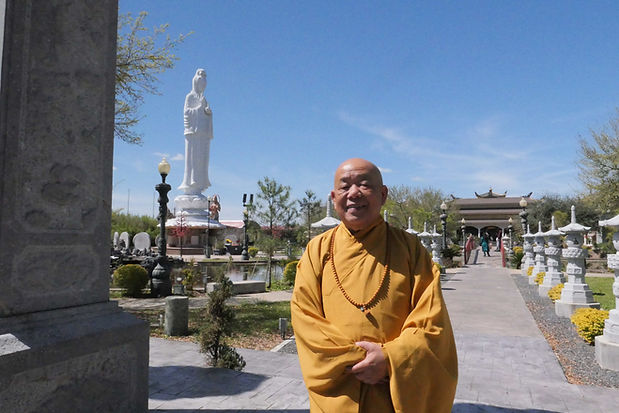
Venerable Thích Nguyên Hạnh and Quan Âm
President of Vietnam Buddhist Center, Venerable Thich Nguyen Dat, posing near the Quan Âm statue
photograph by the author
Standing beneath the Quan Âm statue, with Hanuman gleaming in the background, Tri Tanh says they are symbols of both change and continuity. Looking outward from a diasporic landscape that now defines much of Houston’s religious geography, he said they embody the city’s ongoing development through communities that take root and transform, while still honoring what came before.
Back in Montrose, that story of religious ambition and civic imagination is being recast in a different form at the newly opened Ismaili Center Houston, the first and only such center in the US.
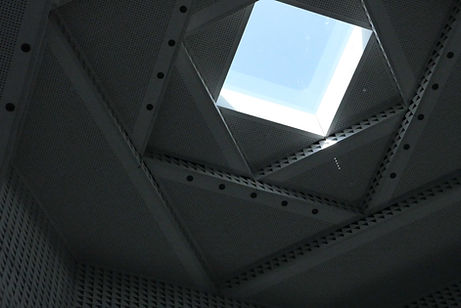
Alongside the vigorous improvisation of Synott Road and the reflective chorus on offer at Rothko, the Ismaili Center is more akin to a concert hall, purpose-built and intentional, presenting pluralism as something to be hosted, curated, and elevated by deliberate design. Backed by the global vision and financial power of the Aga Khan, it creates structured encounters through dialogue, education, civic engagement, and guided tours. Designed as both a sacred space and a public commons, the Ismaili Center brings together a prayer hall, nine gardens, a café, as well as numerous exhibition spaces and performance venues into a single, highly contemporary architectural statement about what religious life can look like in a diverse city.
The building’s low, horizontal profile is anchored by a luminous glass and stone façade, where geometric patterns, drawn from Islamic design traditions such as the mashrabiya, filter the Texas light into bands of shadow that shift with the time of day. Outside, visitors can sit in the shade of a veranda meant to mimic the fluctuating blues of Houston’s skyline, supported by 49 columns—a wink and a nod to Aga Khan IV, the forty-ninth imam of the Ismaili community.

Ismaili Center
photographs by the author
Omar Samji, a local lawyer and volunteer spokesman for the Ismaili Council, said that along with hosting theater productions, festivals, and art shows, the center is also part of a long-term vision for Ismaili Muslims—Shia Muslims with deep ties to Central Asia, East Africa, and South Asia—to engage with and foster connections between faith communities. This, he said, is in line with what he found to be Houston’s reputation as a welcoming city. “When you’re in Texas, in Houston, you find we’re friendly people. You have to be open,” he said.
When Samji relocated in 2012, he said one of the first things he noticed was a sense of connection between curious people of faith. As an Ismaili, he was heartened by Houstonians who knew what they believed and were not afraid to ask questions of others. Jewish, Christian, or Muslim, his neighbors were both inquisitive and respectful, he found.
The Ismaili Center is as much a civic space as a sacred space. A café, exhibition galleries, and performance spaces are meant to extend the building’s purpose beyond worship, inviting visitors of all backgrounds to gather, linger, and encounter one another. The result is not just a religious complex, but an architectural insistence that religion in a diverse city can be at once rooted, open, and unmistakably contemporary.
That impulse is echoed across a city that features a range of religious institutions and buildings designed to make difference visible without making it divisive—including spaces like the Rothko Chapel and Interfaith Ministries of Greater Houston’s Brigitte and Bashar Kalao Plaza of Respect in Midtown. Together, they suggest how Houston is perhaps leaning further into its reputation as a friendly, go-along-to-get-along, frontier of American religious change.
Nevertheless, as Antepli and Emerson suggest, that experiment remains unresolved. Whether in Buddhist temple gardens, Muslim civic centers, megachurches or interfaith plazas, Houston is still negotiating how far diversity can stretch before it becomes a shared framework for living together.
In that sense, Emerson says Houston is not a finished model but a “bellwether”—a glimpse of what America is becoming, or perhaps what it might choose to become. “Houston shows us that as diversity increases, it can work and can happen and can help a place to flourish rather than fail,” he said. “But that’s always been America.”
If people are uncertain, Emerson invites them to visit the Bayou City. “If you want to see what opening yourself up to diversity looks like,” he said, “just look to Houston. And you will see we are doing just fine. More than fine.”
SOURCES & FURTHER READINGS
For more on Houston’s changing demographics in recent decades, see Prophetic City: Houston on the Cusp of a Changing America (Simon & Schuster, 2020) by Stephen L. Klineberg and Rice University’s Kinder Houston Area Survey (2025). For more on national trends, refer to Pew Research Center: Religious Landscape Studies, 2023–2024 (2025) and the Public Religion Research Institute’s American Values Atlas (2025). For more on immigration, its impact on US religion, and the visions of pluralism that animate discussions around diversity and difference, see Religion and the New Immigrants: Continuities and Adaptations in Immigrant Congregations (Bloomsbury Publishing, 2000) by Helen Rose Ebaugh and Janet S. Chafetz, A New Religious America: How a “Christian Country” Has Become the World's Most Religiously Diverse Nation (HarperCollins, 2001) by Diana L. Eck, God Needs No Passport: Immigrants and the Changing American Religious Landscape (The New Press, 2007) by Peggy Leavitt, American Grace: How Religion Divides and Unites Us (Simon and Schuster, 2010) by Robert D. Putnam and David E. Campbell, and Out of Many Faiths: Religious Diversity and the American Promise (Princeton University Press, 2018) by Eboo Patel. For more on some of the traditions and institutions mentioned in the article, specifically as they relate to Houston, see The Black Church in the Post-Civil Rights Era (Orbis Books, reprint 2009) by Anthony B. Pinn, Dixie Dharma: Inside a Buddhist Temple in the American South (Oxford University Press, 2012) by Jeff Wilson, Lone Star Muslims: Transnational Lives and the South Asian Experience in Texas (Oxford University Press, 2014) by Ahmed Afzal, Salvation with a Smile: Joel Osteen, Lakewood Church, and American Christianity (New York University Press, 2015) by Phillip Luke Sinitiere, Latino and Muslim in America: Race, Religion, and the Making of a New Minority (Oxford University Press, 2018) by Harold D. Morales, “Losing Religion and Finding Ecstasy in Houston” (The New Yorker, May 20, 2019) by Jia Tolentino, Rothko Chapel: An Oasis for Reflection (Rizzoli Electa, 2021) by Pamela Smart and Stephen Fox, and “With Islamophobia on the Rise, Houston Becomes Home to First Ismaili Center in the Country” (Texas Observer, December 12, 2025) by Sana Patel. AUTHOR PHOTO CREDIT: Jonathan Christopher
Ken Chitwood
is an award-winning scholar, journalist, and feature writer whose work traces the unexpected intersections of religion, migration, and global culture. He is especially drawn to the everyday, lived textures of belief and how faith travels, adapts, and takes root in unlikely places. Along the way, he’s reported from a Puerto Rican Muslim ninja’s house in Staten Island and Oman’s frankincense farms and mountainside shrines, rode e-scooters through Berlin with missionaries from Eastern Europe and followed the migrant trail with Muslims through Mexico, scaled the sides of Brutalist buildings in Casablanca, Morocco, and abandoned castles outside Tbilisi, Georgia. His writing moves between the street-level and the structural, connecting intimate human stories to the broader forces reshaping religion in a global age. He is a postdoctoral researcher pursuing Habilitation with the Department for the Study of Religion at Universität Bayreuth, an Affiliate Researcher with the University of Southern California’s Center for Religion and Civic Culture, and Editor of ReligionLink, a nonpartisan, monthly newsletter with source guides and story ideas for journalists reporting on religion. His work has appeared or been featured in Foreign Policy, The Los Angeles Times, The Washington Post, The Chicago Tribune, BBC Radio 4, chrismon, NPR, Religion News Service, The Times of India, The Guardian, Christianity Today, The Houston Chronicle, and other publications across the globe.
