(1942)
BUDDHISTS BEHIND BARBED WIRE

Duncan Ryūken Williams shares the story of three objects from World War II-era Japanese internment camps—a photograph of the Buddha and the American flag; a lotus-flower-shaped memorial statue; and the Stone Sutras of Heart Mountain—that reveal the presence, survival, and adaptation of American Buddhism.
When the Japanese Imperial Navy attacked the Pearl Harbor naval base in December 1941, the very first person arrested and interned by the FBI—even before the smoke had cleared or martial law had been declared—was a Buddhist priest. In the days and weeks that followed, hundreds more Buddhist priests and other community leaders, like businessmen and Japanese language teachers, were rounded up.
Buddhism had first been brought by Asian immigrants to the US in the mid-nineteenth century. The survival of the tradition and its practitioners was often a struggle. They fought immigration laws excluding so-called “heathen Asiatics” because of their non-Christian religions and racial difference, naturalization laws denying Asian immigrants pathways to citizenship, and anti-alien land laws making it difficult to build a permanent home in the US.
Nonetheless, by the outbreak of World War II in 1939, Asian American Buddhists practiced their faith and shared their teachings, establishing nearly one thousand temples across the nation. The largest group of Asian Americans were the quarter-million Japanese Americans, the vast majority of whom were Buddhists.
Just like the Chinese before them, who had faced legal exclusion because of their racial and religious identities, this community soon found that in wartime, the US government viewed them as un-American, sometimes even anti-American. Indeed, starting in the 1930s, intelligence agencies had been surveilling Buddhist temples and creating registries of prominent Japanese American community leaders to arrest in the event of war with Japan. Intelligence agencies deemed Buddhist and Shinto priests to be national security threats—but not Japanese Christian pastors.
On the Hawaiian Islands, where martial law had been imposed after Pearl Harbor, Hawaiʻi’s new military government closed down Buddhist temples and Shinto shrines, and actively encouraged Japanese Americans to attend Christian churches instead as a way to show their loyalty to America. As justification, the government claimed that in a national emergency, certain constitutional rights would have to be temporarily suspended, including, apparently, the free exercise of religion.
On the mainland, where martial law had not been declared, Japanese Americans hoped that their constitutional rights would be upheld. But two months later, President Roosevelt issued Executive Order 9066, which authorized the US military to designate areas as “military zones” from which “any or all persons” could be removed. It created such an exclusion zone on the West Coast, from which the US Army forcibly removed anyone with even a single drop of Japanese blood.
Buddhist leaders were among the first people placed into the internment camps that opened up across the nation. But all Japanese Americans, from small babies to infirm grandmothers, were soon imprisoned there as well. They were treated as categories, rather than as individuals worthy of due process rights, even though two-thirds of them were US citizens. The government conflated the entire community with the enemy and embarked on a process of forced removal, family separation, incarceration, and deportation. Nor did this prejudice evaporate quickly: It would take many decades for the injustice of the wartime Japanese American incarceration to be officially recognized by Congress with the passage of the Civil Liberties Act of 1988, signed into law by President Ronald Reagan, that provided for a formal letter of apology and a modest financial reparations check.
It would have seemed natural, under these circumstances, for Japanese Americans to drift away from their Buddhist religion, which had been part of the reason they were singled out as enemies of the US. Instead, something surprising happened in the Japanese internment and concentration camps of World War II: Buddhism not only survived, it adapted and expanded. Through Buddhist traditions, Japanese Americans actively asserted that their religion was not only compatible with American ideals, but that it could serve as a reminder to all Americans of the principles of religious freedom and equal justice under the law.

Buddhist Funeral during WWII
at the Manzanar Incarceration Camp
Nagatomi Collection
Manzanar National Historic Site
Executive Order 9066 gave Japanese Americans in the West Coast “exclusion zone” between a week and ten days to leave their homes, take only what they could carry, and report to a civil control station. From there, they would be transported to confinement sites in destinations unknown and for a time indefinite. These first stops were usually at makeshift facilities, euphemistically known as Assembly Centers, which in many cases had been hastily built on local county fairgrounds or racetracks; one’s new home was a livestock enclosure or a horse stable.
Upon entering the Assembly Center, military personnel searched one’s luggage, typically a single suitcase. They would confiscate not only items that might be typically considered contraband, such as weapons or cameras, but also materials written in the Japanese language, such as Buddhist sutra books or collections of haiku poems. These were considered dangerous. The only exception to this rule were bilingual Japanese-English dictionaries and Japanese-language Bibles and hymnals. The message received by those entering these camps was that the government only found it acceptable to have Japanese-language materials only if you needed it to study English or practice Christianity. The government here presumed America to be essentially a White, English-speaking, and Christian nation.
The majority-Buddhist community entering the camps knew this. Yet, not everyone acquiesced to this notion of American belonging and loyalty. For example, Rev. Tansai Terakawa, who had served Portland’s largest Buddhist temple before the war, made great efforts to transform the dirty, unfurnished, manure-smelling stall his family had been assigned. They hung a photo of a Buddha statue, a scroll of Japanese calligraphy, and an American flag on the wall, a clear assertion that they believed in America’s ideals of religious freedom, and believed that they could be both Buddhist and American at the same time.
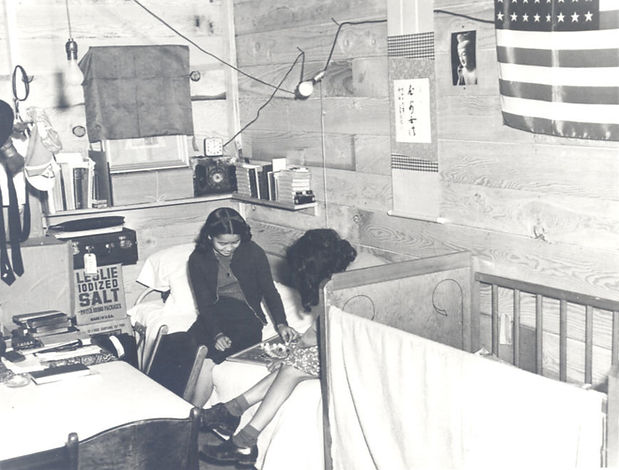
American flag & Buddha photo
Displayed in barracks at the Portland Livestock Exposition Building. Shown are Rev. Tansai Terakawa’s daughter Hiroko and friend Lilian Hayashi. (31 May 1942)
Courtesy of the Oregon Journal Collection
Oregon Historical Society
ORHI-28163
In these initial months of dislocation, Japanese American Buddhists were denied the opportunity to bring their sacred texts into the camps. When the historical Buddha passed away, his disciples continued to feel his presence through his teachings, called the Dharma. The Dharma were compiled into authoritative texts called sutras, which were initially transmitted through oral traditions before being produced in written form. In the camps, to access the teachings of their faith, Buddhists had to reproduce those sutras from memory.
One unique Buddhist scripture recreated in this context was a sutra written onto stones and buried in the cemetery area of the Heart Mountain concentration camp in Wyoming. This stone sutra was accidentally uncovered in 1956 when Bill Higgins, a heavy equipment operator with the Bureau of Reclamation, hit something hard just below the surface with his road grader. Though he had been told that the Japanese Americans buried at the camp cemetery had been transferred to the local town cemetery, or to the west coast, Higgins’s first worry was that he had disturbed a casket. To his relief, he instead found a large metal drum filled with hundreds of small stones.

Onto each one was transcribed a single kanji character from the classical text, the Lotus Sutra. This “stone sutra” is thought to have been produced by Rev. Nichikan Murakita, who had served a temple in Los Angeles prior to the war, and taught a popular calligraphy class in the camp, either as a private act of devotion or as a communal effort, with fellow devotees and students.
Today, scholars posit that the devotional act of copying scripture was likely inspired by the medieval Japanese custom of creating sutra burial mounds, wherein scriptures were copied and buried in anticipation of the coming of the future Buddha. In addition to the practical need to reproduce the Buddhist teachings using what was available, the use of stones, likely collected from the shores of the Shoshone River that abutted the camp, also indicated a prayer for a future America, when Buddhism could be openly and freely practiced.
Buddhist scriptural teachings were certainly shared in the “barrack churches” in the camps to give some perspective on loss and displacement and deal with difficult karmic circumstances. One of the key teachings that many Buddhists reminded themselves of was the well-known metaphor of a lotus flower rising above the muddy water found in various scriptures, including the buried Lotus Sutra.
The lotus flower symbolizes the awakening and liberation of the Buddha that grows up and out of the muddy waters, which represents the world of suffering. A Buddhist priest arrested in Hawaiʻi, Rev. Kyokujo Kubokawa, spoke of this teaching at a Buddha’s birthday ceremony he officiated in a mainland internment camp. Since the Pearl Harbor attack took place on a Sunday morning, Kubokawa had been taken into custody whilst in his Buddhist robes. He hadn’t been allowed to return home, so four months later, he was still wearing the same robes to officiate the ceremony. Another priest recalled that he had only a single pair of underwear, a pair of pants he’d been unable to wash, and a belt made of rope.
And so Kubokawa reminded them that their filthy clothes could be likened to the world of the mud, but that the purity of their minds in maintaining their Buddhist practices was akin to the lotus flower rising above the mud. The deeper teaching of his sermon was that lotus flowers cannot grow well in pure or sterile water, that they need the nutrients in the mud to grow tall and emerge from the pond waters for us to see. No mud, no lotus.
Residents of the Rohwer concentration camp in Arkansas secretly cut sections of the barbed wire fence surrounding the camp and used them to provide structural integrity to an eighteen-foot-tall Ireihi [Spirit Consoling] monument, which remains intact today.
This monument was conceived of by Buddhist priest Rev. Daitetsu Hayashima, who served a temple in Los Angeles before the war. Similarly-named Irei monuments were erected at the Manzanar in California and Amache in Colorado concentration camps to provide comfort both for those who had died in the midst of this tragic episode, and for those living family members who had not only lost their homes and freedom, but also their loved ones.
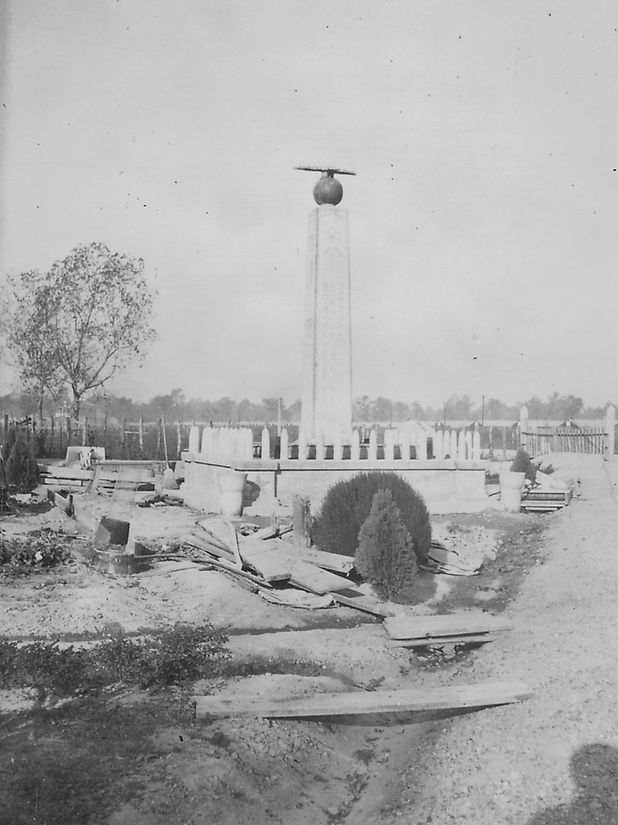
Ireihi (Spirit Consoling Monument)
at the Rohwer concentration camp
Rohwer, Arkansas
Japanese American National Museum
Gift of the Walter Muramoto Family
97.292.15G.
The sangha, or community, built the monument collectively, recognizing how a community survives only by acknowledging those who have gone before, those who may be struggling through the present, and those yet to come. Drawing on Buddhist traditions in Japan for memorializing both those who lost their lives in unfortunate karmic circumstances such as natural disasters like tsunami and earthquakes, and human-made disasters like workplace casualties and war, these monuments still stand today as a testament to the toll of forced removal and unjust incarceration.
The Buddhist teaching of “no mud, no lotus” was embodied quite literally in the building of this concrete monument. The barbed wire fence that took away freedom became the very thing that gave form to a monument to freedom, transforming the mud into the lotus. The Rohwer camp newspaper noted that the monument expressed this idea by “making the tower rising in the midst of lotus blossoms shaped from the concrete which he used.” The main elongated portion of the tower depicted etched lotus leaves climbing up a fence. The fence looks like a Shimenawa, a rice-straw rope enclosing a sacred space typically found on the grounds of a shrine belonging to the Shinto tradition. The monument was clearly also meant to evoke a Buddhist stupa, a structure that traditionally contains sacred relics. The monument builders placed a globe and an American eagle above the mud, lotus, and stupa design.
All this suggests a hybrid design approach for the making of this monument in Arkansas. While clearly drawing from the Buddhist tradition by evoking the message of a lotus flower rising above muddy water and integrating the structural form of a Buddhist stupa, it also incorporates motifs associated with the Shinto tradition, and gestures towards an integration with an American symbol of liberty and a global perspective for peace. This monument thus embodies a vision of America that is multireligious, multiethnic, and free.
Whether it was reframing the Buddha in a horsestall in Portland, Oregon, transmitting the Dharma teachings by writing and burying stones in a Wyoming wartime camp, or building a Sangha or community monument in Arkansas, American Buddhism adapted to survive the most trying of circumstances. Even when the nation told them they did not belong, Buddhists drew on their teachings, rituals, and communities to persist as Buddhists and Americans, building and expanding the long lineage of the Buddhist tradition in the United States.
SOURCES & FURTHER READINGS
To learn more, we recommend Dr. Williams’s book, American Sutra: A Story of Faith and Freedom in the Second World War (Harvard University Press, 2020), and the accompanying exhibition. Find out more at Dr. William’s website: www.duncanryukenwilliams.com. AUTHOR PHOTO CREDIT: USC Dornsife
Duncan Ryūken Williams
is currently the Alton Brooks Professor of Religion and the Director of the Shinso Ito Center for Japanese Religions and Culture at the University of Southern California. His monographs include American Sutra: A Story of Faith and Freedom in the Second World War (Harvard University Press, 2020), the winner of the 2022 Grawemeyer Religion Award and an LA Times bestseller, and The Other Side of Zen (Princeton University Press, 2009). He is also the editor of seven volumes on race and American belonging or Buddhist studies, including Hapa Japan, Issei Buddhism in the Americas, American Buddhism, and Buddhism and Ecology. His most recent project is the building of the Irei Names Monument, a memorial to honor those of Japanese ancestry who were incarcerated in America’s internment and concentration camps during WWII.
