(1912)
A BAHÁ'Í ROAD TRIP

In 1912, as Americans debated woman suffrage, race relations, war, and the future of modern society, ‘Abdu’l-Bahá spent eight months traveling across the US on a tour that would transform the Bahá’í Faith. Speaking in churches, universities, settlement houses, and public halls, he advanced a vision of human unity that challenged many of the era’s prevailing assumptions. Jonathan Menon follows this extraordinary journey, revealing how one of the twentieth century’s lesser-known religious tours helped transform a small American Bahá’í community and connect it to an emerging global religion.
It was a sparkling morning in New York Harbor on Thursday, April 11, 1912. A pack of reporters scrambled aboard the SS Cedric, a 700-foot-long oceangoing steamer of the White Star Line, which lay at anchor off Staten Island after a sixteen-day journey from Alexandria, Egypt. It carried thousands of men, women, and children bound for Ellis Island and a new life in the United States. The reporters made their way through the passengers milling on deck and set off to find their subject.
They found the visitor on the ship’s upper deck, surveying the dozens of tugs, cutters, and ferries plying the bay. He was ‘Abdu’l-Bahá, the 67-year-old head of the Bahá’í Faith, embarking on an eight-month circuit of the US. He stood straight as an arrow, wearing a long black cloak that rippled with the breeze over a robe of light tan, his iron grey hair and beard visible beneath his white turban. “As he paced the deck,” one reporter wrote in Star of the West, “he appeared alert and active in every movement, his head thrown back and splendidly poised upon his broad, square shoulders.” They peppered him with questions.
“Is it not possible that peace can become the cause of trouble and war the means of progress?” one of them asked. ‘Abdu’l-Bahá was becoming a well-known figure in the international peace movement.
“No,” he replied, through his translator. “It is war which is today the cause of all trouble. If all would lay down their arms, they would be freed from all difficulties and every misery would be changed into relief.” “What the people earn through hard labor is extorted from them by the governments and spent for purposes of war.”
“What is your attitude toward woman suffrage?” The suffragette Emmeline Pankhurst had just been released from prison in London.
“The modern suffragette is fighting for what must be,” ‘Abdu’l-Bahá answered. “If women were given the same advantages as men, their capacity being the same, the result would be the same.”
As the ship passed the Statue of Liberty, ‘Abdu’l-Bahá opened his arms wide in salutation. “Here is the new world’s symbol of liberty and freedom,” he said. “After being forty years a prisoner I can tell you that freedom is not a matter of place. It is a condition... When one is released from the prison of self, that is indeed a release.”

‘Abdu’l-Bahá
by Underwood & Underwood
New York (11 April 1912)
National Bahá’í Archives, Evanston, IL
The journey that brought ‘Abdu’l-Bahá to US shores had wound through a lifetime of exile and imprisonment.
The Bahá’í Faith was a new religion that had begun in Persia, modern-day Iran, in the middle of the nineteenth century. Under the leadership of Bahá’u’lláh, its prophet-founder, the Bahá’í Faith had spread rapidly through the Middle East and south and central Asia. Bahá’u’lláh renounced partisan politics, but by claiming to fulfill Islamic prophecies he threatened the entrenched power of Persia’s religious hierarchy, unleashing a torrent of brutal persecution that claimed the lives of twenty thousand of his followers. Bahá’u’lláh was stripped of his wealth and banished from Persia—first to Baghdad, then to Constantinople. Finally, in 1868, he was imprisoned with his family in ‘Akká, the penal colony of the Ottoman Empire. He died near ‘Akká, in 1892 at the age of 74.
Bahá’u’lláh lived and taught in an era when scientific and technological advances were breaking down the geographic, economic, and cultural barriers that separated nations and peoples. He asserted that the major religious systems of the world were each individual stages in a single, progressive process of divine revelation. He prohibited the emergence of a priestly or clerical class, challenged his followers to investigate truth independently instead of just imitating the past, urged them to banish all forms of superstition and prejudice, and affirmed that service to the entire human race was the highest form of worship. “The earth is but one country,” he wrote, “and mankind its citizens.”
‘Abdu’l-Bahá was Bahá’u’lláh’s eldest son. He had been eight years old when the family was banished, and was just a young man when they were incarcerated in ‘Akká. He became his father’s closest companion, acted as Bahá’u’lláh’s personal representative with the government and the public, managed the affairs of the prisoners, and nursed them when they were sick. Bahá’u’lláh, in his will and testament, appointed ‘Abdu’l-Bahá as his successor as head of the Faith. When the revolution of the Young Turks in 1908 released all political prisoners in the empire, ‘Abdu’l-Bahá, now free after forty years, made plans to visit the West.
The press in 1912 had spent twenty years bringing eastern religious figures to the attention of the general public. The colorful Hindu Swami Vivekananda and the Buddhist monk Anagarika Dharmapala had broken into popular consciousness at the World’s Parliament of Religions in Chicago in 1893. Religious teachers from Asia, wearing flowing robes, were usually portrayed as mystical representatives of ancient traditions—otherworldly, exotic, and contemplative, the polar opposite of modern, practical Americans. The early accounts of ‘Abdu’l-Bahá in US newspapers show journalists determined to fit this visitor into these stereotypes.
“Out of the mystic Orient,” a journalist wrote, “out of the land of the Arabian Nights, comes this turbaned teacher to convert the New World.” He came from “the land that was old when Abraham walked the earth, from the deserts across which flitted the Wise Men two thousand years ago to worship the Babe of Bethlehem...” “Of course nobody could be named Baha without having a beard,” a New York World columnist joked, “and the eternal fitness of things has seen to it that this seventy-year-old head of a new religion had the regulation prophet’s whiskers.”
‘Abdu’l-Bahá may have looked like a Hebrew prophet, but instead of a discourse on mystical enlightenment, the reporters on the Cedric received a discussion of the responsibilities of the press, the economic consequences of war, and a radical position on gender equality. Rather than promoting meditation, withdrawal from the world, and personal salvation, his public addresses focused on practical issues of social reform, such as economic inequality, racial and class prejudice, and international arbitration.
The New York Evening Mail came to terms with ‘Abdu’l-Bahá this way: For him, they wrote, “things modern are just as good as things ancient. This makes the white-bearded and snowy-turbaned leader exactly as much at home on Broadway, in New York, as he was in the lonely cell at Acre...” He is “the strange anomaly of an oriental mystic who believes in woman suffrage and modern development.”
The Bahá’í Faith found its first converts in the United States in Chicago in 1894. Most of the new believers came from Protestant backgrounds, having left their churches and explored a variety of spiritual and healing movements—such as Christian Science, New Thought, and Theosophy—before being attracted to the Bahá’í Faith by its millennial claim that the prophecies of the Bible had all been fulfilled. Across Asia the Bahá’í community numbered two hundred thousand, but in Europe and the Americas it was almost entirely unknown. By the turn of the century, in a country of a hundred million Americans, there were no more than two thousand Bahá’ís.
Disconnected pockets of believers were scattered across the continent without any formal mechanism of national coordination. More than half of American Bahá’ís lived in Chicago. Smaller communities existed in New York, Cincinnati, Kenosha and Racine in Wisconsin, and North Hudson County in New Jersey. Small groups of just a few believers could be found in Washington, DC; Philadelphia; Baltimore; Boston; Ithaca, New York; London, Ontario; Enterprise, Kansas; and Oakland, California. Isolated believers lived in far-flung locations across twenty-five states.
Beliefs differed from city to city depending on what a few itinerant teachers imparted. Several early Bahá’í teachers in the US, being very new believers themselves, filled their lessons with metaphysical ideas, such as reincarnation, that bore no relationship to the Bahá’í teachings. And without Bahá’í sacred writings in English, the community’s primary scripture was the Bible. As Charles Mason Remey, an early DC Bahá’í, put it, “I, like many of the other early believers, knew but little of the teachings, but one thing we did know was that ‘the Lord had come’ and of this we were very sure indeed and this we reiterated over and over again.”
‘Abdu’l-Bahá took it upon himself to nurture the young community. He wrote thousands of letters to the Bahá’ís in the United States, guiding their activities, strengthening their faith, bringing their beliefs in line with Bahá’í teachings, and, above all, cementing their unity. He sent Persian Bahá’í teachers, arranged for English translations of key works of Bahá’u’lláh, and sent home returning pilgrims fired with enthusiasm for serving their faith.
‘Abdu’l-Bahá’s 1912 tour was a pivotal moment in how the Bahá’ís understood and presented their faith in the West.
Prior to 1912 most materials produced by Bahá’ís that listed the religion’s teachings focused on prophecy, prayer, and the spiritual path. One such outline of basic Bahá’í principles, by Isabella Brittingham of New York, emphasized personal qualities and interpersonal ethics. It included:
To serve one another, and to know that all mankind are brothers;
To give the Truth and Teachings of GOD without money and without price;
To be sane and practical;
To make today better than yesterday;
To establish work as worship and to help mankind to help itself ;
To establish the “Kingdom of GOD upon the earth.”
When ‘Abdu’l-Bahá was in the US, from April to December 1912, he, in four hundred speeches to almost a hundred thousand people, and in hundreds of personal interviews, spoke out against the ideologies of race, gender, militarism, social Darwinism, and religious and class prejudice that dominated life in the United States.
Of all the causes ‘Abdu’l-Bahá championed during his tour, perhaps none was as unexpected—for the Bahá’ís as well as the public—as his campaign against the entrenched American attitudes toward race. He was invited to address Black churches and institutions, including 1,600 students and faculty at Howard University and the fourth annual conference of the NAACP, but his arguments transcended merely promoting economic and civil rights for African Americans.
“Until these prejudices are entirely removed from the people of the world,” he wrote, “the realm of humanity will not find rest. Nay, rather, discord and bloodshed will be increased day by day, and the foundation of the prosperity of the world of man will be destroyed.”
‘Abdu’l-Bahá explained to his Howard audience that contrary to the prevailing belief that racial categories were biological and fixed in human nature, they were in fact superficial, environmentally produced variations. The only meaningful human distinction, moral character, had nothing to do with race. He disputed the myth that mixed races were degraded or inferior, asserting that mixed-race children, several of whom he had in his household, were “wonderful—perfect.” And he told both sides they would have to change their attitudes in difficult ways if they were to heal the centuries of mistrust that racial prejudice had created between them. ‘Abdu’l-Bahá insisted on racial integration in his meetings and used personal gestures to upset social conventions, such as once seating a Black man in the place of honor at a diplomatic luncheon in the capital to which he, being Black, had not been invited. And he came out publicly for interracial marriage in the US, going so far as to encourage the same Black man, Louis G. Gregory, a DC lawyer, and Louise Mathew, a British teacher who was white, to marry. They were married in a quiet ceremony in New York on September 27, 1912, and their happy marriage lasted almost forty years until Louis’s passing in 1951.
‘Abdu’l-Bahá’s discourse in the US in 1912 generated a revolution in the Bahá’ís’ thinking about their religion. From then onward, when Bahá’ís listed summaries of their teachings, they often ignored prophecy, prayer, and the spiritual path and focused on issues of social reform. The principles that ‘Abdu’l-Bahá articulated in 1912—the oneness of mankind; the independent investigation of truth; the common foundation of all religions; religion as the cause of unity; the harmony of science and religion; the equality of men and women; the elimination of prejudice and fanaticism of all kinds; the abolition of extremes of wealth and poverty; universal compulsory education; a universal auxiliary language; universal peace; and world government—transformed the Bahá’í Faith in America, establishing a new framework that Bahá’ís used to teach their faith for generations.
With ‘Abdu’l-Bahá’s encouragement, the Bahá’ís in Chicago began to correspond with Bahá’í communities abroad. In 1903 they learned that the Bahá’ís of Ashkhabad, in Russian Turkestan, had just finished building the world’s first Bahá’í temple. They asked ‘Abdu’l-Bahá for permission to build one in Chicago.
He was more than enthusiastic. But when he told Chicago’s Bahá’ís that building a temple must be their highest priority, few of them could have grasped the breadth of his vision.
Certainly not Corinne True.
Corinne Knight True was a Chicago wife and mother of eight who had already suffered the loss of three young children. It began on June 1, 1892, when nine-year-old Harriet fell down the basement stairs. Corinne’s faith in God was severely shaken. She left the Episcopal church and set off on a search for new meaning. She investigated Unity, a progressive Christian movement, then Christian Science, then Divine Science. After three-year-old Nathanael died of heart failure in a diphtheria epidemic in May 1899, a close friend told her about a new religion that was being taught by some Persians in Chicago, and that it might offer her some insight on death and the meaning of life. When Nathanael’s seven-year-old brother Kenneth died from the same cause in 1901, Corinne turned for solace to ‘Abdu’l-Bahá.

Corinne Knight True
In spite of recurring personal tragedies, she became the indispensable driving force behind the Bahá’í House of Worship.
National Bahai Archives, Evanston, IL.
“Be not grieved at the calamity which hath unexpectedly come upon thee,” he wrote her upon Kenneth’s passing. “It behooveth one like thee to endure every trial...Truly, I say unto thee, wert thou informed of the position in which is thy son, thy face would be illumined by the lights of happiness and thou wouldst...long for ascending to that praiseworthy position.
Corinne dedicated herself to teaching the new faith, sometimes coming into disagreement with the community’s elected governing council, the House of Spirituality, whose members were all men.
On August 5, 1906, 21-year-old Laurence True lost his life in a sailing accident. Corinne had four children left. She sailed for ‘Akká.
The temple plan had lain dormant for three years. But Corinne had assembled a petition containing eight hundred names, pasted together into a scroll, rededicating the community to the project. “This,” ‘Abdu’l-Bahá exclaimed, holding the scroll high above his head, “this is what gives me great joy.” He laid out for Corinne the fundamentals of the temple’s design. It should be circular in shape with nine sides, surrounded by a circular court. Nine avenues should radiate outwards, with a garden between each, and in the middle of each garden a fountain. And it should stand on a large piece of land along the lakeshore, away from the busy city.
When three men from Chicago arrived in ‘Akká shortly thereafter, charged by the House of Spirituality with consulting ‘Abdu’l-Bahá on the temple project, he told them, “When you return consult with Mrs. True—I have given her complete instructions.” Somehow, ‘Abdu’l-Bahá had placed a woman at the center of the community’s defining enterprise.
Corinne threw herself into the work. For weeks she trekked north of Chicago on Saturdays seeking a building site, traipsing in work boots across fields, over fences, and across streams to the point of exhaustion. Her search bore fruit when she found a tract of several wooded lots that overlooked Lake Michigan at Gross Point, in what is now the village of Wilmette, fourteen miles north of downtown Chicago. Several other temple sites were under consideration, but under pressure from the women the financially conservative House of Spirituality conceded to purchasing two lots at Gross Point. One member expressed his displeasure in a private letter. “Mrs. True was, and always is, the leader in such things,” he wrote.
In frustration with the House of Spirituality’s unwillingness to secure more land, or because she felt the Chicago community was unequal to the task, Corinne wrote ‘Abdu’l-Bahá in the spring of 1908, proposing a new national organization to take over the project. ‘Abdu’l-Bahá made it clear that its membership must include women.
The election was held on March 23, 1909. Thirty-nine delegates from fourteen states, Hawaiʻi, and the District of Columbia gathered in a large room in the attic of the Trues’ home on Kenmore Avenue. Corinne and two other women were elected to the nine-member executive committee of the Bahá’í Temple Unity. In a unanimous decision the convention selected the Gross Point site.
As the financial secretary of the Bahá’í Temple Unity, Corinne True became the linchpin in the project. She received the donations, shaped through extensive correspondence the community’s understanding of the temple, and managed the project from day to day, exercising a pervasive influence over it. Sustaining that effort over decades of financial hardship and years of uncertainty was, in the end, her greatest contribution to the Bahá’í Faith.
On a cold and windy afternoon on May 1, 1912, almost four hundred people gathered around ‘Abdu’l-Bahá as he raised an ax high above his head and brought it down hard on a patch of hard turf. He was conducting the groundbreaking ceremony for the temple. The day before, 25-year-old Davis True, Corinne’s last surviving son, had died from tuberculosis. Corinne buried him on the morning of May 2. In the afternoon ‘Abdu’l-Bahá asked her to join him at Chicago’s Plaza Hotel. Next to a window overlooking Lincoln Park he spoke to her about the nearness of the spiritual world to this one, and that she would one day be reunited with her children. He may have understood Corinne’s grief better than anyone on that sad afternoon, for he, too, had lost five children, including both of his young sons.
In the turn-of-the-century US, architecture, construction, and real estate were ruled by men. But with ‘Abdu’l-Bahá’s backing, a woman spearheaded the most important single project undertaken by Bahá’ís in the Western world in the first century of the Bahá’í Faith. In spite of recurrent personal tragedies, Corinne True became its indispensable driving force, as well as ‘Abdu’l-Bahá’s agent in breaking down the barriers facing women in the early American Bahá’í community.
When the Chicago Bahá’ís had first proposed a temple to ‘Abdu’l-Bahá in 1903, they had seen it as a strictly local endeavor. In hindsight it became clear that ‘Abdu’l-Bahá’s vision had been much greater than merely constructing a building. For such a small and informally organized community it was a herculean task, demanding that they raise funds and conduct business, elect delegates to the annual convention, manage relationships with distant Bahá’í communities, and maintain commitment across decades from people who would never live to see the result of their sacrifices. The temple project forced the scattered Bahá’ís to come together and forge the institutions of a unified national community.
More and more responsibilities were assumed by the executive committee of the Bahá’í Temple Unity. It took over publishing, coordinated teaching across the continent, and supported geographically isolated Bahá’ís. As it evolved into the National Spiritual Assembly of the Bahá’ís of the United States and Canada, its model of democratic religious governance provided the constitutional basis of Bahá’í communities worldwide. “In reality,” Corinne True wrote, “this marks the beginning of our nationality.”

Bahá’í House of Worship
The interior view of the dome of the Continental Bahá’í House of Worship in Wilmette, Illinois.
© Bahá’í International Community
‘Abdu’l-Bahá warned repeatedly of an impending war in Europe and attempted to rally public opinion to avert it. In 1912 most of the public was sanguine about the prospects for continuing peace. An influential book by Normal Angell had argued that war had become pointless, because modern economic integration made it impossible to profit from conquest. ‘Abdu’l-Bahá was less optimistic.
“The continent of Europe is one vast arsenal,” he told the Buffalo Courier, “which only requires one spark at its foundations and the whole of Europe will become a wasted wilderness. And what flimsy, what impudent pretexts they use. Patriotism, say they; glory, say they; the upbuilding of the continent, say they. What a travesty on God’s truth.”
After an additional year of travel in Europe, ‘Abdu’l-Bahá returned to his home in Haifa on December 5, 1913. Eight months later Europe was at war.
The Allies blockaded Haifa and shelled the city. Before the door closed ‘Abdu’l-Bahá was able to get a few messages out, including the first five of fourteen epistles that opened a new vista for the American Bahá’ís. In the Tablets of the Divine Plan, ‘Abdu’l-Bahá charged the small band of North American believers with a global mission to establish their religion in more than 120 territories and island groups around the world.
In order to pass the Ottoman censors ‘Abdu’l-Bahá wrote these first five messages on multiple postcards, each containing a piece of the whole, which the Americans reassembled at their destination.
“O that I could travel, even though on foot and in the utmost poverty,” he wrote, “to these regions, and, raising the call . . . in cities, villages, mountains, deserts and oceans, promote the divine teachings! This, alas, I cannot do. How intensely I deplore it! Please God, ye may achieve it.” Having spent two years battling ill health while traveling through Europe and the US, he was effectively confined again, watching the world burn, wishing he could share his message once more.
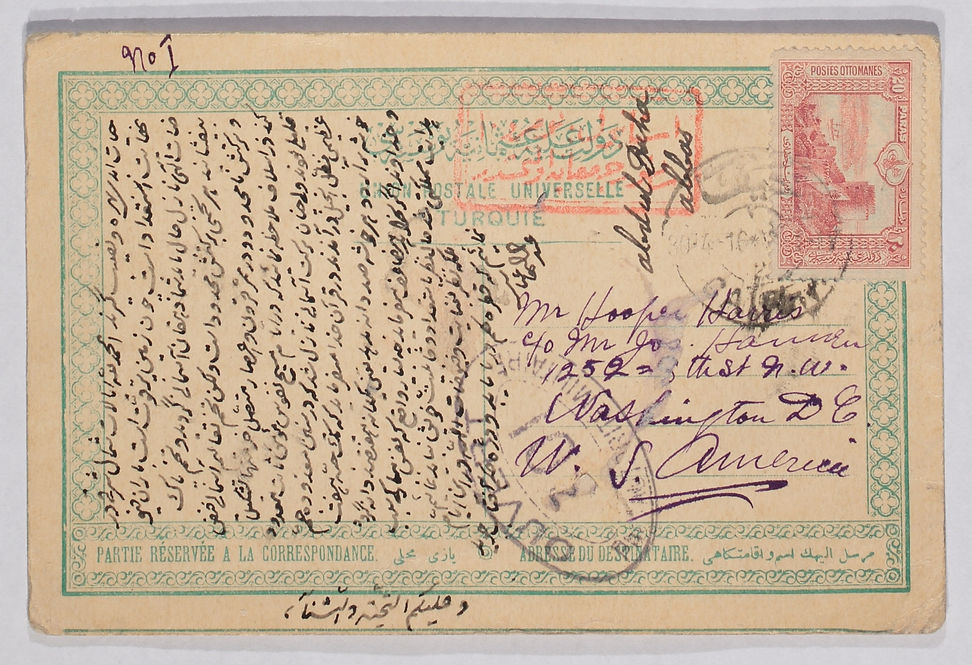
First Tablet of the Divine Plan
Segment, sent on a postcard
(Ottoman censor’s stamp is at the top in red)
National Bahai Archives, Evanston, IL
Because there are no clergy in the Bahá’í Faith, individual Bahá’ís responded. John Henry Hyde Dunn and his wife Clara, English immigrants living in Oakland, sailed for Australia. Hyde supported them as a traveling milk salesman for Nestlé. Twenty-four-year-old Leonora Holsapple from Hudson, NY, alone and unable to speak Portuguese, moved to Brazil, teaching English and working several jobs to make ends meet. And Martha Root, a journalist from Pittsburgh with breast cancer, set out on the first of several solo journeys that would take her to twenty countries on five continents, supporting herself on a shoestring as she traveled by giving lectures and writing articles for local newspapers.
Over the decades hundreds of Bahá’ís, from the US and beyond, arose in response to ‘Abdu’l-Bahá’s call to plant their faith in foreign lands. After a century of Bahá’í pioneering, Bahá’ís reside in more than a hundred thousand cities, towns, and villages around the world. There are 188 national spiritual assemblies, and approximately six thousand local spiritual assemblies are elected every year.
.jpg)
An Elderly ‘Abdu’l-Bahá
writing near his home in Haifa (c. 1920)
National Bahá’í Archives, Evanston, IL
In 1912, Corinne True believed that in a few short years the Bahá’ís of America would be worshiping in their temple. In reality it would take forty more years to raise it. The Bahá’í House of Worship in Wilmette was dedicated to public worship on May 2, 1953. Shortly before the service began, Corinne True, now 91 years old, arrived at the temple. She was accompanied by her three surviving daughters, Edna, Arna, and Katherine.
“I have never seen her so affected by anything as she was by the fact that she was going to the dedication,” her daughter Edna observed. “As she approached the Temple everyone stopped her wanting to speak to her, but she couldn’t. She did not weep, but she could not speak. She could hardly raise her head. It was a tremendously moving moment. It was like carrying a load for a very long time, and then, suddenly, the load was lifted. At that moment it was reality.”
‘Abdu’l-Bahá found dozens of men and women like Corinne True. He had an uncanny talent for finding capable individuals and setting them on paths of service that suited their particular gifts. Through his meetings with them in person, the reports of returning pilgrims, and his vast correspondence—the Bahá’í World Center has more than 27,000 authenticated letters of ‘Abdu’l-Bahá on file—he forged deeply personal bonds that motivated them to extraordinary sacrifices.
‘Abdu’l-Bahá considered the establishment of the Bahá’í Faith on the North American continent to be the greatest achievement of his 29-year ministry. When he looked upon the company of believers in the United States at the turn of the twentieth century, he found an assortment of disconnected, doctrinally inconsistent groups of former Protestants preoccupied with biblical prophecy and personal spirituality. When he was finished he had transformed them into a unified national community based firmly on Bahá’í scriptures, governed by elected institutions, driven by a progressive agenda of social reform, and committed to a global mission.
Because of ‘Abdu’l-Bahá’s work, and the efforts of the American Bahá’ís, the international Bahá’í community today is interwoven with US history.
SOURCES & FURTHER READINGS
Bahá’u’lláh. Gleanings from the Writings of Bahá’u’lláh. Bahá’í Publishing Trust, 1974. Mahmúd-i-Zarqání. Mahmúd’s Diary: The Diary of Mírzá Mahmúd-i-Zarqání Chronicling ‘Abdu’l-Bahá’s Journey to America, translated by Mohi Sobhani. George Ronald, 1998. Abdu’l-Bahá. “Talk at Howard University, 23 April 1912.” The Promulgation of Universal Peace: Talks Delivered by ‘Abdu’l-Bahá during His Visit to the United States and Canada in 1912, 2nd ed., comp. Howard MacNutt. Bahá’í Publishing Trust, 1982. FURTHER READING: For more about ‘Abdu’l-Bahá and his engagement with Americans in 1912 see “239 Days in America” at http://239days.com/. Amin Egea provides a comprehensive study of American press coverage of ‘Abdu’l-Bahá in The Apostle of Peace: A Survey of References to ‘Abdu’l-Bahá in the Western Press, 1871–1912, Volume One: 1871–1912 (George Ronald Publisher Ltd, 2019). For the early history of the Bahá'í Faith in the United States, see the definitive books by Robert Stockman, The Bahá'í Faith in America, Vols. 1 and 2 and Abdu’l-Bahá in America (Baha'i Publishing, 2012). The construction of the Bahá'í House of Worship is chronicled in The Dawning Place by Bruce W. Whitmore. For more about how Asian religions were portrayed in America, see “Orientalism in Nineteenth-Century America,” by Michael J. Altman, in The Oxford Handbook of Religion and Race in American History, from Oxford University Press. Cover image: The Bahá'í House of Worship in Wilmette, Illinois. Photograph by the author.
Jonathan Menon
is a ghostwriter and independent scholar. He is the editor-in-chief of “239 Days in America,” an online narrative history that contextualizes ‘Abdu’l-Bahá’s journey across America in 1912 within the broader debates of the Progressive Era. He is currently writing A Sphere of Her Own: The Life and Battles of Sarah J. Farmer, a biography of the mystic, reformer, and tireless organizer who built her summer colony at Green Acre into a crossroads of American religious life. Jonathan lives near Toronto, Canada.