(1809)
HARVESTING THE SUN

Lauren Pond captures the surprising lives of Amish groups who have embraced solar-powered electricity.
As a resident of Columbus, Ohio, I’ve long had a certain idea of who the Amish are: a rural, traditional Christian people who live not far from me, yet a world away, deliberately separate from modern American society and its technologies.
Imagine my surprise, then, when I visited Ohio Amish Country for the first time in the spring of 2021 and saw nearly everyone riding electric bicycles.
Out the car window, I watched men with beards and brimmed straw hats whiz around on motorized bikes in all directions, navigating the area’s rolling hills with ease. Women in bonnets and muted pastel dresses joined them, some with children or groceries in tow. There was hardly a horse-drawn buggy in sight.

Flag Croquet
Members of an Old Order Amish church district play a variation of disc golf outside of their bishop’s home in central Ohio.
photograph by Lauren Pond
My assumptions about the community disappeared more quickly than the cream-filled donut I’d purchased from an Amish bakery that morning.
But even more surprising was what I learned when I returned to northeastern Ohio several months later as a journalist, eager to work on a story: Many Amish here powered their bicycles, and the rest of their daily lives, using solar panels. In fact, historically speaking, the Amish have been some of the most enthusiastic adopters of solar electricity in the state. In the early 2000s, they even achieved Ohio’s highest per capita solar power use, authors Charles Hurst and David McConnell note in An Amish Paradox.

Mattie Yoder & Electric Bicycle
shown at Dublin Valley Farms, a horse breeding facility in the Holmes County area
photograph by Lauren Pond
Settled by the Amish in 1809 as part of their westward expansion from Pennsylvania, the greater Holmes County region is now home to the second largest Amish community in the world, with some 40,000 residents. With its abundance of green technology, it is also a place of irony and striking juxtapositions that shed light on an unexpectedly complex culture—one that is, in many respects, quite contemporary and innovative.
The contrast between the old-fashioned Amish I thought I knew and the modernized community I actually met was enough to draw me back to the area, equipped with my camera and curiosity. How did solar energy fit into the lives of the so-called “plain” people—who, I had long assumed, did not even use electricity?
In all honesty, I hoped it had something to do with environmentalism.
In my more than 15 years as a writer and documentary photographer, I have often been drawn to stories about the ways people interact with nature, particularly through religious practice. In the process, I’ve consumed many a doom-and-gloom narrative about environmental destruction and the current climate crisis—and fairly or not, conservative Christianity today has been linked with a certain apathy toward the natural world.
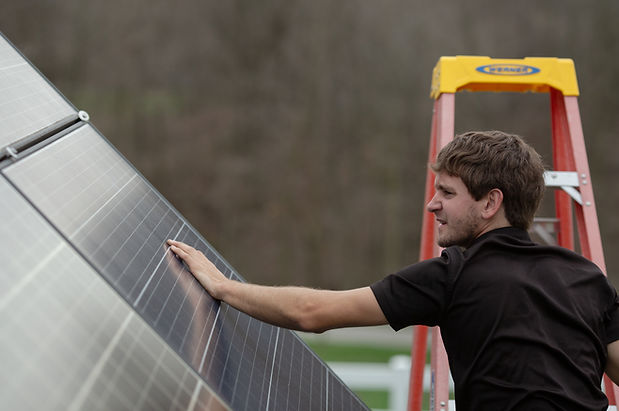
Upgrading a Solar Array
Adam Miller, a technician at the Holmes County installation company Trail Battery and Solar, prepares to upgrade a solar array outside of an Amish home.
photograph by Lauren Pond
In addition, it’s a precarious moment for Ohio, environmentally speaking: Not only does the state have some of the most polluted air in the nation, but it ranks sixth nationally for the number of data centers it houses, many of these planned or built recently to accommodate the artificial intelligence boom. The anticipated effects on natural resources are catastrophic.
In Ohio Amish Country, had I actually found a community that had shifted ideological courses and decided to “go green”?
On a certain level it would make sense given the kinds of promotions I’d seen for the area, which largely occupies Holmes County, but also includes parts of neighboring Tuscarawas, Wayne, Ashland, Coshocton, and Stark counties. Online videos feature sprawling farms, horses grazing in green fields, and wooded trails illuminated by filtered sunlight. Indeed, part of the appeal for city-dwellers like me is the idea of a rustic, simple people living in harmony with the land. According to the Holmes County Chamber of Commerce and Tourism Bureau, about four million tourists visit Ohio Amish Country annually.
“A beautiful part of the country with lovely rolling hills and fresh air,” exalts one review. “I love the back roads, the simple slow down way of life,” reads another.
Green energy blends seamlessly into this landscape. Driving in from the city, the monotonous interstate gradually gives way to verdant hills dotted with cheese shops, furniture stores, and solar panels almost everywhere: fastened to the roofs of homes and businesses, affixed to fence posts, mounted on poles in fields.

Amish Man Photographs Tourists
Hershberger’s Farm and Bakery, a popular Holmes County attraction that offers horse-drawn buggy rides, a petting zoo, and Amish food and crafts.
photograph by Lauren Pond


Solar Arrays
Local experts estimate that 90 percent of Old Order Amish living in the area use solar energy to power their lives. Arrays of all sizes dot the landscape in and around Ohio Amish Country.
photographs by Lauren Pond
During one of my early visits to the area, I interviewed employees at a local Amish solar installation company. That morning, I asked my burning question: How did green initiatives and climate change factor into their business?
There was an awkward pause.
“We ourselves don’t buy a lot into the climate change idea,” the company’s owner told me.
I struggled to hide my dismay. Afterward, I asked other Amish, hoping I’d hear a different perspective. By and large, I did not.
Among her business’s Amish clients, one woman explained, “Green energy is—how should we say—maybe the least of their concerns?” The warming planet is “not something that many of us as consultants focus on,” another solar panel salesman told me.

Miriam Beachy
Beachy, a client of Trail Battery and Solar, hangs laundry to dry outside of her home in central Ohio. Since the company installed the Beachys’ solar array in 2023, she and her daughters have used a solar-powered washer and spinner to do laundry for their family of eight.
photograph by Lauren Pond

Roy Miller's Daughter Picks Flowers
The Miller family home in Holmes County. They switched from gas generators to solar electricity in 2015.
photograph by Lauren Pond
When I spoke to an Amish woman who’d had solar panels installed at her home, she hadn’t heard of climate change at all.
“You mean weather change?” she asked me. “I think that God will control the weather. It doesn’t matter what we try. The weather will be controlled by God.”
Not long after my initial conversation with the solar installers, I met Marcus Yoder, an Ohio native who grew up Amish but left the community to attend Yale. Now back home, he directs the Behalt Amish and Mennonite Heritage Center, where he specializes in giving outsiders like me an insider perspective on the culture that raised him.
As Yoder joined me on a Zoom call from his office in the center—itself drawing electricity from 76 solar panels—he seemed to share my sense of disappointment about the reasons the community uses solar energy.
“I wish it was driven by social responsibility,” he said. “It’s generally not.”
Theologically speaking, in line with the Bible’s assertion that God gave man dominion over the earth, many Amish view nature in “unsentimental terms, as designed by God for the benefit of humans,” authors McConnell and Marilyn Loveless write. While Amish life is intertwined with the natural environment, and the community believes in caring for God’s creation, community members largely view nature as a resource to be used, not preserved.
Notably, through their interactions with their so-called “English” (i.e., non-Amish) neighbors in recent years, some Amish here have also absorbed the deep red political sentiments of rural Ohio, Yoder said. Local shops display Christian nationalist motifs, a stark departure from this community’s historically apolitical, pacifist way of life. One man told Yoder that climate change was “an invention of the Democrats.”
“You’re not going to get far talking about those kinds of things in our community,” Yoder advised me.
So if the Amish weren’t interested in preserving the environment, why were they using so much green technology? For that matter, why were a people popularly known for leading quaint, isolated lives using technology at all?
As Yoder and I continued to talk, he was quick to correct this line of thinking.
“One of the biggest misnomers about the Amish is that they’re Luddites,” he explained. “They’re actually very innovative at dealing with the modern world.”
To understand why the Amish feel they need to keep the modern world at bay, it’s helpful to go back a few centuries.
As Hurst and McConnell recount in their book, the Amish are descendants of the Swiss Anabaptist movement, itself a product of the Protestant Reformation in Europe in the 1500s. Among other convictions, the central Anabaptist belief that baptism should be reserved for religiously committed adults instead of babies led to the torture and execution of thousands. In the mid-1700s, followers of a particularly conservative Anabaptist sect led by Jacob Amman—i.e., the “Amish”—fled to North America, first settling in Pennsylvania and eventually expanding to some 32 US states, including eastern Ohio, where they found fertile soil for farming.

Buggy Parking
Families park outside an Amish school benefit auction in central Ohio. In order to avoid government entanglements, the Amish do not accept state or federal funding, and the community raises money annually to cover costs of its parochial schools.
photograph by Lauren Pond
There are now Amish settlements throughout the state, each of which contains distinct church districts with their own rules, the Ordnung, that govern the lives of people living there. Districts themselves are aligned with diverse Amish affiliations, which range from ultra-conservative to liberal in their guidelines and ideology. Despite these differences, the tens of thousands of Amish living in the Holmes County settlement today—along with the rest of the more than 400,000 living in the United States more broadly—share the same dark history of state persecution.
They also share the “skeptical and even fearful view of the outside world” that it created, Hurst and McConnell note—as well as a strong desire to protect their faith, families, and communities, Yoder told me. Much of what defines the insular Amish culture, including its views on technology, is connected to these fundamental values.
“It’s really important kind of theologically and philosophically to back up and say: It is about these three things,” he explained.
It’s not that technology is banned outright, as many English people like me assume. Rather, when deciding whether to use or restrict something, the Amish carefully consider its dangers and “ask whether it could create a link over which corporate and governmental control can indirectly reach in and corrode the cultural ties that bind their small communities together,” writes author Lindsay Ems.

Miriam Beachy & daughters
Miriam Beachy and her three daughters cool off at home on a warm summer day.
photograph by Lauren Pond

Lonnie Yoder
Yoder, a technician with Trail Battery and Solar, works on the solar installation at the Beachys' home. He was about 8 years old when his own church district adopted solar electricity, he said.
photograph by Lauren Pond

Cedar Waxwing
The bird greets Karen Shetler and her family during their visit to the Ohio Bird Sanctuary, located about an hour outside of Holmes County.
photograph by Lauren Pond
Cars, which could transport community members to unsavory places far from home, are not allowed. Neither are televisions, which could erode family relationships and expose people to profane content. Cell phones and the internet pose similar risks and are heavily regulated, if they are used at all. Smartphones are a particular threat, it seems, inspiring tracts like The Snare of the Smartphone, which one Amish woman gave me. “The rushing torrent of information, pictures, advertisements, news and opinions is just too powerful for our limited minds to control,” the text cautions.
Additionally, most Amish do not connect to the public electric grid, seen as a tether to the outside world and a threat to self-sufficiency. However, rather than avoid electricity entirely, many have long relied on alternative energy sources—wind, water, propane, gas—to power specific items for specific purposes their communities deem acceptable. Then, in the 1980s, solar came along.
Not all Amish use solar, to be sure, and those who do have typically adopted it gradually, with caution. Those of the ultra-conservative Swartzentruber affiliation still live without electricity at all. But for Old Order Amish, the largest affiliation in the greater Holmes County area, solar power has become a central part of home life, business, and societal operations. Local experts estimate that about 90 percent of this group use it.
When Yoder goes on his morning runs, almost every property within a 10-mile radius of his home has one or more panels.
“I’m astonished at the amount of solar power being used in this immediate area,” he said.

Beachy Children at Play
Two of the Beachys’ children play outside during the installation of a solar array at their home.
photograph by Lauren Pond

Solar inverter & lithium battery charging station
A central Ohio Amish barn
photograph by Lauren Pond
For the Amish, then, solar electricity is something deeply practical—a contemporary tool that, ironically, helps preserve a traditional way of life.
It’s also far from the first such tool. As I’ve learned from Lindsay Ems’s Virtually Amish: Preserving Community at the Internet’s Margins, Amish culture is full of so-called “workarounds” that allow the community to live and work in the twenty-first century while remaining true to their values—things like pneumatic drill presses and other air-powered power tools, or PcFreeEmail, which allows people to send and receive email via fax machine. Solar energy is just one of the latest manifestations of this characteristically Amish adaptability and ingenuity.
In August of 2023, I got a first-hand view of Amish pragmatism from the roof of a barn belonging to Miriam and Joni Beachy, clients of the Holmes County solar installation company Trail Battery and Solar. Around me, a young technician mounted eight panels, which would transfer electricity via underground conduit to a bank of batteries in the house nearby. On cloudy days, a backup propane generator would kick on if needed—a necessity during Ohio’s notoriously gray winters, one of the company’s employees explained.
The Beachys moved into their house, located outside of the Holmes County region, in 2022, Miriam told me. But it was an English home, meaning that it was fully wired and connected to the electric grid at the time. The community gave them a year to get their finances in order and install an array, and she was glad this day had finally arrived.
The previous winter, they’d lost power.
“I never realized how nice we have it living off the grid until we moved down here,” she said. “I was like, I can’t even take a drink of water, I can’t shower—this is hopeless. I told my husband: I can’t live like this.”
With the solar panels installed, Miriam, her husband, and their five (now six) children could now access necessities without being subject to the whims of the power grid, or the dangers of some other power sources. The gas generator that once powered the family washing machine generated unhealthy fumes. Gas and kerosene lamps—long a fixture in the Amish community—pose a fire hazard, especially with kids running around.

Beachy daughters baking
The Beachys’ daughters bake chocolate chip “Subway” cookies using an electric stand mixer connected to a portable solar generator.
photograph by Lauren Pond
But beyond the basics, solar has allowed the Beachys to modernize and be comfortable in their home, without running afoul of cultural restrictions.
Through special adaptors, rechargeable cordless drill batteries connect to all sorts of appliances, like light fixtures and the oscillating fan that one of the Beachys’ daughters brought out for me when I visited on a summer day and stumbled into the living room, sweaty and red-faced. Miriam also has several portable solar generators that power larger appliances, like an electric sewing machine, which she used to make four dresses and four multi-piece suits for her family to wear to her sister’s wedding last year.
For other Amish I’ve spoken to, solar use has followed a common trajectory: People will start with a basic array to power water pumps and in-floor heating, then transition to larger, more complex systems that allow them to electrify their lives and access conveniences previously out of reach—although church districts still regulate what their communities can use, McConnell suggested.
“It’s been really interesting watching that,” said Sheldon Stutzman, a consultant for another local solar installation company, Paradise Energy Solutions. “Now these guys, they have really nice arrays. They’re living the good life.”
By far, e-bikes have been the most notable solar-powered additions to the Amish lifestyle in the Holmes County region. One family I met had amassed almost 10 of them, which they charged using electricity from an upgraded solar array.
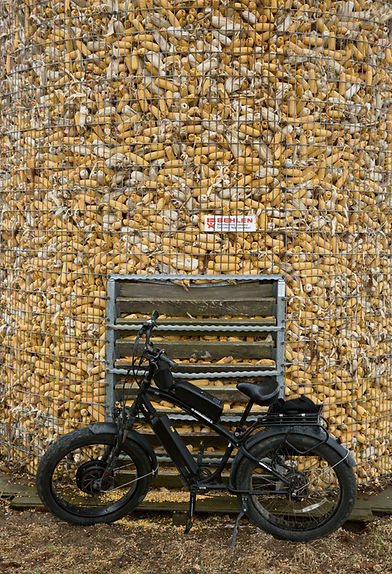

Electric Bicycles
have “revolutionized” the solar industry in the Holmes County region, Yoder said. The Amish in part install arrays to charge their e-bikes, which are visible almost everywhere in the area: along the roads, outside of workplaces, and next to corn cribs.
photographs by Lauren Pond
The electric bicycles were a “no-brainer” when they arrived on the scene in the 2010s, said David Mullett, the owner of E-Bikes of Holmes County, a local e-bike store. Offering a limited battery range of 20 to 60 miles, they allow community members to easily commute to work or run errands without the cultural risks that cars pose. They are arguably safer than buggies, too, he suggested, as they take up less space on the roads. Some Amish families are now foregoing the iconic horse-drawn buggy altogether.
At Dublin Valley Farms, a stable and horse breeding facility in Fredericksburg, Mattie Yoder stopped to talk to me one afternoon about her e-bike.
“The Amish are evolving just like the rest of the world,” she said, shortly before leaving work for the day and riding home.
Behind all the cultural practicality that solar offers the Ohio Amish, it’s impossible to ignore a deep financial pragmatism, as well.
The economic landscape in the Holmes County region has shifted dramatically in the past century: In the early 1900s, about 90 percent of Amish here were farmers and made their living off of the land, Yoder told me. Today, that figure has dropped to about 10 to 15 percent. According to Hurst and McConnell’s book, increasing land prices and development are partly to blame.
As the Amish have moved away from agriculture, they’ve excelled at other manual trades, including carpentry: the wooden furniture in Holmes County is world-renowned. Solar has also helped fill the void. For some, it has facilitated at-home business, Yoder said. For others, it offers an alternative kind of farming.
“I like harvesting the sun,” said Jacob Hershberger, the owner of Trail Battery and Solar.

Solar Panel at Auction
Solar panels have even made appearances at auctions, a favorite Amish pastime. Joni Beachy, who works in construction and moonlights as an auctioneer, recently sold used solar panels during a consignment auction in central Ohio.
photograph by Lauren Pond
By my latest count, in the greater Holmes County region, there are at least seven Amish or Anabaptist-affiliated solar companies like this one, and their business has surged alongside the Amish demand for solar power. Trail Battery and Solar, which began as an offshoot of Hershberger’s plumbing business, recently installed about 140 arrays per year, largely for off-grid Amish clients. It has also started installing grid tie-in systems for English customers. The arrays that the company offers have likewise increased in size, wattage, and complexity.
“The stuff we did five years ago, you know, we think would be funny for it to work today,” one employee said.
It’s a similar situation at The Lighthouse Installation, which averages about two residential solar installations per week, alongside maintenance services and system upgrades—most within a 20-mile radius of the company’s headquarters in Fredericksburg.
“It’s the place to be,” said Regina Miller, who runs the business with her brother, Ray.
And there are a seemingly endless array of solar-adjacent Amish businesses that have popped up in Ohio Amish Country.
The e-bike industry is doing particularly well. Mullett opened his store in 2016, then expanded to a second location in 2020. It’s one of at least ten e-bike companies in the region and now has clients from both within and outside of the Amish community. It also has a built-in customer base, Mullett explained: Often, an Amish father will buy his family’s first bike, but it’s rarely the last.
“As the kids get older, they want an electric bike. They don’t want a traditional bike,” Mullet said. “The collection continues to grow.”


A technician at E-Bikes of Holmes County services an electric bike at the company’s Millersburg location. In addition to a showroom full of the latest models, the store has a full service center for bicycle maintenance and repairs, as well as an e-bike pickup and delivery service.
Popular Amish e-bike accessories include skirtweights, designed to help women ride their bicycles.
photographs by Lauren Pond

Electric Bikes
Since electric bikes arrived in the Ohio Amish community in the 2010s, fewer horse-drawn buggies have been on the roads.
photograph by Lauren Pond
Even companies that don’t specialize in solar technology are taking advantage of it and installing massive arrays. The truth is, with the growth of AI and other developments, the US is facing an energy shortage—and solar saves money, Stutzman, of Paradise Energy Solutions, explained. When I spoke to him in 2025, he noted that the number of commercial solar installations his company did had soared in recent years amid this changing energy landscape.
“You can’t argue with turning sunshine into electricity,” Stutzman said. “It’s unfortunate that it’s become so divisive and political.”
Since then, the One Big Beautiful Bill Act has eliminated or undermined most federal solar financial incentives. Solar arrays have also faced increasing opposition on the state level, with Ohio now leading the country in rejection or withdrawal of renewable energy permits. One recent headline declared: “Ohio is Where Wind and Solar Projects Go to Die.”
Yet, given solar’s unique role as a culturally sanctioned source of electricity in Ohio Amish society, the renewable energy industry here may be largely insulated from these changes. At The Lighthouse Installation, Regina Miller wasn’t particularly worried about business. She explained that while solar panels might be a nice addition to an English home, in the plain community, they’re essential.
“The Amish aren’t putting in solar because they think it’s cool,” she said. “They’re putting it in because it’s their option.”
Or, as a solar installer told me once: “We’re Amish, so we have to.”

German Village Market
At German Village Market, a Holmes County grocery store, about 200 panels now line the roof and power everything from cash registers to the store’s refrigerated section, well-stocked with local Amish meats and cheeses.
photograph by Lauren Pond
During one of my last trips to Holmes County, I stopped to visit David Kline, an 80-year-old Old Order bishop, organic farmer, and published author I had met a couple years prior. A gentle man known for his environmental stewardship and sustainable living, he is the kind of solar energy user I’d imagined I would meet when I first learned the Amish were using green technology.
As the two of us sat in lawn chairs in his yard, a kitten nestled against the bishop’s chest and beard. On the roof of the house nearby, a singular solar panel collected sunlight to power some essentials: lamps, a water pump, and LED lights for the family buggy.
“I think the greatest thing about solar is really here,” Kline said, gesturing to the open, rolling landscape in front of us. “There are no wires along the road.”
Kline is somewhat of an anomaly among the Ohio Amish I’ve met, speaking readily about scientific advances, extreme weather, and how he has seen the environment change as a farmer: He used to graze his cattle until Thanksgiving and now can do so until Christmas. He also mulls humans’ role in natural catastrophes like Hurricane Katrina.
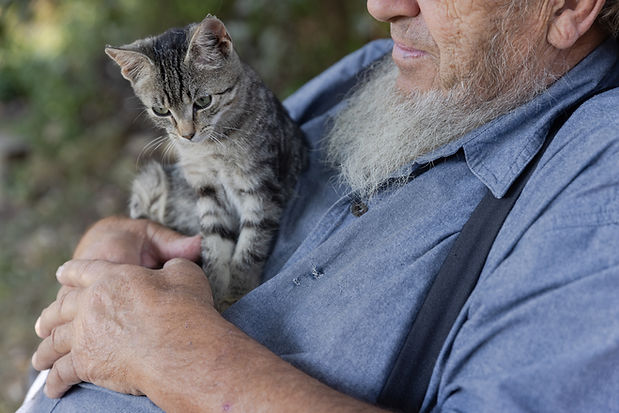
Bishop David Kline & “Tommy”
Old Order Amish bishop David Kline with “Tommy,” one of the kittens living on his organic farm in the greater Holmes County region.
photograph by Lauren Pond
Perhaps more notably, Kline has also lived outside of the Holmes County region. In the 1960s, he was drafted to serve in the Vietnam War. Given the pacifist underpinnings of Amish culture, he registered as a conscientious objector and was allowed to perform Civilian Public Service instead, working at a hospital in Cleveland for two years. The experience was a formative one, exposing him not only to the medical field but to the progressive, anti-war ideology of the time.
“The world was a lot bigger than I thought it was,” he told me when we first spoke in 2023.
Back home, Kline tends to the needs of the approximately 30 families in his church district. Though the warming planet is not something they discuss, all use solar power—which, like other Amish, they adopted with some hesitation.
“Technology is hardly ever neutral,” he explained, as our conversation drifted from solar panels to farming equipment to AI.
Today, I can’t help but think of the 34 data centers already eating up land and energy resources in the Ohio counties neighboring Kline’s, threatening not only the environment, but human health and well-being. More may be on the way.
Maybe why the Amish are using solar energy isn’t as important as how they are using it, I’ve realized. In my five years visiting Holmes County, I have not discovered a conservative Christian culture embracing green energy to fight climate change, as I once hoped I would. But I have met a people who make deliberate, practical decisions about the technologies they adopt and how they use them, always with the future impact on their community in mind. It’s more than I can say for my own.
Like Kline, I’ve found a world far vaster and more nuanced than I had once imagined it, one that is even instructive, in its own way.
“We try to look at technology with a little bit of caution,” the bishop said.
We could all use a little more of that.

Ginger House Coffee
Outside of Ginger House Coffee, a popular Amish hangout in Holmes County
photograph by Lauren Pond
SOURCES & FURTHER READINGS
This story draws on interviews and conversations with local scholars and community members, all of whom graciously shared their time and expertise with me. It also references several texts important to the study of Amish history and culture. To learn more about Amish views on technology, read Virtually Amish: Preserving Community at the Internet’s Margins by Lindsay Ems (The MIT Press, 2022). For further information on Amish environmental perspectives, read Nature & the Environment in Amish Life by David L. McConnell and Marilyn D. Loveless (Johns Hopkins University Press, 2018). To get a comprehensive introduction to the Holmes County Settlement, read An Amish Paradox: Diversity and Change in the World’s Largest Amish Community by Charles E. Hurst and David L. McConnell (Johns Hopkins University Press, 2010). Lastly, if you’re interested in an Amish bishop’s take on nature, check out Scratching the Woodchuck: Nature on an Amish Farm by David Kline (University of Georgia Press, 1999). AUTHOR PHOTO CREDIT: Michael Bou-Nacklie
Lauren Pond
Lauren Pond is an award-winning documentary storyteller interested in the complex lives and cultures of religious communities. Through photography, writing, and multimedia, she has spent nearly two decades chronicling how belief and practice intertwine with contemporary life among Pentecostal serpent-handlers, incarcerated Pagans, Ethiopian Orthodox practitioners, the Amish, and others. Lauren is the author of Test of Faith: Signs, Serpents, Salvation (Duke University Press, 2017), published with support from the Duke Center for Documentary Studies/Honickman First Book Prize in Photography. She was also the inaugural artist in residence for Saint Louis University’s Lived Religion in the Digital Age initiative and a multimedia producer for the American Religious Sounds Project. Lauren’s work has appeared in publications including The New York Times, The Washington Post, The Wall Street Journal, The Guardian, and The Revealer, among others. She received her BS in journalism from Northwestern University and her MA in photography from Ohio University’s School of Visual Communication. Website: laurenpondphoto.com.
